The Diesel Engine
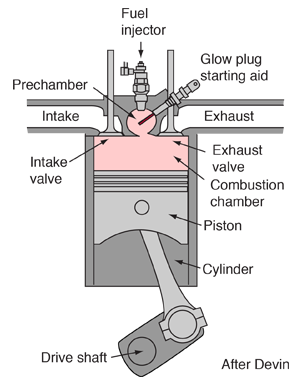
The diesel internal combustion engine differs from the gasoline powered Otto cycle by using a higher compression of the fuel to ignite the fuel rather than using a spark plug ("compression ignition" rather than "spark ignition").
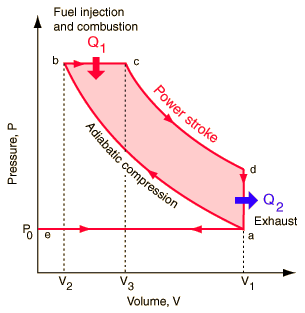 Air standard diesel engine cycle
|
In the diesel engine, air is compressed adiabatically with a compression ratio typically between 15 and 20. This compression raises the temperature to the ignition temperature of the fuel mixture which is formed by injecting fuel once the air is compressed.
The ideal air-standard cycle is modeled as a reversible adiabatic compression followed by a constant pressure combustion process, then an adiabatic expansion as a power stroke and an isovolumetric exhaust. A new air charge is taken in at the end of the exhaust, as indicated by the processes a-e-a on the diagram.
|
|
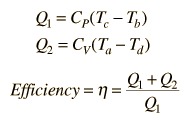
Since the compression and power strokes of this idealized cycle are adiabatic, the efficiency can be calculated from the constant pressure and constant volume processes. The input and output energies and the efficiency can be calculated from the temperatures and specific heats:
|
|
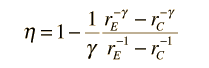
It is convenient to express this efficiency in terms of the compression ratio rC = V1/V2 and the expansion ratio rE = V1/V3. The efficiency can be written
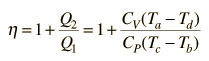
and this can be rearranged to the form
|
|
For an air standard engine with γ = 1.4 , compression ratio rC = 15 and expansion ratio rE = 5, this gives an ideal diesel efficiency of 56%.
The diesel cycle depends upon this temperature being high enough to ignite the fuel when it is injected.
*psig is pounds per square inch gauge pressure. Common pressure gauges in the U.S. measure pounds per square inch excess over atmospheric pressure.
Index
Heat engine concepts
Reference
Devins
Ch 4 |
| |
Go Back |
Diesel Engine Theoretical Efficiency
 Air standard diesel engine cycle
|
Since the compression and power strokes of this idealized cycle are adiabatic, the efficiency can be calculated from the constant pressure and constant volume processes. The input and output energies and the efficiency can be calculated from the temperatures and specific heats:
It is convenient to express this efficiency in terms of the compression ratio rC = V1/V2 and the expansion ratio rE = V1/V3.
|
The efficiency can be expressed in terms of the specific heats and temperatures.
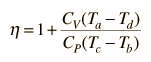
Now using the ideal gas law PV=nRT and γ = CP/CV, this can be written
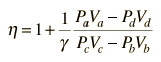
Now using the fact that Va=Vd=V1 and Pc=Pb from the diagram
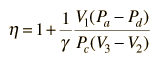
Dividing the numerator and denominator by V1Pc
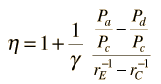
Now making use of the adiabatic condition PVγ = constant,
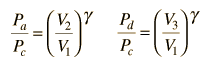
the efficiency can be written
|
|
Index
Heat engine concepts
References
Devins
Ch 4
Wark and Richards
Ch 15 |
| |
Go Back |
Diesel Engine Cycle
 Air standard diesel engine cycle
The term "compression ignition" is typically used in technical literature to describe the modern engines commonly called "Diesel engines". This is in contrast to "spark ignition" for the typical automobile gasoline engines that operate on a cycle derived from the Otto cycle. Rudolph Diesel patented the compression-ignition cycle which bears his name in the 1890s.
|
|
Index
Heat engine concepts
References
Devins
Ch 4
Wark and Richards
Ch 15 |
| |
Go Back |