Bilingual edition: English is preserved and Chinese follows each unit. Terminology uses the confirmed v20260916 glossary; automated semantic review remains traceable.
中英双语版:英文原文完整保留,中文紧随对应单元;术语采用 v20260916 确认表,自动语义审校结果可追溯。

Thermal Expansion: How to Loosen a Jar Lid

热胀冷缩:如何松开罐盖

During thermal expansion, every linear dimension increases by the same percentage with an increase in temperature, including holes. This assumes that the expanding material is uniform. Applied to a metal jar lid, this implies that the inside diameter of the lid will increase, tending to loosen the lid. Directing the stream of hot water at the center of the lid heats the metal more than the glass, so that you get a greater difference in the expansion of the top and the jar. The thermal conductivity of the metal top is much greater than that of the glass, and its specific heat is relatively low, so the temperature of the entire metal lid rises rapidly.

在热膨胀过程中,每个线性尺寸随着温度的升高都会增加相同的百分比,包括孔洞。这假设膨胀材料是均匀的。将此原理应用于金属罐盖时,这意味着罐盖的内径会增加,从而倾向于松开罐盖。将热水流直接对着罐盖中心加热,会使金属部分比玻璃部分加热得更多,因此罐盖顶部和罐体之间的膨胀差异会更大。金属盖的热导率远高于玻璃,其比热容相对较低,因此整个金属盖的温度会迅速上升。

Even if you heated the metal lid and the glass jar equally, you would loosen the lid a bit because the thermal expansion coefficient of the metal is greater than that of the glass.

即使你对金属盖和玻璃罐均匀加热,盖子也会稍微松开,因为金属的热膨胀系数大于玻璃的。

If you examine the table of thermal expansion coefficients, you will find that the expansion of a steel top is only about 40% greater than that of the glass, so it is helpful if you can heat the metal more than the glass. The fact that the thermal conductivity of the steel is over 60 times that of glass aids you in raising its temperature more than that of the glass.

如果你查阅热膨胀系数表,会发现钢制桌面的膨胀量仅比玻璃约大40%,因此如果你能将金属加热得比玻璃更高,这将是有帮助的。钢的热导率是玻璃的60多倍这一事实,也帮助你将温度提高得比玻璃更高。

!?If the thermal conductivity of steel is 60 times that of glass, why isn't the expansion coefficient 60 times as large, instead of just 1.4 x that of glass?
如果钢的热导率是玻璃的60倍,为什么它的线膨胀系数并不是也是60倍,而是只是玻璃的1.4倍?

The amount of actual expansion is quite small since the coefficients of expansion are very small. If the 7 cm diameter lid were heated from 20°C to 60°C, the amount of expansion is only

实际的膨胀量相当小,因为膨胀系数非常小。如果将直径为7厘米的盖子从20°C加热到60°C,其膨胀量仅
ΔL = (7 cm)(13 x 10-6)(40°C) = 0.0036 cm

Fortunately, even this small amount of expansion is sometimes sufficient to enable you to remove a stubborn lid.

幸运的是,即使这种微小的膨胀有时也足以让你去掉一个顽固的盖子。
Table of expansion coefficients
膨胀系数表
ΔL = (7 cm)(13 × 10⁻⁶)(40°C) = 0.0036 cm
Index

Expansion concepts
索引扩展概念
 
HyperPhysics***** Thermodynamics
HyperPhysics ***** 热力学
R Nave
Go Back
返回


Thermal Expansion vs Thermal Conductivity

热膨胀与热导率

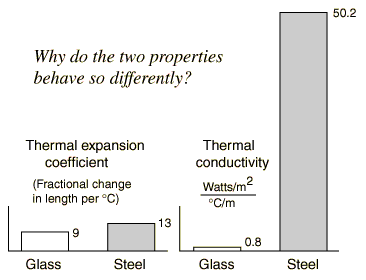
Why do they behave so differently?

为什么它们的行为如此不同?

In the example of loosening a jar lid, experiment shows that you can loosen a steel lid on a glass jar by heating because the thermal expansion coefficient of steel is greater than that of glass. But it is a bit tricky, because the expansion of the steel is only 1.44 times that of the glass, and both expansions are quite small. Directing the stream of hot water at the center of the lid heats the metal more than the glass, so that you get a greater difference in the expansion of the top and the jar. This can be done because the thermal conductivity of the steel top is almost 63 times the thermal conductivity of glass.

在松开罐盖的例子中,实验表明,通过加热可以松开玻璃罐的钢制盖子,因为钢的热膨胀系数大于玻璃。但这是有点微妙的,因为钢的膨胀只是玻璃的1.44倍,而且两者的膨胀都很小。将热水流直接对着盖子中心加热,会使金属部分比玻璃加热得更多,从而产生顶部和罐体之间更大的膨胀差异。这可以实现的原因是钢盖的热导率几乎是玻璃的63倍。

Solid substances expand with increasing temperature because the average spacing between the nuclei increases slightly as a result of the greater kinetic energy of the molecules - they vibrate with greater amplitude and on the average find themselves a bit further apart. This kinetic energy involves the atoms as a whole and there is not such a great difference between what happens in glass and steel.

固体随温度升高而膨胀,因为分子的平均间距略微增加,这是由于分子的动能增加所致——它们的振动幅度更大,平均而言会彼此间距稍大。这种动能涉及原子整体,玻璃和钢的行为之间并没有太大差异。

However, in thermal conductivity a new mechanism arises. In the metal there are essentially free electrons which can move through the steel. While they have no role in determining thermal expansion, they do provide a means for rapid heat transfer through the material. The same kind of argument applies to the electrical conductivity of the materials. The steel is an electrical conductor because of the mobility of the electrons through the material. The electrical and thermal conductivities can in fact be shown to be proportional to each other; this is the subject of the Wiedemann-Franz law.

然而,在热导率中出现了一种新的机制。在金属中存在大量自由电子,它们可以在钢中移动。虽然它们对确定热膨胀没有作用,但它们确实为材料中的快速传热提供了途径。同样的论点也适用于材料的电导率。钢之所以是电导体,是因为电子在材料中的移动性。事实上,电导率和热导率可以被证明是成正比的;这是魏德曼-弗兰兹定律的内容。
Good thermal conductor <--> Good electrical conductor.
Table of expansion coefficients
膨胀系数表
Table of thermal conductivities
热导率表
好的热导体 < --> 好的电导体。
Index

Expansion concepts
索引扩展概念
 
HyperPhysics***** Thermodynamics
HyperPhysics ***** 热力学
R Nave
Go Back
返回