Thermal Conductivity热导率
Heat transfer by conduction involves transfer of energy within a material without any motion of the material as a whole. The rate of heat transfer depends upon the temperature gradient and the thermal conductivity of the material. Thermal conductivity is a reasonably straightforward concept when you are discussing heat loss through the walls of your house, and you can find tables which characterize the building materials and allow you to make reasonable calculations. 通过传导进行的热传递涉及材料内部的能量转移,而材料整体并不发生运动。热传递的速率取决于温度梯度和材料的热导率。当讨论通过房屋墙壁的热损失时,热导率是一个相对直观的概念,你可以找到描述建筑材料的表格,从而进行合理的计算。
More fundamental questions arise when you examine the reasons for wide variations in thermal conductivity. Gases transfer heat by direct collisions between molecules, and as would be expected, their thermal conductivity is low compared to most solids since they are dilute media. Non-metallic solids transfer heat by lattice vibrations so that there is no net motion of the media as the energy propagates through. Such heat transfer is often described in terms of "phonons", quanta of lattice vibrations. Metals are much better thermal conductors than non-metals because the same mobile electrons which participate in electrical conduction also take part in the transfer of heat. 当考察热导率的显著差异原因时,会浮现更多根本性的问题。气体通过分子间的直接碰撞来传递热量,正如预期的那样,它们的热导率比大多数固体低,因为它们是稀疏的介质。非金属固体通过晶格振动传递热量,因此介质中没有净的运动,因为能量通过晶格传播。这种热传递通常用“声子”(晶格振动的量子)来描述。金属比非金属的热导率高得多,因为参与电导的相同自由电子也参与了热量的传递。
Conceptually, the thermal conductivity can be thought of as the container for the medium-dependent properties which relate the rate of heat loss per unit area to the rate of change of temperature. 从概念上讲,热导率可以被视为一个容器,用于容纳与介质相关的性质,这些性质将单位面积上的热量损失率与温度变化率联系起来。
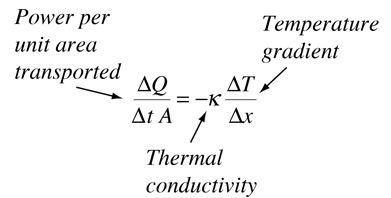
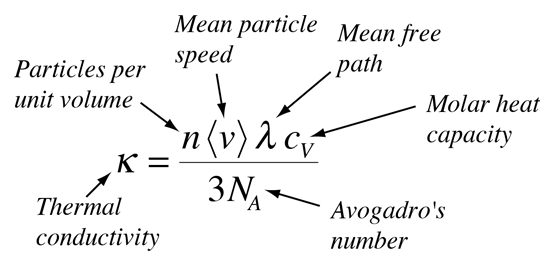
For an ideal gas the heat transfer rate is proportional to the average molecular velocity, the mean free path, and the molar heat capacity of the gas. 对于理想气体,热量传递速率与平均分子速度、平均自由程和气体的摩尔热容量成正比。
![]() For non-metallic solids, the heat transfer is view as being transferred via lattice vibrations, as atoms vibrating more energetically at one part of a solid transfer that energy to less energetic neighboring atoms. This can be enhanced by cooperative motion in the form of propagating lattice waves, which in the quantum limit are quantized as phonons. Practically, there is so much variability for non-metallic solids that we normally just characterize the substance with a measured thermal conductivity when doing ordinary calculations. 对于非金属固体,热量传递被视为通过晶格振动进行的,因为固体中某一部分的原子振动更加剧烈,会将能量传递给能量较低的邻近原子。这种传递可以以协同运动的形式通过传播的晶格波来增强,而在量子极限下,这些晶格波被量化为声子。实际上,由于非金属固体的变异性很大,我们在进行常规计算时通常只需用测量得到的热导率来表征物质。
For metals, the thermal conductivity is quite high, and those metals which are the best electrical conductors are also the best thermal conductors. At a given temperature, the thermal and electrical conductivities of metals are proportional, but raising the temperature increases the thermal conductivity while decreasing the electrical conductivity. This behavior is quantified in the Wiedemann-Franz Law: 对于金属来说,热导率相当高,那些最好的电导体同时也是最好的热导体。在给定温度下,金属的热导率和电导率成正比,但温度升高会增加热导率而降低电导率。这种行为在韦德曼-弗兰兹定律中得到了定量描述:
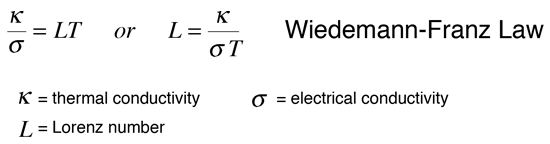
![]() where the constant of proportionality L is called the Lorenz number. Qualitatively, this relationship is based upon the fact that the heat and electrical transport both involve the free electrons in the metal. The thermal conductivity increases with the average particle velocity since that increases the forward transport of energy. However, the electrical conductivity decreases with particle velocity increases because the collisions divert the electrons from forward transport of charge. This means that the ratio of thermal to electrical conductivity depends upon the average velocity squared, which is proportional to the kinetic temperature. 其中,比例常数L被称为洛伦兹数。定性地说,这种关系基于这样一个事实:热传导和电传导都涉及金属中的自由电子。由于平均粒子速度增加,热导率会增加,因为这增加了能量的正向传输。然而,随着粒子速度的增加,电导率会降低,因为碰撞会将电子从电荷的正向传输中偏离。这意味着热导率与电导率的比值取决于平均速度的平方,这与动能温度成正比。
|
Index Heat transfer concepts Heat transfer examples 索引 热传递概念 热传递示例 | ||||
|
Go Back
返回 |
The Wiedemann-Franz Law魏德曼-弗兰兹定律
The ratio of the thermal conductivity to the electrical conductivity of a metal is proportional to the temperature. Qualitatively, this relationship is based upon the fact that the heat and electrical transport both involve the free electrons in the metal. The thermal conductivity increases with the average particle velocity since that increases the forward transport of energy. However, the electrical conductivity decreases with particle velocity increases because the collisions divert the electrons from forward transport of charge. This means that the ratio of thermal to electrical conductivity depends upon the average velocity squared, which is proportional to the kinetic temperature. The molar heat capacity of a classical monoatomic gas is given by ![]() Qualitatively, the Wiedemann-Franz Law can be understood by treating the electrons like a classical gas and comparing the resultant thermal conductivity to the electrical conductivity. The expressions for thermal and electrical conductivity become: ![]() Using the expression for mean particle speed from kinetic theory 利用从气体动理论得出的平均粒子速率表达式
![]() 定性地讲,可以通过将电子视为经典气体,并将由此得到的热导率与电导率进行比较,来理解韦德曼-弗兰兹定律。热导率和电导率的表达式变为:它们的比值可以表示为温度的函数。热导率与电导率的比值体现了韦德曼-弗兰兹定律。
![]() While qualitatively agreeing with experiment, the value of the constant is in error in this classical treatment. When the quantum mechanical treatment is done, the value of the constant is found to be: 虽然定性上与实验相符,但在此经典处理中,常数的值存在误差。当进行量子力学处理时,常数的值被发现为:
![]()
|
Index Heat transfer concepts Heat transfer examples 索引 热传递概念 热传递示例 | ||||||||||||||||||||||||||||||||||||||||||||
|
Go Back
返回 | ||||||||||||||||||||||||||||||||||||||||||||
Thermal Conductivity热导率
Heat transfer by conduction involves transfer of energy within a material without any motion of the material as a whole. The rate of heat transfer depends upon the temperature gradient and the thermal conductivity of the material. Algebraic methods can be used for the calculation of conduction heat transfer across plane walls, but for most geometries the heat transfer must be expressed in terms of the thermal gradient. 通过传导进行的热传递涉及材料内部的能量转移,而材料整体没有运动。热传递的速率取决于温度梯度和材料的热导率。代数方法可以用于计算平面壁的传导热传递,但对大多数几何形状,热传递必须用温度梯度来表达。
Conceptually, the thermal conductivity can be thought of as the container for the medium-dependent properties which relate the rate of heat loss per unit area to the rate of change of temperature. 从概念上讲,热导率可以被视为一个容器,用于容纳与介质相关的性质,这些性质将单位面积上的热量损失率与温度变化率联系起来。
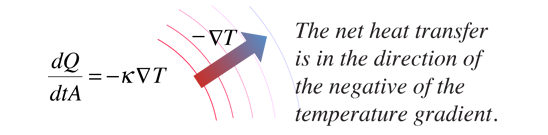
![]() The mathematical gradient of a function is a directional derivative which points in the direction of the maximum rate of change of the function. The direction of heat transfer will be opposite to the temperature gradient since the net energy transfer will be from high temperature to low. This direction of maximum heat transfer will be perpendicular to the equal-temperature surfaces surrounding a source of heat. 函数的数学梯度是一个方向导数,指向函数最大变化率的方向。热量传递的方向将与温度梯度相反,因为净能量传递将从高温区域流向低温区域。最大热量传递的方向将垂直于围绕热源的等温面。
|
Index Heat transfer concepts Heat transfer examples 索引 热传递概念 热传递示例 | ||
|
Go Back
返回 |