Bilingual edition: English is preserved and Chinese follows each unit. Terminology uses the confirmed v20260916 glossary; automated semantic review remains traceable.
中英双语版:英文原文完整保留,中文紧随对应单元;术语采用 v20260916 确认表,自动语义审校结果可追溯。

Specific Heat

比热容

The specific heat is the amount of heat per unit mass required to raise the temperature by one degree Celsius. The relationship between heat and temperature change is usually expressed in the form shown below where c is the specific heat. The relationship does not apply if a phase change is encountered, because the heat added or removed during a phase change does not change the temperature.
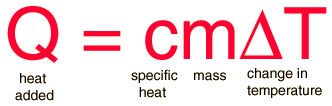
比热容是将温度升高1摄氏度所需单位质量的热量。热量与温度变化的关系通常以下面的形式表示,其中c是比热容。如果遇到相变,则此关系不适用,因为相变过程中加入或移除的热量不会改变温度。

The specific heat of water is 1 calorie/gram °C = 4.186 joule/gram °C which is higher than any other common substance. As a result, water plays a very important role in temperature regulation. The specific heat per gram for water is much higher than that for a metal, as described in the water-metal example. For most purposes, it is more meaningful to compare the molar specific heats of substances.

水的比热是 1 千卡/克·°C = 4.186 焦/克·°C,这比任何其他常见物质都要高。因此,水在温度调节中起着非常重要的作用。水的比热每克远高于金属,如水-金属例子中所述。对于大多数用途来说,比较物质的摩尔比热更为有意义。

The molar specific heats of most solids at room temperature and above are nearly constant, in agreement with the Law of Dulong and Petit. At lower temperatures the specific heats drop as quantum processes become significant. The low temperature behavior is described by the Einstein-Debye model of specific heat.

Table
表
Specific heats of gases
气体的定压比热和定容比热
Specific heats of solids
固体的比热容
Calculation
计算
在室温及以上时,大多数固体的摩尔定容比热几乎保持不变,这与杜隆-珀蒂定律一致。在较低温度下,比热会随着量子效应的显著而下降。低温行为由爱因斯坦-德拜模型描述。
Index
索引
 
HyperPhysics***** Thermodynamics
HyperPhysics ***** 热力学
R Nave
Go Back
返回


Specific Heat

比热容

The specific heat is the amount of heat per unit mass required to raise the temperature by one degree Celsius. The relationship between heat and temperature change is usually expressed in the form shown below where c is the specific heat. The relationship does not apply if a phase change is encountered, because the heat added or removed during a phase change does not change the temperature.

比热容是将温度升高1摄氏度所需单位质量的热量。热量与温度变化的关系通常以下面的形式表示,其中c是比热容。如果遇到相变,则此关系不适用,因为相变过程中加入或移除的热量不会改变温度。

Heat added = specific heat x mass x (tfinal - tinitial)

加入的热量 = 特定热容 × 质量 × (末温 - 初温)

Enter the necessary data and then click on the active text above for the quantity you wish to calculate.

输入必要的数据,然后点击上方的活动文本以计算您希望计算的量。

For a mass m = gm = kg

对于质量 m = gm = kg
中文译文中的待填/计算数值依次对应:1:mg 2:m。实际数值以上方原输入框为准。

with specific heat c = cal/gm°C = joule/gm°C,

特定热容为 c = cal/gm°C = joule/gm°C,
中文译文中的待填/计算数值依次对应:1:cc 2:cj。实际数值以上方原输入框为准。

initial temperature Ti = °C = K = °F

初始温度 T_i = °C = K = °F
中文译文中的待填/计算数值依次对应:1:tci 2:tki 3:tfi。实际数值以上方原输入框为准。

and final temperature Tf = °C = K = °F,

以及最终温度 T_f = °C = K = °F,
中文译文中的待填/计算数值依次对应:1:tcf 2:tkf 3:tff。实际数值以上方原输入框为准。

the amount of heat added is

所加热量的量是

Q = calories = kcal = x 10^ calories.

Q = 卡路里 = 大卡 = x 10^ 卡路里。
中文译文中的待填/计算数值依次对应:1:qc 2:qk 3:qb 4:qp。实际数值以上方原输入框为准。

Q = joules = x 10^ joules.

Q = 焦耳 = x 10^ 焦耳。
中文译文中的待填/计算数值依次对应:1:qj 2:qjb 3:qjp。实际数值以上方原输入框为准。

Calculation note: Unit conversions will be performed when you enter data, but the parameters will not be forced to be consistent until you click on the quantity you wish to calculate. Default values will be entered for unspecified parameters.

计算说明:当您输入数据时,单位转换将自动进行,但直到您点击想要计算的量,参数才会被强制保持一致。未指定的参数将输入默认值。
Table
表
Discussion of specific heat
特定热容的讨论
Index
索引
 
HyperPhysics***** Thermodynamics
HyperPhysics ***** 热力学
R Nave
Go Back
返回
