Temperature from the Thermodynamic Identity
温度从热力学恒等式得出
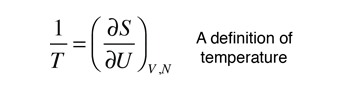
Often the definition of temperature is made in terms of the average translational kinetic energy of the particles; this is called the kinetic temperature. An alternative defintion of temperature can be made from the thermodynamic identity:
温度的定义通常基于粒子的平均平动动能;这被称为动能温度。另一种温度的定义可以从热力学恒等式得出:
|
Thermodynamic identity:
热力学恒等式:
dU = TdS - PdV
"d" denotes the total differential of the associated quantity
dU = TdS - PdV 其中“d”表示相关量的全微分 |
| U = internal energy
U 是内能 |
| S = entropy
S = 熵 |
| V = volume
V = 体积 |
| T = temperature
T = 温度 |
| P = pressure
P = 压强 |
|
If we hold the volume constant, this leads to an expression for temperature as a partial derivative of the entropy with respect to the internal energy.
如果体积保持不变,这会导致温度作为熵对内能的偏导数的表达式。
This definition implies that you are holding both the volume and the number of particles constant in taking the derivative. This can be applied to the expression for the entropy of a monoatomic ideal gas:
这个定义意味着你在求导时同时保持体积和粒子数不变。这可以应用于单原子理想气体的熵的表达式:

Taking the partial derivative of this with respect to U to get the temperature requires some gymnastics with the logarithms. Using the rules for the logarithms of products allows us to express the logarithm as just ln(U3/2) plus some other log terms which do not contain U and therefore will drop out when the derivative is taken. Then remember that ln(U)3/2=3/2ln(U) and that the derivative of ln(U) is just 1/U. This finally gives us:
要通过求U的偏导数来得到温度,需要一些对数的运算。利用对数法则,可以将对数表达式表示为ln(U^{3/2})加上一些不包含U的其他对数项,这些项在求导时会消失。然后记住ln(U^{3/2})= (3/2)ln(U),而ln(U)的导数就是1/U。最后我们得到:
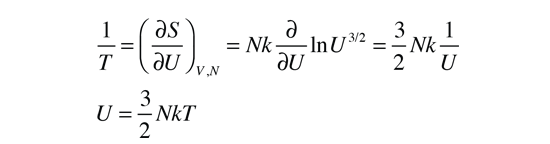
This relationship for the internal energy is just that which is obtained from equipartition of energy. Since the internal energy of a monoatomic gas is just the translational kinetic energy of the molecules, this is in agreement with the kinetic temperature mentioned above, so the two definitions of temperature are equivalent for this case.
这种内能的关系就是从能量均分定理得到的。由于单原子气体的内能仅仅是分子的平动动能,这与上面提到的动能温度是一致的,因此这两种温度的定义在这种情况 下是等价的。
|