Bilingual edition: English is preserved and Chinese follows each unit. Terminology uses the confirmed v20260916 glossary; automated semantic review remains traceable.
中英双语版:英文原文完整保留,中文紧随对应单元;术语采用 v20260916 确认表,自动语义审校结果可追溯。

Ideal Gas Law

理想气体定律

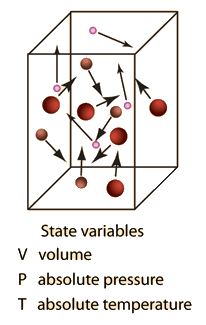
An ideal gas is defined as one in which all collisions between atoms or molecules are perfectly eleastic and in which there are no intermolecular attractive forces. One can visualize it as a collection of perfectly hard spheres which collide but which otherwise do not interact with each other. In such a gas, all the internal energy is in the form of kinetic energy and any change in internal energy is accompanied by a change in temperature.

理想气体被定义为一种所有原子或分子之间的碰撞都是完全弹性的,并且分子间没有吸引力的气体。可以将其想象为一组完全硬的球体,它们会发生碰撞,但除此之外不会相互作用。在这样的气体中,所有的内能都以动能的形式存在,任何内能的变化都会伴随着温度的变化。

An ideal gas can be characterized by three state variables: absolute pressure (P), volume (V), and absolute temperature (T). The relationship between them may be deduced from kinetic theory and is called the

理想气体可以由三个状态变量来表征:绝对压力(P)、体积(V)和绝对温度(T)。它们之间的关系可以从气体动理论推导出来,称为
  • n = number of moles
    n = 物质的量
  • R = universal gas constant = 8.3145 J/mol K
    R = 普遍气体常数 = 8.3145 J/(mol·K)
  • N = number of molecules
    N = 分子数
  • k = Boltzmann constant = 1.38066 x 10⁻²³ J/K = 8.617385 x 10⁻⁵ eV/K
    k = 玻尔兹曼常数 = 1.38066 × 10⁻²³ J/K = 8.617385 × 10⁻⁵ eV/K
  • k = R/NA
  • NA = Avogadro's number = 6.0221 x 10²³ /mol
    N_A = 阿伏伽德罗常数 = 6.0221 × 10²³ /mol

The ideal gas law can be viewed as arising from the kinetic pressure of gas molecules colliding with the walls of a container in accordance with Newton's laws. But there is also a statistical element in the determination of the average kinetic energy of those molecules. The temperature is taken to be proportional to this average kinetic energy; this invokes the idea of kinetic temperature. One mole of an ideal gas at STP occupies 22.4 liters.

理想气体定律可以看作是源于气体分子碰撞容器壁的动能压力,这符合牛顿运动定律。但分子的平均动能的确定也包含统计因素。温度被定义为与这个平均动能成正比;这引出了动能温度的概念。一摩尔的理想气体在标准温度和压力下占据22.4升。
Calculation
计算
Departure from an ideal gas: van der Waals equation of state
偏离理想气体:范德瓦尔方程
Index

Gas law concepts

Kinetic theory concepts
索引 气体定律概念 气体动理论概念
 
HyperPhysics***** Thermodynamics
HyperPhysics ***** 热力学
R Nave
Go Back
返回


Molecular Constants

分子常数
In the kinetic theory of gases, there are certain constants which constrain the ceaseless molecular activity. Gas properties are described in terms of state variables.
A given volume V of any ideal gas will have the same number of molecules. The mass of the gas will then be proportional to the molecular mass. A convenient standard quantity is the mole, the mass of gas in grams equal to the molecular mass in amu. Avogadro's number is the number of molecules in a mole of any molecular substance.

NA=Avogadro's number=6.0221 x 10²³/mole

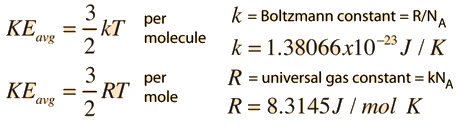
The average translational kinetic energy of any kind of molecule in an ideal gas is given by
任何理想气体在给定体积V时,分子数目相同。气体的质量则与分子质量成正比。一个方便的标准量是摩尔,即质量以克为单位,等于分子质量以原子质量单位(amu)为单位。阿伏伽德罗常数是任何分子物质1摩尔中的分子数目。N_A=阿伏伽德罗常数=6.0221×10²³/摩尔。理想气体中任何种类分子的平均平动动能由
在气体动理论中,有一些常数会限制分子的无休止活动。气体的性质是通过状态变量来描述的。
Index

Kinetic theory concepts
索引 气体动理论概念
 
HyperPhysics***** Thermodynamics
HyperPhysics ***** 热力学
R Nave
Go Back
返回


State Variables

状态变量

A state variable is a precisely measurable physical property which characterizes the state of a system, independently of how the system was brought to that state. It must be inherently single-valued to characterize a state. For example in the heat-work example, the final state is characterized by a specific temperature (a state variable) regardless of whether it was brought to that state by heating, or by having work done on it, or both.

状态变量是能够精确测量的物理性质,它描述系统的状态,与系统如何达到该状态无关。它必须本质上是单值的以描述一个状态。例如在热功例子中,最终状态由特定的温度(一个状态变量)来描述,无论它是通过加热、对系统做功还是两者结合的方式达到该状态。

Common examples of state variables are the pressure P, volume V, and temperature T. In the ideal gas law, the state of n moles of gas is precisely determined by these three state variables. If a property, e.g., enthalpy H, is defined as a combination of other state variables, then it too is a state variable. Enthalpy is one of the four "thermodynamic potentials", and the other three, internal energy U, Helmholtz free energy F and Gibbs free energy G are also state variables. The entropy S is also a state variable.

常见的状态变量包括压力P、体积V和温度T。在理想气体定律中,n摩尔气体的状态由这三个状态变量精确确定。如果一个性质,例如焓H,被定义为其他状态变量的组合,那么它也是状态变量。焓是四个“热力学势”之一,其他三个,内能U、亥姆霍兹自由能F和吉布斯自由能G也是状态变量。熵S也是一个状态变量。

Some texts just use the term "thermodynamic variable" instead of the description "state variable".

一些教材直接使用‘热力学变量’这一术语,而不是‘状态变量’这一描述。
Index

Kinetic theory concepts
索引 气体动理论概念
 
HyperPhysics***** Thermodynamics
HyperPhysics ***** 热力学
R Nave
Go Back
返回


The Mole

摩尔

A mole (abbreviated mol) of a pure substance is a mass of the material in grams that is numerically equal to the molecular mass in atomic mass units (amu). A mole of any material will contain Avogadro's number of molecules. For example, carbon has an atomic mass of exactly 12.0 atomic mass units -- a mole of carbon is therefore 12 grams. For an isotope of a pure element, the mass number A is approximately equal to the mass in amu. The accurate masses of pure elements with their normal isotopic concentrations can be obtained from the periodic table.

一种物质的摩尔(符号为mol)是指该物质以克为单位的质量,其数值等于该物质的分子质量(以原子质量单位amu为单位)。任何物质的摩尔都包含阿伏伽德罗数的分子。例如,碳的原子质量恰好为12.0原子质量单位——因此,1摩尔的碳就是12克。对于纯元素的同位素,质量数A近似等于以amu为单位的质量。纯元素的准确质量及其正常同位素浓度可以从元素周期表中获得。

One mole of an ideal gas will occupy a volume of 22.4 liters at STP (Standard Temperature and Pressure, 0°C and one atmosphere pressure).

1摩尔的理想气体在标准温度和压力(STP,0°C和一个大气压)下会占据22.4升的体积。
Avogadro's number

Standard Temperature and Pressure

标准温度和压力

STP is used widely as a standard reference point for expression of the properties and processes of ideal gases. The standard temperature is the freezing point of water and the standard pressure is one standard atmosphere. These can be quantified as follows:

STP广泛用作理想气体性质和过程表达的标准参考点。标准温度是水的冰点,标准压力是一个标准大气压。这些可以量化如下:

Standard temperature: 0°C = 273.15 K

标准温度:0°C = 273.15 K

Standard pressure = 1 atmosphere = 760 mmHg = 101.3 kPa

标准压力 = 1 个大气压 = 760 毫米汞柱 = 101.3 kPa

Standard volume of 1 mole of an ideal gas at STP: 22.4 liters

1摩尔理想气体在标准状况下的体积为22.4升
阿伏伽德罗常数
Index

Kinetic theory concepts
索引 气体动理论概念
 
HyperPhysics***** Thermodynamics
HyperPhysics ***** 热力学
R Nave
Go Back
返回


Gauge Pressure

表压

Does the flat tire on your automobile have zero air pressure? If it is completely flat, it still has the atmospheric pressure air in it. To be sure, it has zero useful pressure in it, and your tire gauge would read zero pounds per square inch. Most gauges read the excess of pressure over atmospheric pressure and this excess is called "gauge pressure". While a useful measurement for many practical purposes, it must be converted to absolute pressure for applications like the ideal gas law.

汽车轮胎上的扁胎有没有零空气压力?如果完全扁了,它里面仍然有大气压的空气。要确定地说,它里面没有有用的压强,轮胎压力表会显示零磅每平方英寸。虽然对于许多实际应用来说,这种读数是有用的,但在像理想气体定律这样的应用中,必须将其转换为绝对压强。

Since a partial vacuum will be below atmospheric pressure, the phrase "negative pressure" is often used. Certainly there is no such thing as a negative absolute pressure, but small decreases in pressure are commonly used to entrain fluids in sprayers, in carburetors for automobiles, and many other applications. In the case of respiration, we say that the lungs produce a negative pressure of about -4 mmHg to take in air, which of course means a 4 mmHg decrease from the surrounding atmospheric pressure.

由于部分真空会低于大气压,因此常使用‘负压’这一术语。当然,并不存在绝对负压,但小范围的压力下降常用于喷雾器、汽车化油器等多种应用中,以带动流体。在呼吸过程中,我们说肺部产生约-4 mmHg的负压以吸入空气,这当然意味着从周围大气压下降了4 mmHg。

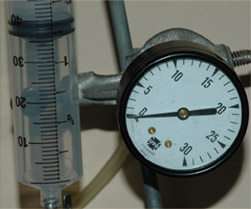
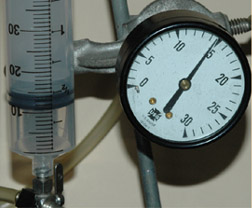
When a system is at atmospheric pressure like the left image above, the gauge pressure is said to be zero. In this image, the system has been opened so that it is at equilibrium with the atmosphere. In the right image, the system has been closed and the plunger pushed down until the pressure reads about 15 lb/in2. This implies that the absolute pressure has been approximately doubled by compressing the gas to half its volume (ideal gas law). Standard atmospheric pressure in these U.S. common units is 14.7 lb/in2, so this must be added to the gauge pressure above to get the absolute pressure.

当系统处于如上左图所示的大气压时,表压被定义为零。在该图中,系统已打开,因此与大气平衡。在右图中,系统已封闭,活塞被向下推,直到压力显示约为15 lb/in²。这表明通过将气体压缩到一半体积,绝对压力已近似加倍(理想气体定律)。这些美国常用单位下的标准大气压为14.7 lb/in²,因此必须将上述表压加到该值上以得到绝对压力。
Index

Kinetic theory concepts
索引 气体动理论概念
 
HyperPhysics***** Thermodynamics
HyperPhysics ***** 热力学
R Nave
Go Back
返回


Ideal Gas Law with Constraints

带约束的理想气体定律

For the purpose of calculations, it is convenient to place the ideal gas law in the form:

为了计算方便,将理想气体定律写成以下形式:

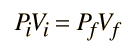
where the subscripts i and f refer to the initial and final states of some process. If the temperature is constrained to be constant, this becomes:

which is referred to as Boyle's Law.

这被称为波义耳定律。

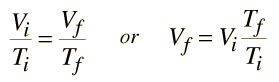
If the pressure is constant, then the ideal gas law takes the form

如果压强保持不变,那么理想气体定律的形式为

which has been historically called Charles' Law. It is appropriate for experiments performed in the presence of a constant atmospheric pressure.

该定律历史上被称为查尔斯定律。它适用于在常压下进行的实验。

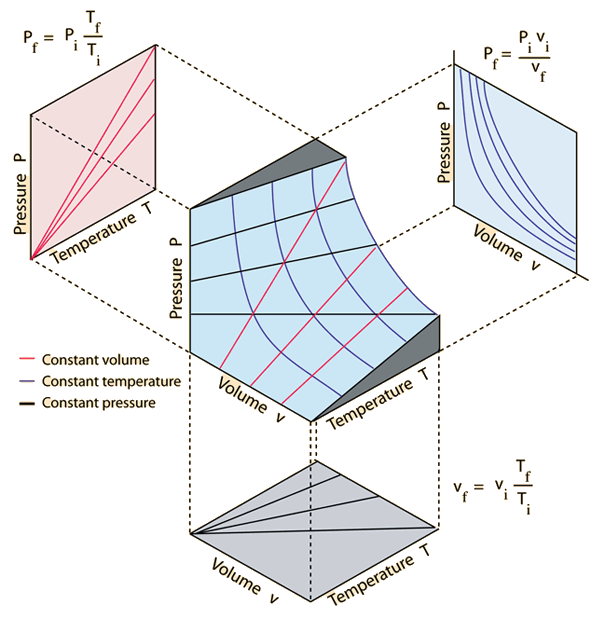
All the possible states of an ideal gas can be represented by a PvT surface as illustrated below. The behavior when any one of the three state variables is held constant is also shown.

理想气体的所有可能状态都可以用PvT表面表示,如图所示。当任何一个状态变量保持不变时的行为也已展示。
其中下标 i 和 f 指的是某个过程的初始和最终状态。如果温度被限制为恒定,这则变为:
Index

Gas law concepts

Kinetic theory concepts
索引 气体定律概念 气体动理论概念
 
HyperPhysics***** Thermodynamics
HyperPhysics ***** 热力学
R Nave
Go Back
返回