What is Temperature?
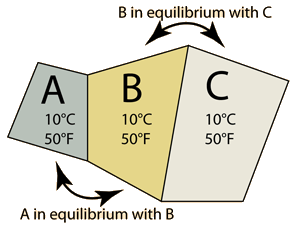 The Zeroth Law of Thermodynamics 热力学零定律 | One approach to the definition of temperature is to consider three objects, say blocks of copper, iron and alumninum which are in contact such that they come to thermal equilibrium. By equilibrium we mean that they are no longer transferring any net energy to each other. We would then say that they are at the same temperature, and we would say that temperature is a property of these objects which implies that they will no longer transfer net energy to one another. We could say that A is at the same temperature as C even though they are not in contact with each other. This scenario is called the "zeroth law of thermodynamics" since this understanding logically precedes the ideas contained in the important First and Second Laws of Thermodynamics. 确定温度的一种方法是考虑三个物体,例如铜块、铁块和铝块,它们相互接触,从而达到热平衡。所谓热平衡是指它们不再相互传递任何净能量。此时我们可以认为这三个物体处于同一温度,温度是这些物体的属性,意味着它们将不再相互传递净能量。即使它们没有接触,我们也可以认为A和C处于同一温度。这种情形被称为“热力学零定律”,因为这种理解逻辑上先于第一定律和第二定律所包含的概念。 |
 Kinetic temperature 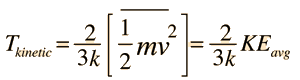 Ideas to think about: 需要思考的要点:
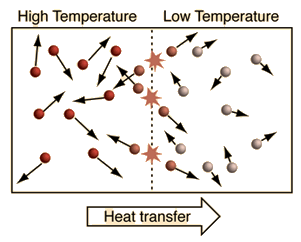
动能温度 | An important idea related to temperature is the fact that a collision between a molecule with high kinetic energy and one with low kinetic energy will transfer energy to the molecule of lower kinetic energy. Part of the idea of temperature is that for two collections of the same type of molecules that are in contact with each other, the collection with higher average kinetic energy will transfer energy to the collection with lower average kinetic energy. We would say that the collection with higher kinetic energy has a higher temperature, and that net energy transfer will be from the higher temperature collection to the lower temperature collection, and not vice versa. Clearly, temperature has to do with the kinetic energy of the molecules, and if the molecules act like independent point masses, then we could define temperature in terms of the average translational kinetic energy of the molecules, the so-called "kinetic temperature". The average kinetic energy of the molecules of an object is an important part of the concept of temperature and provides some useful intuition about what temperature is. If all matter just consisted of independently moving point masses that just experienced elastic collisions with each other, that would be an adequate picture of temperature. 与温度相关的一个重要概念是,一个具有高动能的分子与一个具有低动能的分子碰撞时,会将能量传递给动能较低的分子。温度概念的一部分是,对于两个由相同类型的分子组成的接触在一起的集合,平均动能较高的集合会将能量传递给平均动能较低的集合。我们可以说,平均动能较高的集合温度更高,能量净传递将从高温集合流向低温集合,而不是相反。显然,温度与分子的动能有关,如果分子像独立的质点一样作用,那么就可以用分子的平均平动动能来定义温度,即所谓的“动能温度”。物体中分子的平均动能是温度概念的重要组成部分,它提供了一些关于温度的有用直观。如果所有物质仅仅是独立运动的质点,仅经历弹性碰撞,那么这将是对温度的一个充分描述。 |
Internal or coordinated motions of molecules complicate the picture of temperature. 分子的内部或协同运动使温度的图景变得更加复杂。 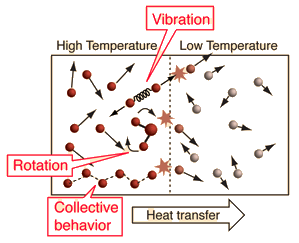 | Molecules for materials other than monoatomic noble gases like helium have the possibility of energy other than the translational kinetic energy of point masses. Molecules can have rotational and translational kinetic energy and the molecules in periodic solids can have collective modes of motion that have energy. This complicates the idea of temperature because they affect the conditions under which energy would be transferred from one collection of molecules to another, and we want to hang onto the idea that if energy is spontaneously transferred from A to B, then A is at a higher temperature than B. 除了氦等单原子惰性气体以外,其他材料的分子可能具有除了质点的平动动能以外的其他形式的能量。分子可以具有旋转和平动动能,而周期性固体中的分子还可以具有集体运动模式,这些模式具有能量。这使得温度的概念变得复杂,因为它们影响能量从一组分子转移到另一组分子的条件,而我们希望保留这样的想法:如果能量自发地从A转移到B,那么A的温度高于B。 |
Defining temperature in terms of entropy. 用熵来定义温度。为什么不用直接去摸它们,看看哪个更热呢? | Many of the most fundamental arguments in physics are those having to do with multiplicity. If there are more ways to accomplish a given state of a system of particles, then other states will spontaneously transition to that state over time if the transition is consistent with conservation of energy. The multiplicity of a system of particles is stated in terms of its entropy. Systems will spontaneously proceed toward states with higher entropy (2nd law of thermodynamics). But what does that have to do with temperature? 物理学中许多最根本的论点都与多重性有关。如果一个质点系有更多实现某种状态的方式,那么在时间推移过程中,如果这种转变符合能量守恒,其他状态会自发地过渡到该状态。质点系的多重性用其熵来表述。系统会自发地趋向于熵更高的状态(第二热力学定律)。但温度又与之有什么关系呢? It turns out that if you have two systems A and B which are thermally coupled to each other, and you make a change of internal energy ΔU to each of them, then if A experiences a larger change in entropy S than B, then A is the lower temperature and energy will spontaneously transfer from B to A. This is far less intuitive than high-speed molecules hitting low-speed molecules and transferring energy to them! But with the variety of energy forms and collective modes in systems, it turns out to be a more reliable approach to temperature. See the examples where this approach with the ideal gas and Einstein solid leads you back to the more intuitive kinetic energy statements. 实际上,如果两个系统A和B热联接在一起,并且对它们各自进行内部能量ΔU的变化,那么如果A的熵变化S比B大,那么A的温度较低,能量会自发地从B转移到A。这比高速分子撞击低速分子并将其能量传递给它们要少直观得多!但是考虑到系统中各种能量形式和集体模式的多样性,这种方法在温度确定上显得更为可靠。可以看到,这种方法通过理想气体和爱因斯坦固体的例子,最终可以回到更直观的动能表述。 |
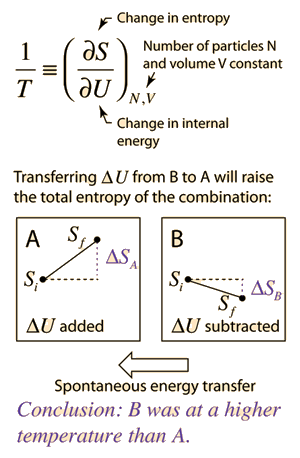
Under conditions where the kinetic temperature as derived from kinetic theory provides reasonable accuracy, we perceive temperature as the average translational kinetic energy associated with the disordered motion of atoms and molecules. That makes it intuitive that the flow of heat is from a high temperature region toward a lower temperature region since higher energy molecules are striking lower energy molecules and transferring energy to them. Temperature is not directly proportional to internal energy since temperature measures only the kinetic energy part of the internal energy, so two objects with the same temperature do not in general have the same internal energy (see water-metal example). Temperatures are measured in one of the three standard temperature scales (Celsius, Kelvin, and Fahrenheit).
| Suppose we are dealing with two equal mass
objects at ordinary temperatures and can
presume that kinetic temperature gives a
reasonable description of their behavior. If the
two objects are at the same temperature, then
we would say that their average translational
kinetic energies are the same. That does not imply
that their total internal energies are the same,
because the potential energies associated with
intermolecular forces can be quite different.
假设我们处理的是两个质量相等的物体,在常温下,并且可以假设动能温度能合理地描述它们的行为。如果这两个物体处于同一温度,那么我们可以认为它们的平均平动动能是相同的。但这并不意味着它们的总内能相同,因为分子间作用力相关的势能可能差异很大。 |
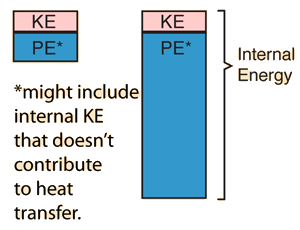 |
Even if there are internal kinetic energies other than translational KE, it could be that heat transfer is mainly by collisional transfer. In such cases this picture might help understand that just a portion of the total internal energy of objects is involved in the conditions for thermal equilibrium.
| Temperature Scales
温度刻度 |
| More generalized view of temperature
温度的更广泛观点 |
Temperature concepts
Reference:
Schroeder
Ch 3
| HyperPhysics***** Thermodynamics
HyperPhysics ***** 热力学 | R Nave |
