Bilingual edition: English is preserved and Chinese follows each unit. Terminology uses the confirmed v20260916 glossary; automated semantic review remains traceable.
中英双语版:英文原文完整保留,中文紧随对应单元;术语采用 v20260916 确认表,自动语义审校结果可追溯。

A Vacuum Flask

真空瓶
Liquid nitrogen and superconductors
液氮和超导体

A vacuum flask or Dewar flask has the remarkable capacity to hold extremely cold liquids like liquid nitrogen for a considerable length of time. The boiling point of liquid nitrogen is 77K compared to a room temperature of about 300K. You can hold liquid nitrogen for about a day without even a cover on the flask! You might expect such a cold liquid to explosively evaporate on contact with air in such an open container. How does it manage this containment?

真空瓶或杜瓦瓶具有 remarkable 的容量,能够长时间保持极冷的液体,如液氮。液氮的沸点是77K,相比之下,室温约为300K。即使在瓶口没有盖子的情况下,你也可以将液氮保存大约一天!你可能会预期如此冷的液体在这样的开放容器中接触空气时会剧烈蒸发。它是如何实现这种 containment 的?

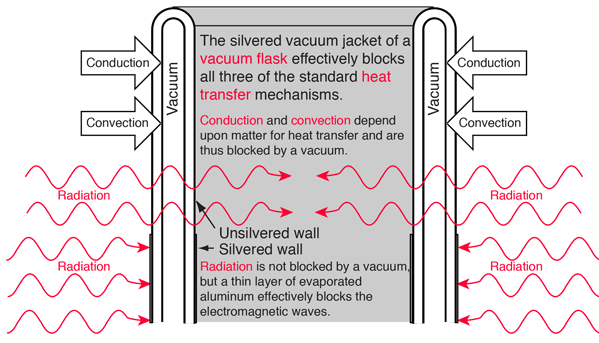
Clearly, the flask is able to effectively block heat transfer from the outside either through the walls or through the open top.

显然,这个烧瓶能够有效地阻止热量从外部通过瓶壁或开口处传递。
Heat blocking by the walls
墙壁的隔热作用
Heat blocking by the top
顶部的隔热
Index

Heat transfer concepts

Heat transfer examples
索引 热传递概念 热传递示例
 
HyperPhysics***** Thermodynamics
HyperPhysics ***** 热力学
R Nave
Go Back
返回


Heat blocking by vacuum flask walls

真空瓶壁的热阻隔
This is an active graphic. Click on any of the highlighted text for further details.
Vacuum flask discussion
真空瓶讨论
Heat blocking by the top
顶部的隔热
这是一个动态图形。点击任何高亮的文本以获取更多详情。
Index

Heat transfer concepts

Heat transfer examples
索引 热传递概念 热传递示例
 
HyperPhysics***** Thermodynamics
HyperPhysics ***** 热力学
R Nave
Go Back
返回


Heat Blocking at Vacuum Flask Top

真空瓶顶部的热阻
Liquid nitrogen
液氮

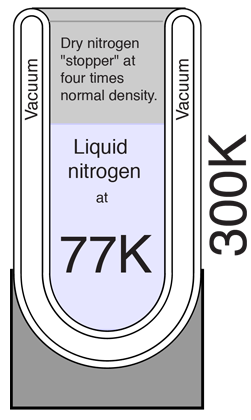
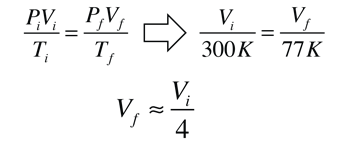
The blocking of heat transfer into the liquid nitrogen from the top of a vacuum flask involves the insulating properties of gases and the ideal gas law. The gas above the liquid surface can be presumed to be dry nitrogen. When the ideal gas law is applied at approximately constant atmospheric pressure:

真空瓶顶部阻止热量传入液氮的过程涉及气体的隔热性能和理想气体定律。液面上方的气体可假设为干燥的氮气。当在近似常压下应用理想气体定律时:

So the cold nitrogen above the liquid occupies about one-fourth of the space it would occupy in the surrounding room- temperature air. The dry nitrogen at about four times normal density forms an effective insulating "stopper" on top of the liquid.

所以,液面上方的冷氮气占据的体积大约是周围常温空气中的四分之一。密度约为四倍的干氮气形成一个有效的隔热‘止挡’,位于液面上方。

Heat blocking by the walls
墙壁的隔热作用
Vacuum flask discussion
真空瓶讨论
Index

Heat transfer concepts

Heat transfer examples
索引 热传递概念 热传递示例
 
HyperPhysics***** Thermodynamics
HyperPhysics ***** 热力学
R Nave
Go Back
返回