Tsunami
Tsunami is the name given to the very long waves on the ocean generated by earthquakes or other events which suddenly displace a large volume of water. "Tsunami" is from "harbor wave" in Japanese. A tsunami is distinct from ordinary wind-driven ocean waves in that its source of energy is the water displacement event. Technical sources strongly discourage the term "tidal wave" for tsunamis since their generation has nothing to do with the Moon or tidal influences, although the effect of a tsunami on a coastal area may be affected by the tidal phase when the tsunami reaches shore. If the wave strikes at local high tide, the inundation of the land area may be more severe.
The long wavelength wave train of a tsunami travels at a very high speed. The 1960 tsunami from the subduction zone off of the Chilean coast reached Hawaii in 15 hours and Japan in 22 hours.
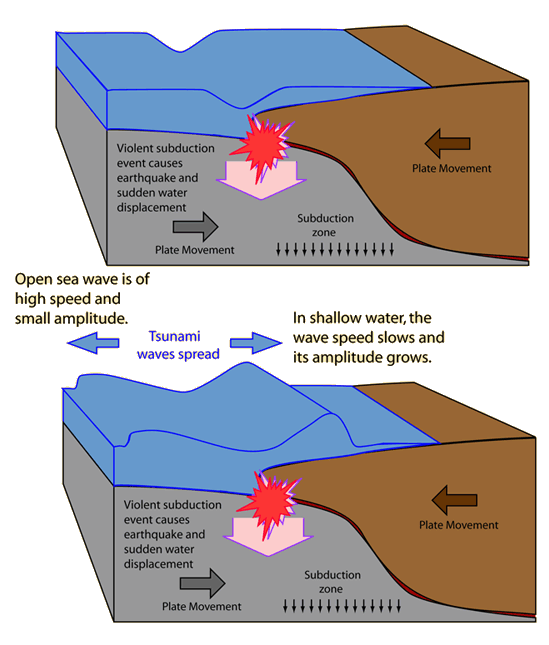
The scenario for tsunami generation often involves the subduction zone where one geographic plate moves under another (a convergent boundary). If there is a "sticking point" or impediment to the motion, it may build up stress until a sudden movement occurs, causing an earthquake. Either a sudden upward or downward motion of a portion of the ocean floor will displace a large amount of water and generate a tsunami.
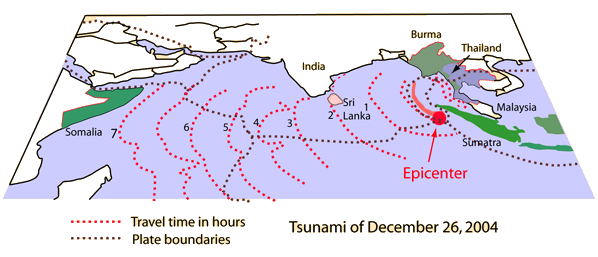
The wave speeds for tsunamis are very high in deep water. The tsunami of December 26, 2004 traveled from near the island of Sumatra to the east coast of Africa in just over seven hours. It was initiated by an earthquake of magnitude 9 off the western coast of northern Sumatra.
The wave speed depends upon wavelength and the depth of the water for tsunamis at sea. Characteristic data is shown in the table at right. As they enter shallower water, their wavelength and wave speed diminishes, causing their amplitudes to greatly increase. The speeds in the table follow from the wavespeed relationship for ideal waves, given the wavelength of 282 km at 7000 ft depth. That initial wavelength at depth is presumbly determined by the nature and size of the disturbance that produces the tsunami. 波速取决于波长和水深,对于海中的海啸而言。表中列出了典型数据。当它们进入较浅的水时,其波长和波速会减小,导致振幅显著增加。表中的速度是根据理想波的波速关系得出的,给定波长为282 km,在7000英尺深度处。该初始波长在深度处 presumably 由产生海啸的扰动的性质和规模决定。
|
|
The "Great Waves" brochure from NOAA referenced below states that "tsunami waves are distinguished from ordinary ocean waves by their great length between wave crests, often exceeding 100 km (60 miles ) or more in the deep ocean, and by the time between these crests, ranging from 10 minutes to an hour. As they reach the shallow waters of the coast, the waves slow down and the water can pile up into a wall of destruction tens of meters (30 ft) or more in height. The effect can be amplified where a bay, harbor or lagoon funnels the wave as it moves inland. Large tsunamis have been known to rise over 30 meters (100 ft). Even a tsunami 3 - 6 meters high can be very destructive and cause many deaths and injuries."
The Unimak tsunami of April 1, 1946 is a famous historical case which for which we have a considerable amount of data. The following data comes from Macdonald, et al., and is quoted from the von Arx text. "This tsunami was composed of a succession of crests 2 feet high and 122 miles apart in mid-ocean, moving at better than 400 knots so that the crests arrived at intervals of about 15 minutes. In Hawaii these waves crested to 55 feet at Pololu Valley. Farther down the windward coast the crest was half as high but caused heavy loss of property and some life in the city of Hilo. The master of a ship lying offshore near Hilo reported feeling no unusual waves pass under his ship, although he could see great waves breaking on the shore. This same wave train was observed at Bikini Atoll in the Marshall Islands to have an amplitude of 1.5 feet. It passed unnoticed except by those who watched for it very carefully."
References:
- http://www.usembassy-china.org.cn/shanghai/pas/hyper/2004/dec/28/epf205.htm
- General and educational material on tsunamis is available at http://www.tsunami.org/
关于海啸的一般性和教育性材料可在 http://www.tsunami.org/ 上找到。
- National Weather Service International Tsunami Information Center
http://www.prh.noaa.gov/itic/library/about_tsu/faqs.html
国家气象局国际海啸信息中心 http://www.prh.noaa.gov/itic/library/about_tsu/faqs.html
- Information about tsunamis and earthquakes from the U.S. Geological Survey (USGS) is available at http://walrus.wr.usgs.gov/tsunami/
美国地质调查局(USGS)关于海啸和地震的信息可在 http://walrus.wr.usgs.gov/tsunami/ 获取。
- USGS tsunami and earthquake links are available at http://walrus.wr.usgs.gov/tsunami/links.html
USGS 海啸和地震的链接位于 http://walrus.wr.usgs.gov/tsunami/links.html
- The Great Waves, a brochure about tsunamis from the National Oceanic and Atmospheric Administration, is available at http://www.prh.noaa.gov/pr/hq/itic/library/pubs/great_waves/tsunami_great_waves_1.html
《巨浪》,这是来自国家海洋和大气管理局关于海啸的宣传册,可在 http://www.prh.noaa.gov/pr/hq/itic/library/pubs/great_waves/tsunami_great_waves_1.html 查看。
- Tsunami FAQ
http://www.pmel.noaa.gov/tsunami-hazard/tsunami_faqs.htm
海啸FAQ http://www.pmel.noaa.gov/tsunami-hazard/tsunami_faqs.htm
| Highest ocean waves
最高海浪 | Wave velocity calculation
波速计算 |
Traveling Wave Concepts
References
Mayo
Bascom
von Arx
G. A. Macdonald et al.
C. K. Green
| HyperPhysics***** Mechanics
力学 | R Nave |