Helix Nebula
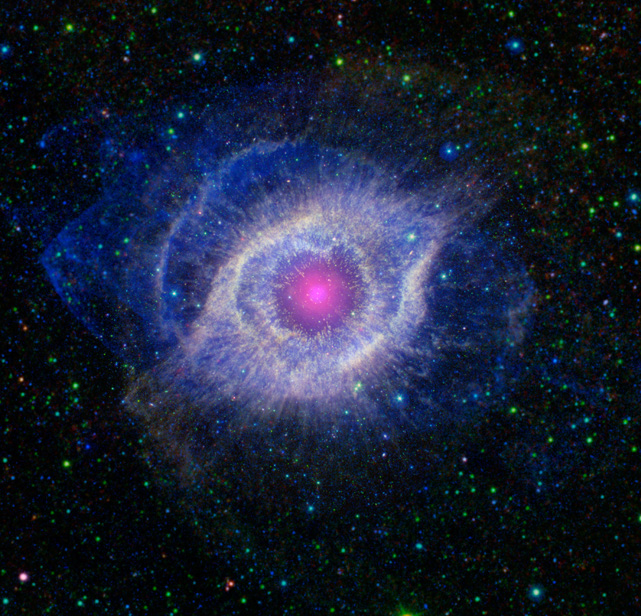
This image of the Helix Nebula is a composite of an ultraviolet image from NASA's Galaxy Evolution Explorer and an infrared image from NASA's Spitzer Space Telescope. Image credit: Galex, NASA/JPL-Caltech
The Helix nebula lies 650 light-years away in the constellation of Aquarius. Also known by the catalog number NGC 7293, it is a typical example of a class of objects called planetary nebulae. Discovered in the 18th century, these cosmic works of art were erroneously named for their resemblance to gas-giant planets.
A white dwarf has been detected at the center of the nebula. The white dwarf is presumed to be about the size of Earth, but has a mass very close to that of the original star. From the NASA description: "The glow from planetary nebulae is particularly intriguing as it appears surprisingly similar across a broad swath of the spectrum, from ultraviolet to infrared. The Helix remains recognizable at any of these wavelengths, but the combination shown here highlights some subtle differences. The intense ultraviolet radiation from the white dwarf heats up the expelled layers of gas, which shine brightly in the infrared. GALEX has picked out the ultraviolet light pouring out of this system, shown throughout the nebula in blue, while Spitzer has snagged the detailed infrared signature of the dust and gas in yellow."
References:
| Galaxies
星系 |
Galaxy concepts
| HyperPhysics********** Astrophysics
HyperPhysics ********** 天体物理学 | R Nave |