The Helix Nebula
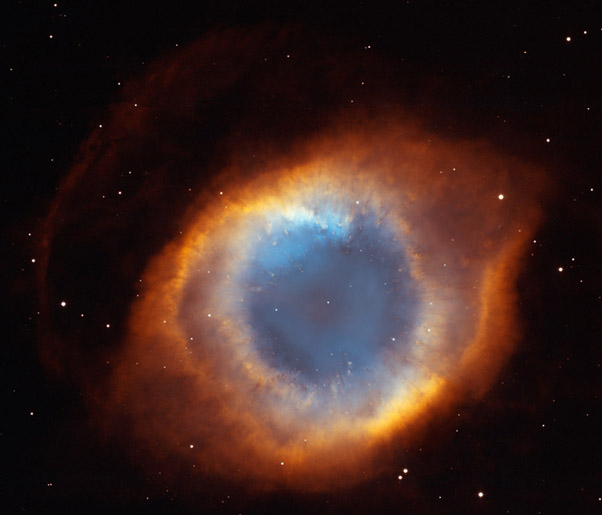
NGC 7293: The Helix Nebula
"Will our Sun look like this one day? The Helix Nebula is the closest example of a planetary nebula created at the end of the life of a Sun-like star. The outer gasses of the star expelled into space appear from our vantage point as if we are looking down a helix. The remnant central stellar core, destined to become a white dwarf star, glows in light so energetic it causes the previously expelled gas to fluoresce. The Helix Nebula, given a technical designation of NGC 7293, lies about 650 light-years away towards the constellation of Aquarius and spans about 2.5 light-years. The above picture is a composite of newly released images from the ACS instrument on the Hubble Space Telescope and wide-angle images from the Mosaic Camera on the WIYN 0.9-m Telescope at Kitt Peak National Observatory. A close-up of the inner edge of the Helix Nebula shows complex gas knots of unknown origin."(NASA description)
Credit: NASA, WIYN, NOAO, ESA, Hubble Helix Nebula Team, M. Meixner (STScI), & T. A. Rector (NRAO)

Spitzer image of Helix Nebula
A striking feature of the Helix, first revealed by ground-based images, is its collection of thousands of filamentary structures, or strands of gas. In this image the filaments can be seen under the transparent blue gas as red lines radiating out from the center. Astronomers believe that the molecules in these filaments are able to stay cooler and more stable because dense clumps of materials are shielding them from ultraviolet radiation. This image is a composite showing ionized H-alpha (green) and O III (blue) gases from the Hubble Space Telescope, and molecular hydrogen (red) from the Spitzer Space Telescope observations at 4.5 and 8.0 microns.
 | A 2007 image of the Helix Nebula by Spitzer shows dust in the range 35 to 150 AU from the white dwarf. It is being described by the observers as comet debris. An ultraviolet image of the Helix Nebula has been obtained by the GALEX instrument. 一张紫外图像显示了螺旋星云。
2007年斯皮策望远镜拍摄的螺旋星云图像显示,距离白矮星35到150个天文单位的尘埃。观测者称这些为彗星残骸。 |
Sources
- Helix Nebula as Astronomy Picture of the Day
螺旋星云作为天文学图片中的每日图片
- Spitzer image and description of Helix Nebula
斯皮瑟图像及螺旋星云描述
- Comet debris in Helix Nebula?
螺旋星云中的彗星残骸?
- R. Cowen, On the Trail of Dead Planets, Science News 171, 100, February 17, 2007.
R. Cowen, 《追踪死行星》, 《科学新闻》171卷第100期, 2007年2月17日。
Nebulae
| HyperPhysics********** Astrophysics
HyperPhysics ********** 天体物理学 | R Nave |