Pinwheel Galaxy, M101
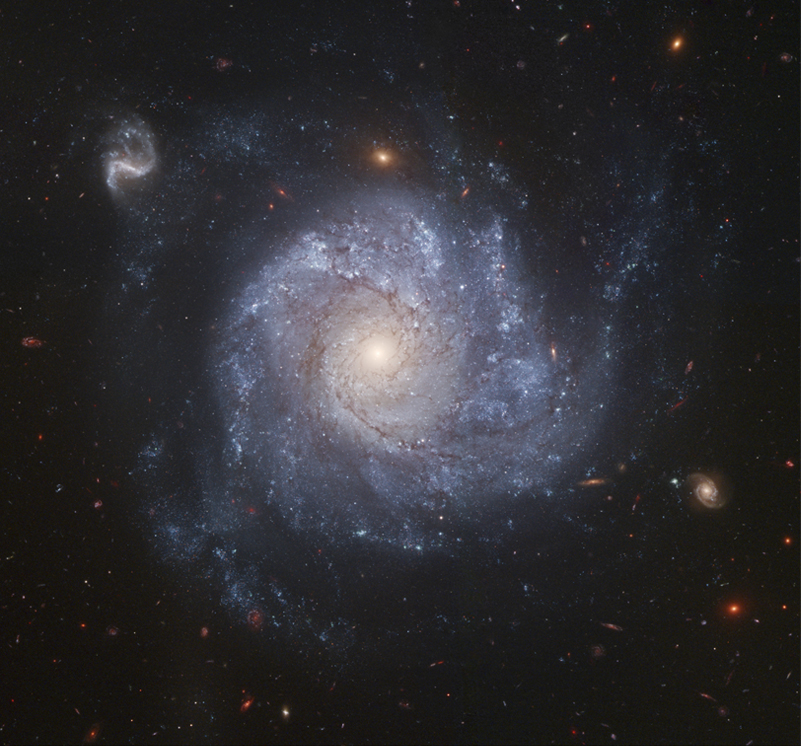
The Pinwheel Galaxy, M101
(credit NASA, ESA)
Galaxy M101, popularly known as the Pinwheel Galaxy, is one of the best known spiral galaxies. It is 23 million light years in distance. The above photo was released on 28 February, 2006.
The Pinwheel Galaxy has attracted more attention because of the discovery of a Type 1a supernova nearby on August 24, 2011. The discovery was made at the Palomar Observatory in California. Mark Sullivan of Oxford comments that they found it probably 12 hours after the start of the event. It is the first close Type 1a supernova observed since 1972. Having such a close Type 1a to study will allow comparisons to Cepheid variables in the same galaxy, which can sharpen our characterization of the Cepheids as a distance scale.(Science News Sep 24, 2011,p5)
"The giant spiral disk of stars, dust, and gas is 170,000 light-years across or nearly twice the diameter of our galaxy, the Milky Way. M101 is estimated to contain at least one trillion stars. Approximately 100 billion of these stars could be like our Sun in terms of temperature and lifetime.
The galaxy's spiral arms are sprinkled with large regions of star-forming nebulae. These nebulae are areas of intense star formation within giant molecular hydrogen clouds. Brilliant young clusters of hot, blue, newborn stars trace out the spiral arms. The disk of M101 is so thin that Hubble easily sees many more distant galaxies lying behind the galaxy.
M101 lies in the northern circumpolar constellation, Ursa Major (The Great Bear), at a distance of 23 million light-years from Earth. The galaxy fills a region in the sky equal to one-fifth the area of the full moon."
The newly composed image was assembled from Hubble archived images taken with the Advanced Camera for Surveys and the Wide Field and Planetary Camera 2 over nearly 10 years: in March 1994, September 1994, June 1999, November 2002, and January 2003. The Hubble exposures have been superimposed onto ground-based images, visible at the edge of the image, taken at the Canada-France-Hawaii Telescope in Hawaii, and at the 0.9-meter telescope at Kitt Peak National Observatory, part of the National Optical Astronomy Observatory in Arizona. The final color image was assembled from individual exposures taken through blue, green, and red (infrared) filters."(from Hubble photo release)
Sources
- Hubble Space Telescope
哈勃太空望远镜
- Hubble photo release
哈勃照片发布
Galaxies
| HyperPhysics***** Astrophysics
HyperPhysics ***** 天体物理学 | R Nave |