Heterodyne Principle
异频原理
Heterodyning is a method for transferring a broadcast signal from its carrier to a fixed local intermediate frequency in the receiver so that most of the receiver does not have to be retuned when you change channels. The interference of any two waves will produce a beat frequency, and this technique provides for the tuning of a radio by forcing it to produce a specific beat frequency called the "intermediate frequency" or IF. Heterodyning is used in the AM radio receiver and played a big part in making AM radio practical for mass communication.
混频是一种方法,用于将广播信号从其载波转换到接收器中的固定本地中间频率,这样当切换频道时,接收器大部分不需要重新调谐。任何两个波的干涉都会产生拍频,这种技术通过迫使无线电产生特定的拍频称为“中间频率”或IF来实现调谐。混频技术用于AM收音机,并在使AM收音机适用于大众传播中发挥了重要作用。
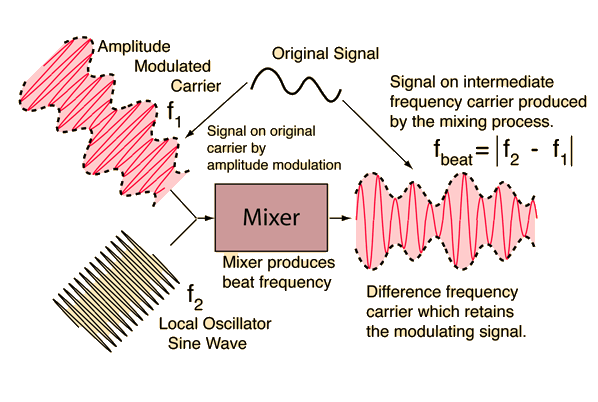
An electromagnetic carrier wave which is carrying a signal by means of amplitude modulation or frequency modulation can transfer that signal to a carrier of different frequency by means of heterodyning. This transfer is accomplished by mixing the original modulated carrier with a sine wave of another frequency. This process produces a beat frequency equal to the difference between the frequencies, and this difference frequency constitutes a third carrier which will be modulated by the original signal.
一个通过幅度调制或频率调制携带信号的电磁载波波,可以通过异频混频的方式将该信号传递到一个频率不同的载波上。这一传递过程是通过将原始调制的载波与另一个频率的正弦波混合来实现的。这一过程会产生一个等于两个频率差的拍频,该拍频频率构成一个第三载波,该载波将被原始信号调制。
Heterodyning is extremely important in radio transmission -- in fact, the development of heterodyning schemes was one of the major developments which led to mass communication by radio. By fixing the beat frequency between the incoming carrier and the local oscillator to a fixed intermediate frequency (IF), most of a radio receiver can be constructed so that it can be used by any incoming radio signal. When the input radio frequency amplifier is tuned to the station's carrier frequency, the local oscillator is tuned along with it to produce a beat frequency equal to the fixed IF frequency. We now take for granted that one radio receiver can be tuned to any of the locally broadcast radio stations, but if it were not for heterodyning, you would have to have one receiver for each broadcast station.
混频在无线电传输中极其重要——事实上,混频方案的发展是导致无线电广播大众传播的主要发展之一。通过将输入载波与本地振荡器之间的拍频固定为一个固定的中间频率(IF),大多数无线电接收机可以被构造出来,使其能够用于任何输入的无线电信号。当输入的无线电频率放大器调谐到电台的载波频率时,本地振荡器也随之调谐,以产生等于固定IF频率的拍频。我们现在假设一个无线电接收机可以调谐到任何本地广播的电台,但如果没有混频,你将不得不为每个广播电台拥有一个接收机。
|