Sum and Difference Frequencies和差频率
When you superimpose two sine waves of different frequencies, you get components at the sum and difference of the two frequencies. This can be shown by using a sum rule from trigonometry. For equal amplitude sine waves 当把两个不同频率的正弦波叠加时,你会得到两个频率之和与之差的分量。这可以通过使用一个三角学的和差公式来证明。对于振幅相等的正弦波

![]() The first term gives the phenomenon of beats with a beat frequency equal to the difference between the frequencies mixed. The beat frequency is given by 第一项描述了拍现象,其拍频等于混频的两个频率之差。拍频由下式给出:
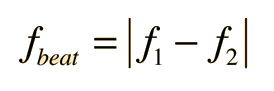
![]() since the first term above drives the output to zero (or a minimum for unequal amplitudes) at this beat frequency. Both the sum and difference frequencies are exploited in radio communication, forming the upper and lower sidebands and determining the transmitted bandwidth. 由于上述第一项在这一拍频处将输出驱动至零(或在振幅不等时达到最小值)。这两个和频与差频都在无线电通信中得到利用,形成上边带和下边带,并决定传输带宽。
When you say that the beat frequency is f1-f2 rather than (f1-f2)/2, that requires some explanation. For the difference frequency you can just say that you get a minumum when the modulating term reaches zero, which it does twice per cycle, so that the number of minima per second is f1-f2.
当你说拍频是f₁ - f₂而不是(f₁ - f₂)/2时,需要一些解释。对于差频,你可以简单地说,当调制项达到零时会出现极小值,它每周期两次达到零,因此每秒的极小值数目为f₁ - f₂。 |
Index Traveling wave concepts Sound reproduction concepts Audio signal concepts 索引:行波概念、声音再现概念、音频信号概念 | ||
|
Go Back
返回 |
Carriers and Sidebands载波和边带
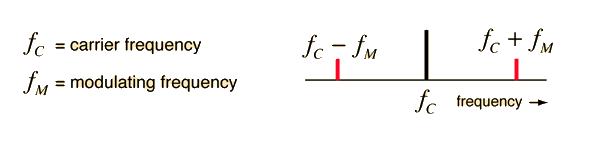
Radio transmission involves putting audio frequency information on a much higher frequency electromagnetic wave called a carrier wave. The process of superimposing the "electrical image" of the sound information on the carrier wave is called modulation, and there are two commonly used schemes: amplitude modulation (AM) and frequency modulation (FM). Either form of modulation produces frequencies which are the sum and the difference of the carrier and modulation frequencies - these frequencies are sometimes called sidebands. 无线电传输涉及将音频频率信息加载到一个频率远高于的电磁波上,这种电磁波被称为载波。将声音信息的'电信号'叠加到载波上的过程称为调制,常用的两种方案是幅度调制(AM)和频率调制(FM)。无论是哪种调制方式,都会产生频率为载波频率和调制频率之和与之差的频率——这些频率有时也被称为边带。
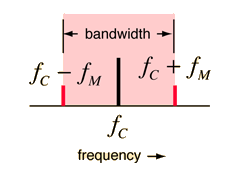
![]() Because of the existence of the sidebands, the frequency range or bandwidth necessary for radio transmission depends on the range of modulating frequencies. 由于存在边带,无线电传输所需的频率范围或带宽取决于调制频率的范围。
|
Index Sound reproduction concepts Audio signal concepts 索引 声学再现概念 音频信号概念 | ||
|
Go Back
返回 |
Bandwidth for Communication通信带宽
Bandwidths are assigned for all types of broadcast communication and this imposes a maximum signal frequency which may be transmitted. The bandwidths assigned to AM and FM radio are such as to limit the fidelity of music broadcasts in AM, but permit the luxury of stereo high-fidelity broadcasts by FM. The high signal frequencies associated with video broadcasting require higher bandwidths for channels assigned to television. 所有类型的广播通信都分配了带宽,这会限制可以传输的最大信号频率。分配给AM和FM广播的带宽使得AM广播中的音乐传输保真度受到限制,但允许FM广播提供立体声高保真传输。与视频广播相关的高信号频率需要为电视频道分配更高的带宽。
|
Index Sound reproduction concepts Audio signal concepts 索引 声学再现概念 音频信号概念 | ||||
|
Go Back
返回 |
Radio Frequency Bands无线电频率波段
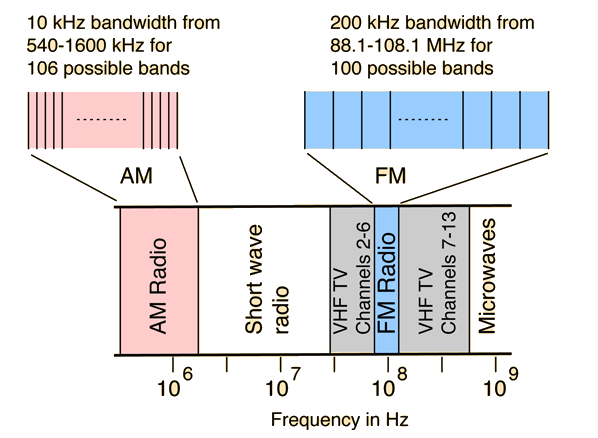
Because of the division of the FM band for the transmission of FM stereo, the frequency limit for music transmission is at 15 kHz. This allows high fidelity signal transmission. The operational bandwidth is limited to 150 kHz, with 25 kHz on each side of that for gaurd bands. Actually FM stereo covers 106 kHz of that. 由于FM频段被用于传输FM立体声,音乐传输的频率限制为15 kHz。这允许高保真信号传输。操作带宽被限制在150 kHz,其中两侧各留出25 kHz作为保护带。实际上,FM立体声占用其中的106 kHz。
![]() AM radio is limited to 5000 Hz maximum frequency by the width of the AM bands. Music transmission by AM radio is limited in fidelity, and adjacent stations tend to interfere with each other. AM电台的频率被AM频段的宽度限制在5000 Hz以内。AM电台传输音乐时音质受限,相邻电台之间容易相互干扰。
|
Index Sound reproduction concepts Audio signal concepts 索引 声学再现概念 音频信号概念 | ||
|
Go Back
返回 |