Broadcast Signals广播信号
Radio communication is typically in the form of AM radio or FM Radio transmissions. The broadcast of a single signal, such as a monophonic audio signal, can be done by straightforward amplitude modulation or frequency modulation. More complex transmissions utilize sidebands arising from the sum and difference frequencies which are produced by superposition of some signal upon the carrier wave. For example, in FM stereo transmission, the sum of left and right channels (L+R) is used to frequency modulate the carrier and a separate subcarrier at 38 kHz is also superimposed on the carrier. That subcarrier is then modulated with a (L-R) or difference signal so that the transmitted signal can be separated into left and right channels for stereo playback. In television transmission, three signals must be sent on the carrier: the audio, picture intensity, and picture chrominance. This process makes use of two subcarriers. Other transmissions such as satellite TV and long distance telephone transmission make use of multiple subcarriers for the broadcast of multiple signals simultaneously. 无线电通信通常以AM广播或FM广播形式进行。单个信号(如单声道音频信号)的广播可以通过直接的幅度调制或频率调制来实现。更复杂的传输利用了由信号与载波波叠加产生的和频与差频所形成的边带。例如,在FM立体声传输中,左声道和右声道的和(L+R)用于对载波进行频率调制,同时在载波上还叠加了一个38kHz的子载波。该子载波随后被(L-R)或差分信号调制,使得传输的信号可以被分离为左声道和右声道以进行立体声播放。在电视传输中,三个信号必须在载波上发送:音频、图像亮度和图像色度。这一过程利用了两个子载波。其他传输,如卫星电视和长途电话传输,也利用多个子载波同时广播多个信号。
|
Index Sound reproduction concepts Audio signal concepts 索引 声学再现概念 音频信号概念 | ||
|
Go Back
返回 |
AM RadioAM调频广播
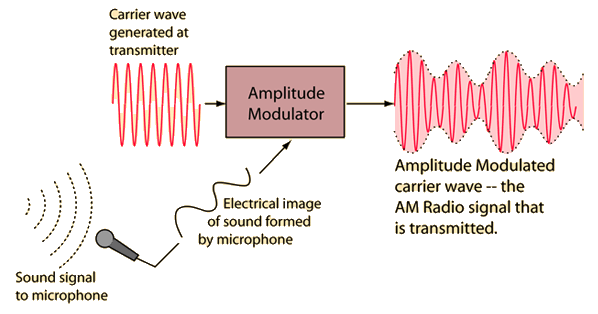
![]() AM radio uses the electrical image of a sound source to modulate the amplitude of a carrier wave. At the receiver end in the detection process, that image is stripped back off the carrier and turned back into sound by a loudspeaker. AM电台利用声音源的电信号来调制载波的幅度。在接收端,通过解调过程将这个信号从载波中提取出来,再通过扬声器转换成声音。
When information is broadcast from an AM radio station, the electrical image of the sound (taken from a microphone or other program source) is used to modulate the amplitude of the carrier wave transmitted from the broadcast antenna of the radio station. This is in contrast to FM radio where the signal is used to modulate the frequency of the carrier. 当AM广播电台向听众广播信息时,从麦克风或其他节目源获取的音频电信号被用来调制广播电台天线发射的载波波的幅度。这与FM广播不同,在FM广播中,信号被用来调制载波波的频率。
The AM band of the Electromagnetic spectrum is between 535 KHz and 1605 kHz and the carrier waves are separated by 10 kHz. 电磁波谱的AM频段位于535 kHz至1605 kHz之间,载波波形间隔为10 kHz。
A radio receiver can be tuned to receive any one of a number of radio carrier frequencies in the area of the receiver. This is made practical by transferring the signal from the carrier onto an intermediate frequency in the radio by a process called heterodyning. In a heterodyne receiver, most of the electronics is kept tuned to the intermediate frequency so that only a small portion of the receiver circuit must be retuned when changing stations. 无线电接收机可以调谐以接收区域内多个无线电载波频率中的任意一个。这一功能通过一种称为混频的过程在无线电中实现,即把信号从载波转移到一个中间频率。在混频接收机中,大部分电子元件都调谐到中间频率,因此在切换频道时,只需重新调谐接收机电路的小部分。
|
Index Sound reproduction concepts Audio signal concepts 索引 声学再现概念 音频信号概念 | ||
|
Go Back
返回 |
FM RadioFM广播
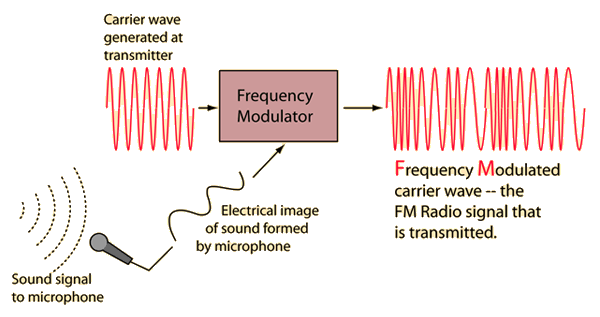
![]() FM radio uses the electrical image of a sound source to modulate the frequency of a carrier wave. At the receiver end in the detection process, that image is stripped back off the carrier and turned back into sound by a loudspeaker. FM广播利用声音源的电信号来调制载波的频率。在接收端,通过解调过程将这个信号从载波中提取出来,再通过扬声器转换成声音。
When information is broadcast from an FM radio station, the electrical image of the sound (taken from a microphone or other program source) is used to modulate the frequency of the carrier wave transmitted from the broadcast antenna of the radio station. This is in contrast to AM radio where the signal is used to modulate the amplitude of the carrier. 当FM广播电台向听众广播信息时,会将从麦克风或其他节目源获取的音频信号用来调制载波波的频率。这与AM广播不同,在AM广播中,信号用来调制载波的幅度。
The FM band of the electromagnetic spectrum is between 88 MHz and 108 MHz and the carrier waves for individual stations are separated by 200 kHz for a maximum of 100 stations. These FM stations have a 75 kHz maximum deviation from the center frequency, which leaves 25 kHz upper and lower "gaurd bands" to minimize interaction with the adjacent frequency band. This separation of the stations is much wider than that for AM stations, allowing the broadcast of a wider frequency band for higher fidelity music broadcast. It also permits the use of sub-carriers which make possible the broadcast of FM Stereo signals. 电磁谱的FM频段位于88 MHz至108 MHz之间,各电台的载波波形间隔200 kHz,最多可容纳100个电台。这些FM电台的最大频偏为75 kHz,留出25 kHz的上、下“保护带”以最小化与相邻频段的干扰。这种电台之间的分离度比AM电台要宽得多,允许广播更宽的频段以实现更高保真的音乐广播。此外,这种分离度也使得使用子载波成为可能,从而实现FM立体声信号的广播。
|
Index Sound reproduction concepts Audio signal concepts 索引 声学再现概念 音频信号概念 | ||
|
Go Back
返回 |
Frequency Modulation频率调制
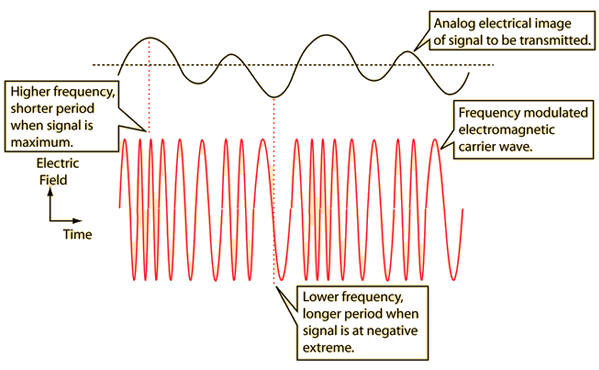
![]() The change in frequency, which is greatly exaggerated here, is proportional to the amplitude of the signal. An FM radio carrier around 100 MHz is limited to modulation of +/- 0.1 MHz. Normal FM stereo broadcast is within +/- .053 MHz. 频率的变化,这里被夸大了,与信号的幅度成正比。一个约100 MHz的FM广播载波被限制在±0.1 MHz的调制范围内。正常的FM立体声广播在±0.053 MHz范围内。
|
Index Sound reproduction concepts Audio signal concepts 索引 声学再现概念 音频信号概念 | |||
|
Go Back
返回 |