Sensitivity of Human Ear人耳的灵敏度
The human ear can respond to minute pressure variations in the air if they are in the audible frequency range, roughly 20 Hz - 20 kHz. 人类耳朵可以感知空气中的微小压力变化,但这些变化必须在可听频率范围内,大约是20赫兹到20千赫兹。
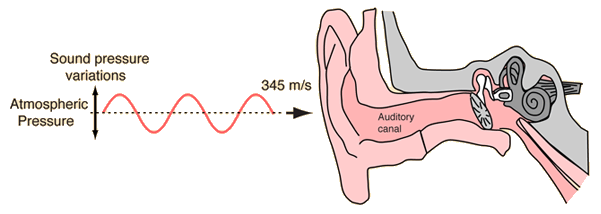
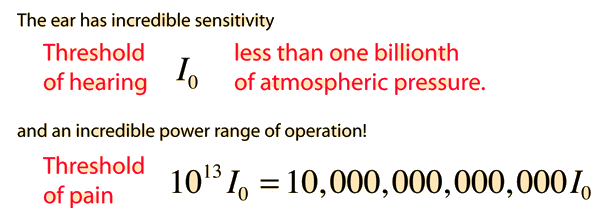
![]() ![]() It is capable of detecting pressure variations of less than one billionth of atmospheric pressure. The threshold of hearing corresponds to air vibrations on the order of a tenth of an atomic diameter. This incredible sensitivity is enhanced by an effective amplification of the sound signal by the outer and middle ear structures. Contributing to the wide dynamic range of human hearing are protective mechanisms that reduce the ear's response to very loud sounds. Sound intensities over this wide range are usually expressed in decibels. 它能够检测到小于大气压百万分之一的压强变化。听阈对应于空气振动的幅度约为原子直径的十分之一。这种惊人的灵敏度由外耳和中耳结构对声音信号的有效放大所增强。保护机制有助于扩大人类听觉的动态范围,这些机制减少了耳朵对非常响亮声音的响应。通常,这个宽广范围内的声音强度用分贝来表示。
|
Index Hearing concepts 索引听力概念 | ||
|
Go Back
返回 |
Dynamic Range of Hearing听觉动态范围
In addition to its remarkable sensitivity, the human ear is capable of responding to the widest range of stimuli of any of the senses. The practical dynamic range could be said to be from the threshold of hearing to the threshold of pain: 除了其卓越的灵敏度外,人类的耳朵能够对任何感官中范围最广的刺激作出响应。实际的动态范围可以认为是从听阈到痛阈:
This remarkable dynamic range is enhanced by an effective amplification structure which extends its low end and by a protective mechanism which extends the high end. 这种显著的动态范围得益于一个有效的放大结构,它扩展了低频端,同时还有一个保护机制,它扩展了高频端。
|
Index Hearing concepts 索引听力概念 | |||||||
|
Go Back
返回 |
Pitch Resolution音调分辨
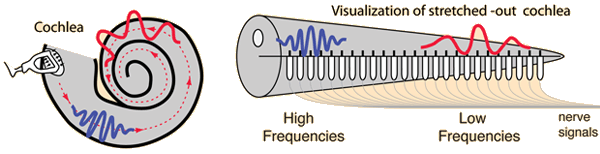
This would require a separate detectable pitch for every 0.002 cm, which is physically unreasonable for a simple peaking action on the membrane. 这需要为每0.002厘米有一个可检测的音调,对于膜片上的简单峰值动作来说在物理上是不合理的。
![]() The normal human ear can detect the difference between 440 Hz and 441 Hz. It is hard to believe it could attain such resolution from selective peaking of the membrane vibrations. Some pitch sharpening mechanism must be operating. 人类正常的耳朵可以分辨440 Hz和441 Hz之间的差异。很难相信它能从膜振动的选性增强中达到这样的分辨率。某些音调提升机制必须在起作用。
|
Index Hearing concepts Place theory concepts 索引听觉概念 理论位置概念 | ||||||||||||
|
Go Back
返回 | ||||||||||||
|
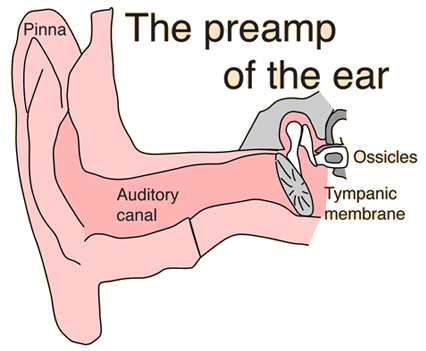
The structures of the outer and middle ear contribute to both the remarkable sensitivity and the wide dynamic range of human hearing. They can be considered to be both a pre-amplifier and a limiter for the human hearing process. 外耳和中耳的结构有助于人类听觉的 remarkable sensitivity 和宽广的动态范围。它们可以被视为人类听觉过程中的前置放大器和限制器。
The outer and middle ears contribute something like a factor of 100 or about 20 decibels of amplification under optimum conditions. 外耳和中耳在最佳条件下可提供约100倍的放大作用,或约20分贝的增益。
|
Index Hearing concepts Reference Stevens & Warshofsky 索引 声学概念 参考 Stevens & Warshofsky | |||||||||||
|
Go Back
返回 | |||||||||||
Audible Sound可听声
Usually "sound" is used to mean sound which can be perceived by the human ear, i.e., "sound" refers to audible sound unless otherwise classified. A reasonably standard definition of audible sound is that it is a pressure wave with frequency between 20 Hz and 20,000 Hz and with an intensity above the standard threshold of hearing. Since the ear is surrounded by air, or perhaps under water, the sound waves are constrained to be longitudinal waves. Normal ranges of sound pressure and sound intensity may also be specified. 通常,“sound”指的是可以被人类耳朵感知的声音,即“sound”指的是可听声,除非另有分类。一个相对标准的可听声定义是,它是一种频率在20 Hz到20,000 Hz之间,且强度高于标准听阈的压强波。由于耳朵被空气或可能在水中包围,声波必须是纵波。正常范围的声压和声强也可以指定。
Animal sounds cover the entire range of audible sound and beyond. Blue whales produce sounds around 20 Hz and with intensity measured as high as 189 dB (Sirovic). For an air temperature of 20°C where the sound speed is 344 m/s, the audible sound waves have wavelengths from 0.0172 m (0.68 inches) to 17.2 meters (56.4 feet). 对于20°C的空气温度,声速为344 m/s,可听声波的波长范围为0.0172 m(0.68英寸)到17.2米(56.4英尺)。
动物声音涵盖了可听范围内的所有声音以及更广的范围。蓝鲸发出约20 Hz的声音,其强度可高达189 dB (Sirovic)。 |
Index Hearing concepts 索引听力概念 | ||||||||||
|
Go Back
返回 |