The Sodium-Potassium Pump
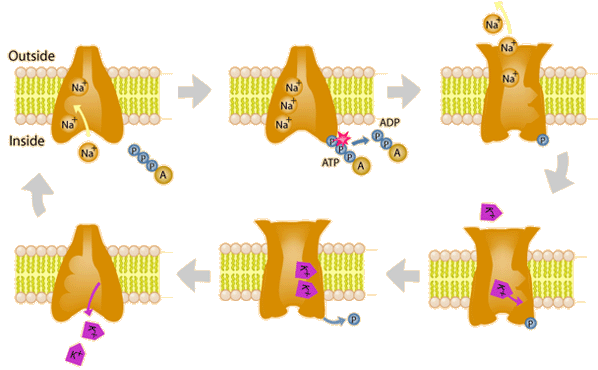
 | The process of moving sodium and potassium ions across the cell membrance is an active transport process involving the hydrolysis of ATP to provide the necessary energy. It involves an enzyme referred to as Na+/K+-ATPase. This process is responsible for maintaining the large excessof Na+ outside the cell and the large excess of K+ ions on the inside. A cycle of the transport process is sketched below. It accomplishes the transport of three Na+ to the outside of the cell and the transport of two K+ ions to the inside. This unbalanced charge transfer contributes to the separation of charge across the membrane. The sodium-potassium pump is an important contributer to action potential produced by nerve cells. This pump is called a P-type ion pump because the ATP interactions phosphorylates the transport protein and causes a change in its conformation. 将钠和钾离子跨细胞膜运输的过程是一种主动运输过程,涉及ATP水解以提供必要的能量。该过程涉及一种称为Na⁺/K⁺-ATP酶的酶。这一过程负责维持细胞外钠离子的大量过剩和细胞内钾离子的大量过剩。下图展示了运输过程的一个周期。该过程实现了将三个Na⁺运输到细胞外和将两个K⁺离子运输到细胞内。这种不平衡的电荷转移导致膜两侧电荷的分离。钠钾泵是神经细胞产生动作电位的重要贡献者。这种泵被称为P型离子泵,因为ATP与运输蛋白相互作用使其磷酸化,并导致其构象发生变化。 |
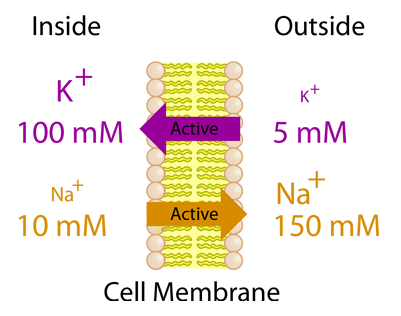 | The sodium-potassium pump moves toward an equilibrium state with the relative concentrations of Na+ and K+ shown at left. 钠钾泵趋向于一个平衡态,其中钠离子和钾离子的相对浓度如图左所示。 |
Reference
Karp
Sec 4.7
| HyperPhysics***** Biology
HyperPhysics ***** 生物学 | R Nave |