Action Potentials
 |
Action potential from a giant squid axon. 巨 squid 神经元的动作电位
|
In response to the appropriate stimulus, the cell membrane of a nerve cell goes through a sequence of depolarization from its rest state followed by repolarization to that rest state. In the sequence, it actually reverses its normal polarity for a brief period before reestablishing the rest potential.
The above example of the squid action potential was patterned after a measured action potential shown in West's Medical Physics. The approximate time intervals shown were scaled from time markers on the experimental trace.
The action potential sequence is essential for neural communication. The simplest action in response to thought requires many such action potentials for its communication and performance. For modeling the action potential for a human nerve cell, a nominal rest potential of -70 mV will be used. The process involves several steps:
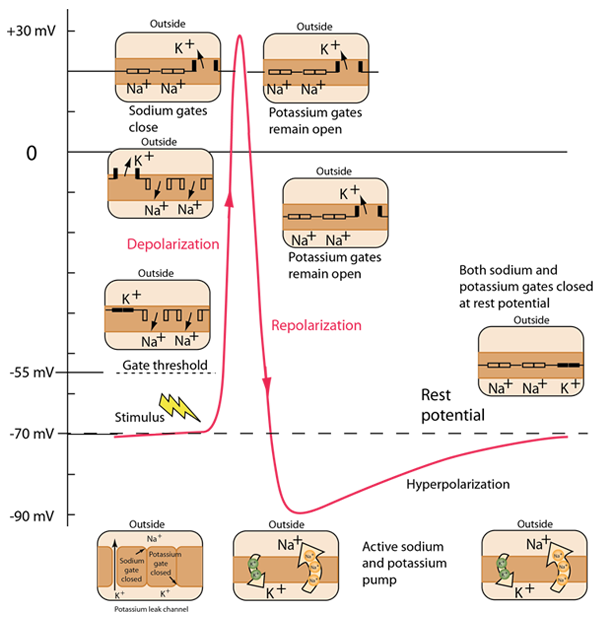
This is an active graphic. Click for more detail.
The following discussion is an attempt to characterize the successive steps involved in the production of an action potential typical of mammalian nerve cells.
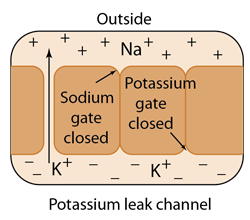 | In the resting state of a nerve cell membrane, both the sodium and potassium gates are closed and equilibrium concentrations are maintained across the membrane. Inside the cell, the K+ concentration is higher, nominally 100 mM compared to 5mM outside the cell. Outside the cell, the Na+ concentration is higher, nominally 150 mM compared to 10 mM inside the cell. The voltage or electric potential of the inside of the cell compared to the outside is typically about -70mV, although this differs significantly in cells other than nerve cells. Although the changes in electric potential across the membrane during an action potential are sufficient to accomplish its purpose, the actual changes in the concentrations of the Na+ and K+ ions are very small. They are like tiny ripples on the concentration seas. Karp, Section 4.8 describes the fact that there are some remaining open K+ channels even in the resting membrane, and they make a contribution to determining the resting potential. They are often called the K+ leak channels. 在神经细胞膜的静息状态下,钠和钾通道均处于关闭状态,膜两侧的平衡浓度得以维持。细胞内钾离子浓度较高,约为100 mM,而细胞外仅为5 mM。相反,细胞外钠离子浓度较高,约为150 mM,而细胞内仅为10 mM。细胞内相对于细胞外的电压或电势通常约为-70mV,尽管这一数值在非神经细胞中差异显著。虽然动作电位过程中膜两侧的电势变化足以实现其功能,但钠离子和钾离子的实际浓度变化非常微小,就像浓度海洋中的微小涟漪。Karp,第4.8节描述了在静息膜中仍存在一些开放的钾离子通道,这些通道对确定静息电势有所贡献。它们通常被称为钾离子漏通道。 |
 | The Na+/K+ pump is a major contributor to the resting state or equilibrium of the cell. It is responsible for maintaining the large excess of Na+ outside the cell and the large excess of K+ ions on the inside. It is an active transport process which makes use of the ATP energy currency of the cell. 钠钾泵是细胞静息状态或平衡的主要贡献者。它负责维持细胞外钠离子的大量过剩以及细胞内钾离子的大量过剩。它是一种主动运输过程,利用细胞的ATP能量货币。 |
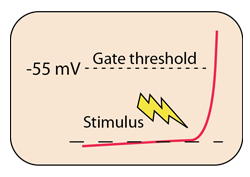 | A stimulus is received by the dendrites of a nerve cell. This causes some Na+ channels to open, and the diffusion influx of Na+ ions starts to drive the potential of the interior more positive. The nerve cells are sensitive to external stimuli, but if such stimuli do not cause the potential to rise to the threshold level, the cell will tend to settle back down to equilibrium. If the stimulus response is sufficient to drive the interior potential from -70 mV up to -55 mV, the process continues. Having reached the threshold, there is no turning back and the cell will fire into the full action potential. This situation is often referred to as the "all-or-none" law. 一个刺激被神经细胞的树突接收。这导致一些Na+通道打开,Na+离子的扩散流入开始使细胞内侧的电位更加正。神经细胞对外部刺激敏感,但如果这种刺激不足以使电位上升到阈值电平,细胞会倾向于恢复到平衡状态。如果刺激反应足够强,使内部电位从-70 mV上升到-55 mV,这一过程将继续。一旦达到阈值,就无法回头,细胞将发出完整的动作电位。这种情形通常被称为“全或无”定律。 |
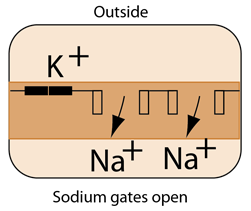 | Once the threshold is reached, more sodium gates open and Na+ ions flood into the cell, raising the voltage rapidly. This transition is said to be "voltage gated" and occurs rapidly since the Na+ ions are driven by both the concentration gradient and the voltage gradient. 一旦达到阈值,更多的钠通道打开,Na⁺离子涌入细胞,使电压迅速上升。这一过程被称为‘电压门控’,由于Na⁺离子同时受到浓度梯度和电压梯度的驱动,因此发生得很快。 |
去极化 | The period of rapid rise of the interior cell potential from its resting state of about -70 mv on the order of milliseconds is referred to as "depolarization". The rise may be to about +30 mV. The typical time for the depolarization of a mammalian nerve cell is on the order of a millisecond. 静息状态下,细胞内电位从约-70 mV迅速上升的时期,称为‘去极化’,这一过程通常在毫秒量级内发生。电位可能上升到约+30 mV。哺乳动物神经细胞的去极化时间通常在毫秒量级。 |
 | 
The open sodium gates continue to transport Na+ ions into the cell, driving the depolarization and raising the potential of the cell's interior. At some point the K+ gates begin to open, but their opening process is slower than that of the Na+ gates, so the depolarization process has time to come to completion. The depolarization continues until the interior cell potential goes positive to about 30mV. 开放的钠通道继续将Na⁺离子运输进细胞,驱动去极化并提高细胞内部的电位。在某个时刻,钾通道开始打开,但其开启过程比钠通道慢,因此去极化过程有时间完成。去极化持续进行,直到细胞内部的电位上升到约30mV。 |
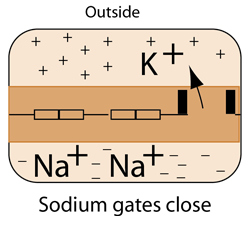 | As the interior cell potential moves through neutrality to positive values, the sodium gates close, ending the depolarization phase. 当内部电池电势从中性过渡到正值时,钠通道关闭,结束去极化相。 |
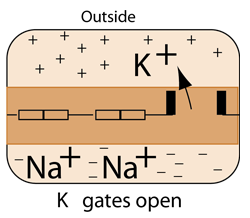 | Once open, the K+ gates remain open and the free diffusion of potassium out of the cell drives the potential back toward negative values in the process called repolarization. 一旦开放,钠离子通道保持开放,钾离子的自由扩散使电位逐渐恢复到负值,这一过程称为复极化。 |
再极化 | The drop in the interior cell potential as a result of the open K+ gates is called repolarization. This re-establishes the "polarization" of having the interior of the cell polarized negative with respect to the outside. 由于钾离子通道开放导致细胞内电位下降的现象称为复极化。这重新建立了细胞内侧相对于外侧极化为负的'极化'状态。 |
超极化 | Hyperpolarization is the name given to the period of overshoot of the interior cell potential to values more negative than the normal rest state. One influence in this phase is the fact that the Na+ gates remain closed and the lack of Na+ mobility across the membrane causes the K+ process to proceed toward the value of -80mV which would occur if potassium alone were present. While hyperpolarization might seem to be counterproductive, it is actually important in the transmission of information. Hyperpolarization prevents the neuron from receiving another stimulus during this time, or at least raises the threshold for any new stimulus. Part of the importance of hyperpolarization is in preventing any stimulus already sent up an axon from triggering another action potential in the opposite direction. In other words, hyperpolarization assures that the signal is proceeding in one direction. 超极化是指细胞内电位超过正常静息状态而变得更负的时期。这一阶段的一个影响是,钠离子通道保持关闭,钠离子跨膜的流动性缺乏,导致钾离子过程趋向于-80mV,这在仅有钾离子存在时也会发生。虽然超极化似乎是有害的,但实际上在信息传递中是重要的。超极化防止神经元在此期间接收另一个刺激,或者至少提高任何新刺激的阈值。超极化的重要性之一在于防止已经沿轴突上传递的刺激在相反方向触发另一个动作电位。换句话说,超极化确保信号单向传递。 |
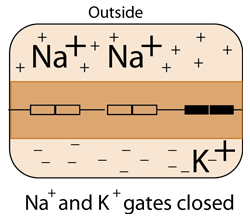 | In the hyperpolarization stage, the K+ gates close and the Na+ gates remain closed. Under the influences that control the equilibrium potential (the Na+/K+ pump and the K leakage channel), the cell membrane again approaches its rest state. 在超极化阶段,K+通道关闭,Na+通道保持关闭。在控制平衡电位的影响下(即Na+/K+泵和K漏通道),细胞膜再次接近静息状态。 |
Having completed the action potential sequence, the Na+ gates remain closed for a time, suppressing the initiation of a new action potential for a period referred to as a "refractory period".
| Transmission of an action potential down an axon
动作电位沿轴突的传导 |
Contributing author: Ka Xiong Charand
Bioelectricty
Karp, 4.7-4.8
| HyperPhysics***** Biology
HyperPhysics ***** 生物学 | A Nave R Nave
R Nave |