Overtones and Harmonics
泛音与谐波
The term harmonic has a precise meaning - that of an integer (whole number) multiple of the fundamental frequency of a vibrating object. The term overtone is used to refer to any resonant frequency above the fundamental frequency - an overtone may or may not be a harmonic. Many of the instruments of the orchestra, those utilizing strings or air columns, produce the fundamental frequency and harmonics. Their overtones can be said to be harmonic. Other sound sources such as the membranes or other percussive sources may have resonant frequencies which are not whole number multiples of their fundamental frequencies. They are said to have non-harmonic overtones.
'谐'这个词有确切的含义——它指的是振动物体的基本频率的整数倍。'泛音'一词用于指任何高于基本频率的共振频率——泛音可能是也可能是不是谐波。许多管弦乐队的乐器,那些利用弦或气柱的乐器,会产生基本频率和泛音。它们的泛音可以称为谐波。其他声音源,如膜或其它打击乐器,可能具有不是其基本频率整数倍的共振频率。它们被称为非谐波泛音。
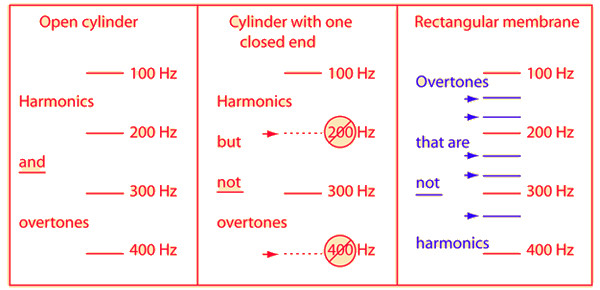
| All harmonics are overtones for an open air column or a string.
所有谐波都是开放空气柱或弦的泛音 | Closed air columns produce only odd harmonics.
封闭的空气柱只能产生奇数泛音。 | A rectangular membrane produces harmonics, but also some other overtones.
矩形膜会产生谐波,但也会产生一些其他泛音。 |
| Harmonics in cents
cents 中的泛音 |
Resonance concepts
索引共振概念
| HyperPhysics***** Sound
HyperPhysics ***** 声音 | R Nave |
返回