Ease of Excitation at Resonance
共振时的激发容易程度
It is easy to get an object to vibrate at its resonant frequencies, hard at other frequencies. A child's playground swing is an example of a pendulum, a resonant system with only one resonant frequency. With a tiny push on the swing each time it comes back to you, you can continue to build up the amplitude of swing. If you try to force it to swing at twice that frequency, you will find it very difficult, and might even lose teeth in the process!
使物体在它的共振频率上振动很容易,而在其他频率上则很难。儿童游乐场的秋千是一个 pendulum 的例子,这是一个只有单一共振频率的共振系统。每次秋千返回时给予它一个轻微的推力,你可以持续增加秋千的振幅。如果你尝试以两倍于该频率来强迫它振动,你会发现非常困难,甚至可能在过程中失去牙齿!
| Swinging a child in a playground swing is an easy job because you are helped by its natural frequency.
在游乐场荡秋千是一件容易的事,因为你会借助其自然频率。 | 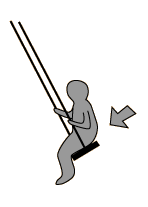 | But can you swing it at some other frequency?
但你能以其他频率摆动它吗? |
Resonance concepts
索引共振概念
| HyperPhysics***** Sound
HyperPhysics ***** 声音 | R Nave |
返回