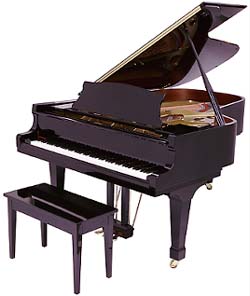
The Piano
钢琴
The piano has 88 keys which span the frequency range 27.5 Hz (A0) to 4186 Hz (C8). The strings are sounded by hammer mechanisms which are activated by the keys. Held in a heavy cast iron frame, the strings pass over a bridge to a pin block by which the strings are tuned. The soundboard is a crucial element in the sound of the piano. Energy is coupled from the strings into the soundboard and from it into the air. The soundboard is usually made of spruce.
钢琴有88个琴键,其频率范围从27.5 Hz(A0)到4186 Hz(C8)。琴键通过锤子机制发声,琴键被按下时激活该机制。琴弦被固定在沉重的铸铁框架中,经过琴桥传至琴钉块,从而调节琴弦的音高。共鸣板是钢琴声音的关键组成部分。能量从琴弦传递到共鸣板,再传递到空气中。共鸣板通常由云杉制成。
Three pedals afford the player some control over the sound of the instrument. The left pedal is the "soft pedal" or una corda. It shifts the keyboard beneath the strings so that the hammers strike fewer strings, giving a softer sound. The center pedal is the sustain or sustenuto pedal which disengages the dampers. The right pedal is the damper pedal to dampen the whole keyboard.
三个踏板使演奏者能够对乐器的声音有所控制。左侧踏板是“弱踏板”或“una corda”,它会将键盘移至琴弦之下,使得琴锤击打更少的琴弦,从而发出更柔和的声音。中间踏板是延音踏板或延音踏板,它会松开制音器。右侧踏板是制音踏板,用于使整个键盘的琴弦被制音器覆盖。
Some grand pianos have on the order of 7000 parts! Their function can be described in terms of six features: the keyboard, the hammers, the dampers, the bridge, the soundboard, and the strings. There are 52 white keys and 36 black keys (for the chromatic notes), bridging seven and a third octaves with 12 equal semitones per octave. The piano is the standard instrument for the equal tempered scale, yet both the high end and low end of the instrument are tuned so that they depart slightly from equal temperament because the sound has been judged to be more pleasing with that arrangement (see "stretched" tuning discussion below).
一些大钢琴拥有约7000个部件!其功能可以描述为六个特征:琴键、琴锤、琴钉、桥、共鸣板和琴弦。有52个白键和36个黑键(用于音阶),跨越七个又三分之一个八度,每个八度有12个等音分。钢琴是等音律的标准乐器,但其高音和低音端被调谐成略微偏离等音律,因为这种安排被认为声音更悦耳(见下文“调谐”讨论)。
Depressing a key on the piano engages a complex mechanism called the "action" of the piano which causes the hammer to strike the string. Actually, the hammers are in sets for the keys which sound two or three strings. The striking point is about 1/7th of the way along the string to discriminate against the 7th harmonic resonance, which is significantly out of tune with the equal tempered scale. This "7th harmonic problem" can be illustrated by examining the musical intervals formed by a an exact harmonic sequence.
按下钢琴键会激活一个复杂的机制,称为钢琴的“作用”(action),从而使得锤子击打琴弦。实际上,每个琴键对应一组锤子,能够击打两到三根琴弦。击打点位于琴弦的约1/7处,以抑制第七泛音共振,这种泛音在等音律中明显不和谐。这种“第七泛音问题”可以通过检查由精确的泛音序列形成的音乐音程来加以说明。
The grand piano has about 230 strings for the 88 keys. Generally, the ten lowest pitches have one wirewound string. The next 18 pitches have two, and the last 60 have three strings each. In the modern piano, the strings are mounted on a cast iron frame to provide the strength to main the required tension in all of these strings (about 30 tons for a grand). Working out combinations of lengths, masses and tensions for these strings within a compact instrument is a formidable problem. In order to maintain comparable tensions in the strings without inconvenient size for the instrument, the length is not halved with each octave but a ratio between 1.88 and 1.94:1 is used. The string mass is varied to constrain the frequencies to their proper values. For the lower pitches, the steel wire is wound with copper or brass, which adds mass without producing excessive stiffness.
大钢琴有约230根琴弦,对应88个琴键。通常,最低的10个音高使用一根缠绕弦。接下来的18个音高使用两根弦,而最后的60个音高则每根使用三根弦。在现代钢琴中,琴弦被安装在铸铁框架上,以提供足够的强度来维持所有这些琴弦所需的张力(约30吨,用于立式钢琴)。在紧凑的乐器中,计算这些琴弦的长度、质量和张力的组合是一个艰巨的问题。为了在不使乐器尺寸不便的情况下保持琴弦的张力,长度并不是在每个八度中减半,而是使用1.88到1.94之间的比例。琴弦的质量被调整以确保频率保持在正确值。对于低音,钢丝被缠绕铜或黄铜,这增加了质量而不产生过度的刚性。
Even with the windings of soft metal, the increased stiffness of the lower strings makes them depart from the "ideal string" necessary to produce exact harmonics. As you increase in harmonic number, the frequencies are increasingly sharp. This has led to the practice of tuning the lower strings of the piano up to about 30 cents flat, since that puts the upper harmonics more in tune with the midrange notes of the piano. This makes the piano sound better to most ears, partially because the low end of the piano at 27.5 Hz is in a frequency range where your hearing has dropped off considerably, so that the upper harmonics of these low strings are probably heard more prominently than the fundamental. The extreme upper end of the piano is tuned up to 30 cents sharp in a practice that is called "stretched" tuning.
即使使用软金属的绕线,较低弦的刚性增加使其偏离“理想弦”,这是产生精确谐波所必需的。随着谐波数的增加,频率变得越来越尖锐。这导致了对钢琴低音弦进行调高约30音的调谐实践,因为这样可以使高次谐波与钢琴中音区的音符更加和谐。这使钢琴听起来更好,部分原因是钢琴低音区的27.5 Hz频率处于人耳听觉显著下降的频率范围,因此这些低音弦的高次谐波可能比基频更明显。钢琴极高音区的调音也向上调高30音,这种做法称为“扩展”调音。
|