Bilingual edition: English is preserved and Chinese follows each unit. Terminology uses the confirmed v20260916 glossary; automated semantic review remains traceable.
中英双语版:英文原文完整保留,中文紧随对应单元;术语采用 v20260916 确认表,自动语义审校结果可追溯。

Equal Temperament

等温音阶

The equal tempered scale is the common musical scale used at present, used for the tuning of pianos and other instruments of relatively fixed scale. It divides the octave into 12 equal semitones. It is common practice to state musical intervals in cents, where 100¢ is defined as one equal tempered semitone. The cents notation provides a useful way to compare intervals in different temperaments and to decide whether those differences are musically significant. A useful parameter for comparison is the just noticeable difference in pitch which corresponds to about 5¢.

均音音阶是目前常用的音阶,用于钢琴和其他固定音阶的乐器调谐。它将八度分为12个相等的半音。通常习惯用音程(cents)来表示音乐音程,其中100¢定义为一个均音半音。音程记号提供了一种有用的比较不同音阶中音程差异的方法,并决定这些差异是否在音乐上具有意义。一个有用的比较参数是音高可察觉差异,这大约对应于5¢。

One of the advantages of the equal tempered scale is that it is the same in any musical "key", so that compositions may be freely transposed up or down without changing the musical intervals. This is such a major advantage that it has made equal temperament the standard temperament in western music for the past 200 years. The equal tempered intervals may be compared with Just and Pythagorean temperaments which maintain the exact-integer-ratio rule for the main intervals, while equal temperament departs from that standard.

等音律的一个优点是它在任何音乐“调性”中都保持一致,因此音乐作品可以自由地转调而不改变音乐的音程。这种优势如此显著,以至于等音律已成为西方音乐过去200年来标准的音律。等音律的音程可以与纯律和毕达哥拉斯音律相比较,后者保持主要音程的精确整数比规则,而等音律则偏离了这一标准。

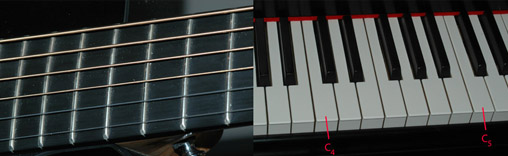
The piano keyboard is the standard example of the equal tempered scale, and the frets on a modern guitar are also placed to fix the instrument into the equal tempered scale.
钢琴琴键是等音律的典型例子,现代吉他上的品也放置在等音律的框架内。
Equal tempered frequency list
等音律频率表
Equal tempered octave on the piano
钢琴上的等音八度
Equal tempered octave vs other temperaments
等音律八度与其他律制
Index

Temperament and musical scales
索引 音乐的音阶与音调
 
HyperPhysics***** Sound
HyperPhysics ***** 声音
R Nave
Go Back
返回


This table is based upon the A-440 Hz frequency standard. The note letters have a number appended which is their octave number beginning at the bottom octave on the piano. The offset frequencies are the chromatic notes (sharps and flats)

此表基于A-440赫兹频率标准。音符字母后附有数字,表示其八度编号,从钢琴的最低八度开始。偏移频率对应的是十二平均律中的音(升音和降音)。
Equal temperament
等音律
Index

Temperament and musical scales
索引 音乐的音阶与音调
 
HyperPhysics***** Sound
HyperPhysics ***** 声音
R Nave
Go Back
返回


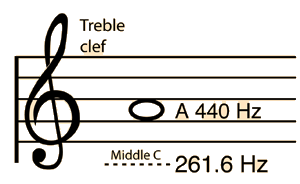
The A 440 Pitch Standard

A 440 音调标准

In 1939, an International Conference met in London and unanimously adopted 440 Hz as the standard frequency for the pitch A4, and that is the almost universal standard at present. It was reaffirmed in 1975 by the International Organization for Standardization. The National Institute of Standards and Technology (NIST) broadcasts a precise 440 Hz reference tone on its short wave radio station WWV.

1939年,一次国际会议在伦敦召开,并一致通过将A4音调的标准频率定为440赫兹,目前这一标准几乎被普遍采用。1975年,国际标准化组织再次确认了这一标准。美国国家标准与技术研究院(NIST)在其短波广播电台WWV上播送精确的440赫兹参考音调。

Rossing reports Handel's tuning fork frequency to be 422.5 Hz for that A, and the eras of Hayden, Mozart, Bach and Beethoven had pitch standards around that frequency. This means that their compositions are now played about 70 cents sharper than the originals.

Rossing报告说,Handel的音叉频率为422.5 Hz,对应那个A音。Hayden、Mozart、Bach和Beethoven时代的音调标准大约在这个频率附近。这意味着现在演奏他们的作品时,音调大约比原作高70 cents。

While the A4 440Hz is the internationally recognized pitch standard, there are some orchestra groups that specialize in the music of a given historical period. For example, some use 415Hz for the baroque period music and there are other pitch standards like "Chorton pitch" at 466Hz and "classical pitch" at 430Hz.

虽然A 4 440Hz是国际认可的音调标准,但有些乐团专门演奏某一历史时期的音乐。例如,有些乐团在演奏巴洛克时期音乐时使用415Hz,还有其他音调标准,如466Hz的'Chorton音调'和430Hz的'古典音调'。
Equal tempered frequencies based on this standard
基于此标准的等温频率
Index

Temperament and musical scales

Reference
Rossing
Science of Sound, 2nd ed.
Ch 7
索引、音色与音乐音阶 参考 Rossing《声音的科学》第二版 第7章
 
HyperPhysics***** Sound
HyperPhysics ***** 声音
R Nave
Go Back
返回