Bilingual edition: English is preserved and Chinese follows each unit. Terminology uses the confirmed v20260916 glossary; automated semantic review remains traceable.
中英双语版:英文原文完整保留,中文紧随对应单元;术语采用 v20260916 确认表,自动语义审校结果可追溯。

Cents

美分

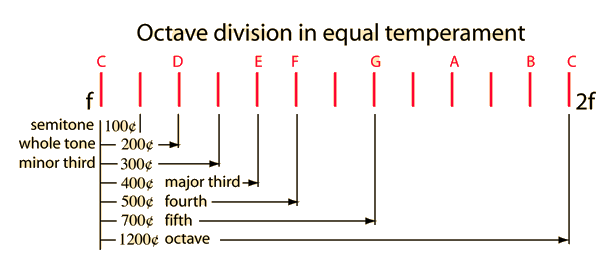
Musical intervals are often expressed in cents, a unit of pitch based upon the equal tempered octave such that one equal tempered semitone is equal to 100 cents. An octave is then 1200¢ and the other equal tempered intervals can be obtained by adding semitones:

音乐音程通常以厘音(cents)表示,这是一种基于十二平均律的音高单位,其中一个十二平均律半音等于100厘音。一个八度则为1200¢,其他十二平均律的音程可以通过添加半音来获得:

If f1 = Hz and f2 = Hz then the interval is cents.
如果 f₁ = Hz 且 f₂ = Hz,则音程为音分。
中文译文中的待填/计算数值依次对应:1:f11 2:f21 3:c1。实际数值以上方原输入框为准。

Advantages of cents
美分的优势
Mathematical expressions
数学表达式
Just noticeable difference in pitch
音调的可察觉差异
Index

Temperament and musical scales
索引 音乐的音阶与音调
 
HyperPhysics***** Sound
HyperPhysics ***** 声音
R Nave
Go Back
返回


Calculating Cents

计算美分

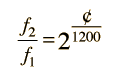
The fact that one octave is equal to 1200 cents leads one to the power of 2 relationship:

一个八度等于1200音分的事实导致了2的幂次关系:

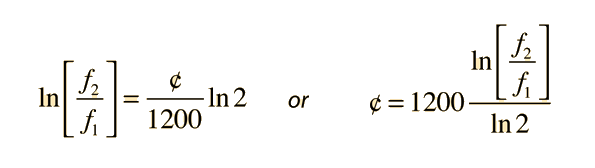
This is convenient for calculating the frequency corresponding to a certain number of cents. To calculate the number of cents for any two frequencies, the above relationship must be reversed. Taking the log of both sides gives:

这在计算对应一定音分数的频率时很方便。要计算任意两个频率对应的音分数,必须将上述关系式逆向使用。对两边取对数得到:

If f1 = Hz and f2 = Hz then the interval is cents.
如果 f₁ = Hz 且 f₂ = Hz,则音程为音分。
中文译文中的待填/计算数值依次对应:1:f12 2:f22 3:c2。实际数值以上方原输入框为准。

Advantages of cents
美分的优势
Index

Temperament and musical scales
索引 音乐的音阶与音调
 
HyperPhysics***** Sound
HyperPhysics ***** 声音
R Nave
Go Back
返回


Advantages of Cents Notation

美分符号的优势

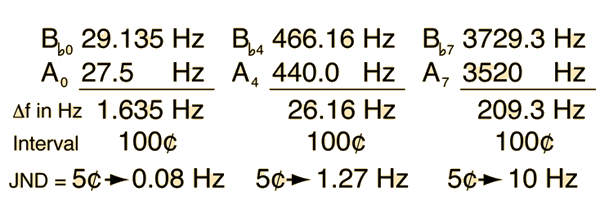
Examining the semitone A to B-flat at different points in the range of the piano will illustrate the fact that if expressed in cents, every equal tempered semitone is the same. Expressed in Hz difference, every semitone is different. The interval value in cents expresses the ratio of the frequencies, which is the same for every equal tempered semitone.

考察钢琴不同音域中的A到B降音的半音,可以说明如果以厘音(cents)来表达,每一个等音半音都是相同的。但如果以赫兹(Hz)差来表达,每一个半音都是不同的。以厘音表示的音程值表达了频率比,而这个比值对于每一个等音半音来说都是相同的。

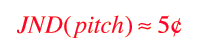
Included with the semitone intervals above is an evaluation of the deviation in Hz needed to equal 5¢, the nominal just-noticeable difference for these pitches. Note that the range represented by 5¢ increases from less than a tenth of a Hz at the low end of the piano to about 10 Hz at the top end of the piano.

上述半音音程中还包括了计算所需频率偏差的评估,该偏差需等于5¢,这是这些音高的名义可察觉差。请注意,5¢所代表的范围从钢琴低音区的不足十分之一赫兹增加到钢琴高音区的约10赫兹。

If f1 = Hz and f2 = Hz then the interval is cents.
如果 f₁ = Hz 且 f₂ = Hz,则音程为音分。
中文译文中的待填/计算数值依次对应:1:f13 2:f23 3:c3。实际数值以上方原输入框为准。

Just noticeable difference in cents
分贝的可察觉差异
Index

Temperament and musical scales
索引 音乐的音阶与音调
 
HyperPhysics***** Sound
HyperPhysics ***** 声音
R Nave
Go Back
返回


Just Noticeable Difference in Pitch

音调的可察觉差异

The just noticeable difference in pitch must be expressed as a ratio or musical interval since the human ear tends to respond equally to equal ratios of frequencies. It is convenient to express the just noticeable difference in cents since that notation was developed to express musical intervals. Although research reveals variations, a reasonable estimate of the JND is about five cents. One of the advantages of the cents notation is that it expresses the same musical interval, regardless of the frequency range.

音调的可察觉差别必须用比值或音乐音程来表达,因为人类的听觉对频率的等比变化反应相当一致。用厘音(cents)来表达可察觉差别是方便的,因为这种记法是为表达音乐音程而发展的。尽管研究显示存在一些变化,但合理的JND估计约为五厘音。厘音记法的一个优点是,它能以相同的方式表达音乐音程,无论频率范围如何。
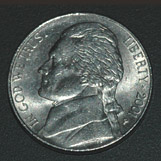
You can hear about
a nickel's worth of difference
你可以说差一分钱
More detail
更多内容
Index

Temperament and musical scales

Reference
Rossing
Science of Sound, 2nd ed.
索引、音色与音乐音阶 参考 Rossing《声音的科学》第二版
 
HyperPhysics***** Sound
HyperPhysics ***** 声音
R Nave
Go Back
返回


Pitch Details Related to Cents

音调与音分细节

Evaluating the just noticeable difference in pitch by the "nickel's worth" rule is convenient, but as you might expect it is an oversimplification. Rossing describes measurements of pitch discrimination with pure tones at about 80 dB for frequencies between 1 and 4 kHz. The jnd is found to be about 0.5% of the pure tone frequency, which corresponds to about 8¢ . He also states that the jnd has been found to depend upon the frequency, the sound level, the duration of the tone, the suddenness of the frequency change, the musical training of the listener, and the method of measurement. The real world can rarely be accurately characterized by simple rules.

通过‘镍的价值’规则评估音调的刚刚可察觉差(jnd)是方便的,但正如你可能预期的那样,这只是一个过于简化的近似。Rossing指出,对于1到4kHz之间的纯音,大约在80dB时的音调辨别测量结果。发现jnd大约是纯音频率的0.5%,这对应于约8个音分。他还认为,jnd被发现依赖于频率、声音的声压级、音的持续时间、频率变化的突然性、听者的音乐训练以及测量方法。现实世界很少能被简单的规则准确描述。

Rossing also reports that the critical bandwidth (related to loudness perception) is about 30 times the jnd for pitch, suggesting that both are related to the regions of excitation along the basilar membrane of the inner ear.

罗斯金还报告说,与响度感知相关的临界带宽大约是音调的30倍,这表明两者都与内耳基底膜上的激发区域有关。
Frequency intervals in cents
音高间隔(以厘音为单位)
Index

Temperament and musical scales

Reference
Rossing
Science of Sound, 2nd ed.
索引、音色与音乐音阶 参考 Rossing《声音的科学》第二版
 
HyperPhysics***** Sound
HyperPhysics ***** 声音
R Nave
Go Back
返回