Bilingual edition: English is preserved and Chinese follows each unit. Terminology uses the confirmed v20260916 glossary; automated semantic review remains traceable.
中英双语版:英文原文完整保留,中文紧随对应单元;术语采用 v20260916 确认表,自动语义审校结果可追溯。

The Singing Formant

鸣响共振峰

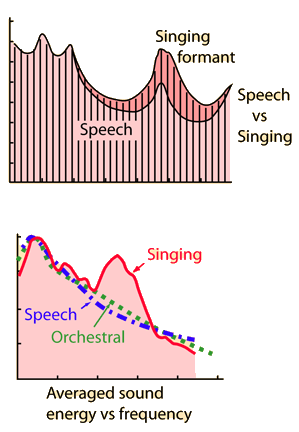
The extensive research of Johan Sundberg into the vocal production of opera singers led him to the concept of the "singing format", an additional vocal resonance associated with singing which is different from the spoken sound. This singing formant also aids the opera singer by standing out above the typical orchestral accompaniment.

约翰·松伯格对歌剧歌手发声的广泛研究使他提出了“歌唱格式”这一概念,这是一种与歌唱相关的额外共鸣,与说话声音不同。这种歌唱共振也帮助歌剧歌手在典型的管弦乐伴奏中脱颖而出。

Sundberg associates the singing formant with lowering the larynx while singing.

Sundberg 将歌唱的共振频率与歌唱时 lowering the larynx 联系起来。

You can click on either graphic at right for further details.

您可以点击右侧的任一图形以获取更多细节。
Equal tempered frequency list
等音律频率表
Index

Voice concepts

Musical instruments

Reference
Sundberg
Scientific American, March 77
索引 声学概念 音乐乐器 参考 Sundberg 科学美国人,1977年3月
 
HyperPhysics***** Sound
HyperPhysics ***** 声音
R Nave
Go Back
返回


Sung and Spoken Sounds

sung 和 spoken sounds
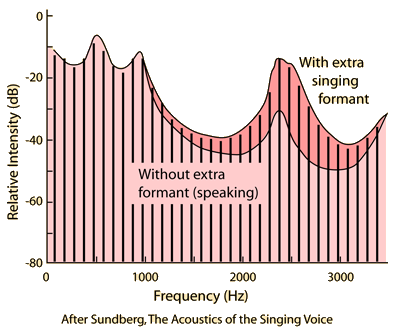
The plot (from Sundberg) shows the resonances of an electronic resonator built to mimic the human vocal tract. To illustrate the difference between spoken and sung vowel sounds, Sundberg inserted an extra formant between the third and fourth formants.
Sundberg绘制的图显示了一个模拟人类声道的电子共振器的共振峰。为了说明说话声和歌唱声元音的区别,Sundberg在第三和第四共振峰之间插入了一个额外的共振峰。
Index

Voice concepts

Musical instruments

Reference
Sundberg
Scientific American, March 77
索引 声学概念 音乐乐器 参考 Sundberg 科学美国人,1977年3月
 
HyperPhysics***** Sound
HyperPhysics ***** 声音
R Nave
Go Back
返回


Voice and Accompaniment

声音与伴奏

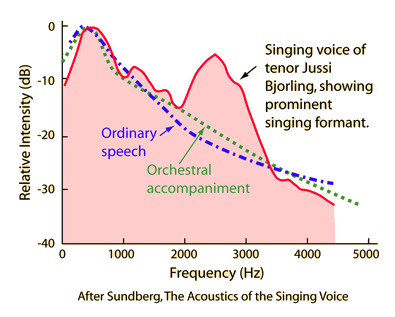
Sundberg's measurments showed that the time averaged energy distribution with frequency was very similar for speech and orchestral music, but that the singing voice exhibited a peak in the range 2000-3000 Hz. This helps the opera singer to be heard above the orchestral ammompaniment. Sundberg called this peak a singing formant.

Sundberg的测量结果表明,语音和管弦乐音乐的频率平均能量分布非常相似,但人声却在2000-3000 Hz范围内有一个峰值。这有助于歌剧歌手在管弦乐伴奏之上被听到。Sundberg将这个峰值称为歌唱共振峰。
Index

Voice concepts

Musical instruments

Reference
Sundberg
Scientific American, March 77
索引 声学概念 音乐乐器 参考 Sundberg 科学美国人,1977年3月
 
HyperPhysics***** Sound
HyperPhysics ***** 声音
R Nave
Go Back
返回


Distinguishing sounds by formant frequencies

通过共振频率区分声音
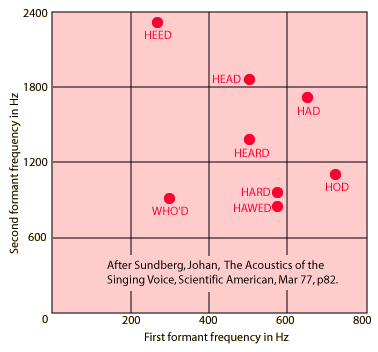
The first two formant frequencies can be considered as a kind of two dimensional space for mapping the distinguishability of two sounds. The vowel sounds which are far apart on this diagram are easy to distinguish, and those close together more difficult to distinguish.

前两个共振频率可以被视为一种二维空间,用于映射两种声音的可区分性。在该图中,相距较远的元音声音更容易区分,而相距较近的则更难区分。
How does the ear make the distinction?
耳朵是如何区分声音的?
Index

Voice concepts

Musical instruments
索引 声学概念 音乐乐器
 
HyperPhysics***** Sound
HyperPhysics ***** 声音
R Nave
Go Back
返回