Bilingual edition: English is preserved and Chinese follows each unit. Terminology uses the confirmed v20260916 glossary; automated semantic review remains traceable.
中英双语版:英文原文完整保留,中文紧随对应单元;术语采用 v20260916 确认表,自动语义审校结果可追溯。

Same Vowel, Different Pitch

同元音,不同音调

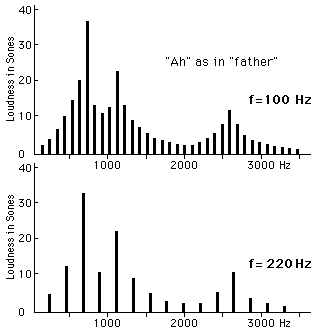
To explain how the ear can recognize a vowel sound as the same vowel, even though it is sounded at different pitches, the idea of vocal formants is invoked. This is data from Benade showing that an "Ah" vowel involves a similar envelope of harmonics when sounded at different frequencies.

为了说明耳朵如何在不同音高下仍能识别同一元音声音,引入了声学共振的概念。这是Benade提供的数据,显示不同频率下发出的‘啊’音其谐波包络线相似。

Stemple, et al., report a mean fundamental frequency for male voices of 106 Hz with a range from 77 Hz to 482 Hz. For female voices the mean was 193 Hz with a range from 137 Hz to 634 Hz. These averages were based on the production of a sustained vowel /a/ .

Stemple 等人报告,男性声音的平均基频为 106 Hz,范围从 77 Hz 到 482 Hz。女性声音的平均基频为 193 Hz,范围从 137 Hz 到 634 Hz。这些平均值是基于发音持续的元音 /a/ 获得的。
Fundamental frequencies for speech
语音的基本频率
Index

Voice concepts

Musical instruments

Reference
Benade
Ch. 19

Stemple, et al.
索引 声学概念 音乐乐器 参考 Benade 第19章 Stemple 等
 
HyperPhysics***** Sound
HyperPhysics ***** 声音
R Nave
Go Back
返回


Same Vowel, Different Pitch

同元音,不同音调

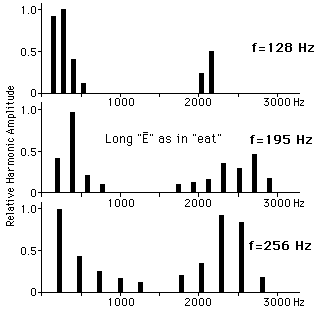
To explain how the ear can recognize a vowel sound as the same vowel, even though it is sounded at different pitches, the idea of vocal formants is invoked. This is data from Backus showing that an "EE" vowel involves a similar envelope of harmonics when sounded at different frequencies. Formants occur at about 300 Hz and about 2300 Hz for each sound.

为了说明耳朵如何在不同音高下仍能识别同一元音声音,引入了声学共振的概念。Backus提供的数据显示,即使在不同频率下,'EE'元音的谐波包络相似。共振频率大约在300 Hz和2300 Hz处出现。

Stemple, et al., report a mean fundamental frequency for male voices of 106 Hz with a range from 77 Hz to 482 Hz. For female voices the mean was 193 Hz with a range from 137 Hz to 634 Hz. These averages were based on the production of a sustained vowel /a/ .

Stemple 等人报告,男性声音的平均基频为 106 Hz,范围从 77 Hz 到 482 Hz。女性声音的平均基频为 193 Hz,范围从 137 Hz 到 634 Hz。这些平均值是基于发音持续的元音 /a/ 获得的。
Fundamental frequencies for speech
语音的基本频率
Index

Voice concepts

Musical instruments

Reference
Backus

Stemple, et al.
索引 声学概念 音乐乐器 参考 Backus Stemple 等
 
HyperPhysics***** Sound
HyperPhysics ***** 声音
R Nave
Go Back
返回


Distinguishing Vowel Sounds

区分元音音素

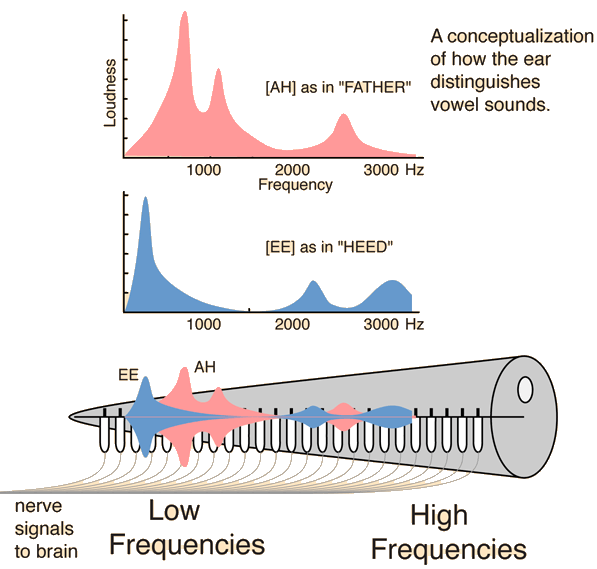
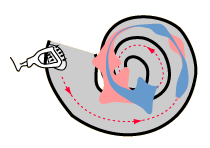
To explain how the ear can recognize different vowel sounds, the idea of vocal formants is invoked. This is a conceptualization only; no scaling to the inner ear was done. The place theory suggests that the ear distinguishes pitches based on the location of maximum excitation along the basilar membrane of the inner ear. So the ear acts as a sound analyzer which can detect differences in harmonic content by the different amounts of excitation at different places along the basilar membrane. Since sustained vowel sounds differ primarily in their harmonic content, this offers a mechanism by which the ear can distinguish them.

为了说明耳朵如何区分不同的元音声音,引入了‘共鸣峰’的概念。这是一种概念性的解释;并未对内耳进行任何缩放。位置理论认为,耳朵通过内耳基底膜上最大激发位置来区分音高。因此,耳朵像一个声音分析器,能够通过基底膜上不同位置的激发量差异来检测谐波成分的差异。由于持续的元音声音主要差异在于其谐波成分,这为耳朵区分这些声音提供了一种机制。
Displays of vowel sounds vs time and frequency
元音音素的显示与时间和频率的关系
Another example with plotted harmonic content
另一个带有绘制谐波内容的例子
Distinguishability based on first two formants
基于前两个共振峰的可区分性
Index

Voice concepts

Musical instruments
索引 声学概念 音乐乐器
 
HyperPhysics***** Sound
HyperPhysics ***** 声音
R Nave
Go Back
返回


Fundamental Frequencies for Speech

语音的基本频率

A number of studies of fundamental frequencies for speech have been conducted. Such frequencies are different for men and women and change with age. There are also differences between ethnic groups.

关于语音基本频率的研究已经开展了许多。这些频率因性别不同而有所差异,并随年龄变化。此外,不同民族群体之间也存在差异。

An interesting study of the speaking pitch of a group of women over a 48 year time span was made by Russell, Penny and Pemberton. They had high quality recordings from 28 young women between the ages of 18 and 25, made in 1945. They were able to find 15 of them in 1993 and recorded them reading the same passages. They found that the group mean speaking fundamental frequency in 1945 was 229.0 Hz and in 1993 was 181.2 Hz. From Russell, A., Penny, L. and Pemberton, C., Speaking fundamental frequency changes over time in women: A longitudinal study, Journal of Speech and Hearing Research 38, 101-109 (1995)

一项有趣的研究显示,Russell、Penny和Pemberton对一组女性在48年时间跨度内的说话音调进行了研究。他们于1945年录制了28名年龄在18至25岁的年轻女性的高质量录音。他们于1993年找到了其中15人,并让他们阅读相同的段落进行录制。他们发现,1945年该群体的平均说话基频为229.0 Hz,而1993年则为181.2 Hz。参考Russell, A., Penny, L. and Pemberton, C., 女性说话基频随时间变化:一项纵向研究,Journal of Speech and Hearing Research 38, 101-109 (1995)。
Age range
年龄范围
Frequency (Hz)
频率 (赫兹)
20-29
119.5
30-39
112.2
40-49
107.1
50-59
118.4
60-69
112.2
70-79
132.2
80-89
146.3

A study of the speaking frequency of different groups of men of different ages was conducted by Hollien & Shipp. They collected 25 men from each decade of age and asked all of them to read a specified paragraph from the same book. They concluded that there was a lowering of the speaking pitch through early and middle adulthood and then a rising frequency into later life. Hollien, H. and Shipp, T, Speaking fundamental frequency and chronological age in males, Journal of Speech and Hearing Research 15, 155-159 (1972).

对不同年龄组男性说话频率的研究由Hollien与Shipp进行。他们从每个年龄阶段中各收集了25名男性,并让所有受试者朗读同一本书中的指定段落。他们得出结论,男性在早年和中年时期说话的音调会降低,而在晚年则会上升。Hollien, H. 和 Shipp, T.,《男性说话基本频率与年龄关系》,《言语与听力研究杂志》15,155-159(1972)。
Index

Voice concepts

Musical instruments

Reference
Benade
Ch. 19

Stemple, et al.
索引 声学概念 音乐乐器 参考 Benade 第19章 Stemple 等
 
HyperPhysics***** Sound
HyperPhysics ***** 声音
R Nave
Go Back
返回