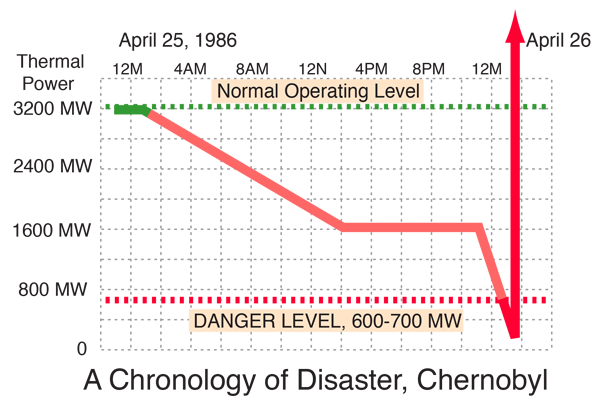
Chernobyl Chronology
切尔诺贝利时间线
1. The reactor was powered down for a test sequence to determine if one of the turbogenerators could supply power to feedwater pumps until standby diesel generators came on line in the case of a local power failure. The test sequence involved the following dangerous steps
反应堆为进行一次测试序列,以确定其中一台涡轮发电机能否在局部停电时为给水泵供电,直到备用柴油发电机投入运行。该测试序列涉及以下危险步骤
a. Instead of the design based 22-32% full power, the power was inadvertantly lowered to 1% of full power, an extremely unstable situation because of the positive void coefficient. Edwards reports that the operator failed to reprogram the computer to maintain power at 700-1000 MW(t).
代替基于22-32%满功率的设计,功率被无意中降低到满功率的1%,这是一个极其不稳定的状况,因为正的空泡系数。爱德华斯报告说,操作员未能重新编程计算机以保持功率在700-1000 MW(t)。
b. Essentially all the control rods were pulled out of the core, to the point where they could not shut down the reactor rapidly if needed. This step was taken to get the power back up, but it only reached 7%, still well below the design parameters for the test. The reason the power could not be brought back up was the "xenon trapping" or "xenon poisoning" effect. Xenon is a decay product of I-135 and is a strong neutron absorber which "poisons" the fission reaction. It reaches an equilibrium at normal operating power levels by being "burned away" by neutron absorption and further decay. When the power level was decreased from the 1600 MW level, you had lots of I-135 to decay into xenon, but a small neutron flux with which to burn it away, so it built up rapidly. Excellent description of this by Kress on pg 45. Good one paragraph summary of accident on p46.
b. 几乎所有的控制棒都被抽出核心,到了无法迅速关闭反应堆的程度。这一步是为了将功率重新提升起来,但仅达到了7%,仍远低于测试的设计参数。功率无法提升的原因是“氙 trapping”或“氙 poisoning”效应。氙是碘-135的衰变产物,是一种强中子吸收体,它会“毒害”裂变反应。在正常运行功率水平下,氙会达到平衡,因为它会被中子吸收和进一步衰变而“消耗掉”。当功率水平从1600 MW降低时,有大量的碘-135衰变成氙,但中子通量却很小,无法有效消耗它,因此氙迅速积累。Kress在第45页对此有 excellent 的描述。事故的简要总结见第46页。
c. In order to keep the reactor from automatically shutting down under these conditions, they had to disconnect the emergency core cooling system and several of the automatic scram circuits.
为了防止反应堆在这些条件下自动停堆,他们不得不断开应急冷却系统和几个自动停堆电路。
d. All eight cooling water pumps were running at the low power, compared to a normal six even at full power, so there was nearly solid water with almost no void fraction, which increased the vulnerability to any power excursion which produced boiling.
d. 八台冷却水泵在低功率下运行,即使在满功率下,正常情况下也只有六台运行,因此几乎全是水,几乎没有汽泡份额,这增加了任何功率波动引发沸腾的脆弱性。
2. The turbogenerator was tripped to initiate the test, which caused the switching off of four of the eight recirculation pumps. (This would have scrammed the reactor if the automatic scram circuit had not been disconnected.)
涡轮发电机被跳闸以启动测试,这导致八台循环泵中有四台停止运行。(如果自动跳闸电路没有被断开,这将导致反应堆停堆。)
3. Reduced coolant flow caused voids to form rapidly in the pressure tubes, increasing reactivity because of the positive void coefficient.
3. 减少的冷却剂流量使压力管中迅速形成空洞,导致反应性增加,因为存在正的空泡系数。
4. Within seconds, with rapidly rising power, an emergency manual scram was ordered, but the almost fully withdrawn rods could not insert negative reactivity fast enough because of their slow speed. Also, an unexpected displacement of water from the control rod tubes occurred, further adding to the positive reactivity.
数秒内,随着功率迅速上升,下令进行手动紧急停堆,但几乎已完全抽出的控制棒无法快 enough 插入负反应性,因为它们的速度太慢。此外,控制棒管路中水的意外位移也进一步增加了正反应性。
5. The core went to prompt criticality, overheating and shattering fuel rods and flashing the coolant into steam. Fuel channels were ruptured.
核心达到临界状态,导致过热并使燃料棒破碎,冷却剂瞬间汽化。燃料通道破裂。
6. Steam pressure blew the 1000-ton steel- and cement-filled biologic shield off the top of the reactor, severing all pressure tubes(some 1600 of them) and exposing the hot core to the atmosphere. Edwards says power reached 100 times operating maximum and the explosive force was about 1 ton of TNT.
6. 蒸汽压力将重达1000吨的钢和水泥填充生物屏蔽层从反应堆顶部吹离,切断了所有压力管(有些共1600根),并使炽热的核芯暴露在大气中。埃德华兹说,功率达到运行最大值的100倍,爆炸力约为1吨TNT。
Soviet scientist Legasov said of the violations of the safety restrictions "It was like airplane pilots experimenting with the engines in flight." The ORNL review says that if the operators had failed to complete the test they could not have repeated it for a year. This probably influenced them to take more risks than normal.
苏联科学家莱加索夫说,违反安全限制的行为“就像飞机飞行员在飞行中试验引擎一样”。ORNL的审查指出,如果操作人员未能完成测试,他们一年内都无法重复该测试。这可能促使他们比平时承担更大的风险。
|