Control Rods for Fission Reactors裂变反应堆中的控制棒
Since the continued chain reaction of a nuclear fission reactor depends upon at least one neutron from each fission being absorbed by another fissionable nucleus, the reaction can be controlled by using control rods of material which absorbs neutrons. Cadmium and boron are strong neutron absorbers and are the most common materials used in control rods. A typical neutron absorption reaction in boron is 由于核裂变反应堆中的链式反应能否持续取决于每个裂变反应至少有一个中子被另一个可裂变核吸收,因此可以通过使用吸收中子的控制棒来控制反应。镉和硼是强中子吸收材料,是控制棒中最常用的材料。硼中的典型中子吸收反应为

![]() In the operation of a nuclear reactor, fuel assemblies are put into place and then the control rods are slowly lifted until a chain reaction can just be sustained. As the reaction proceeds, the number of uranium-235 nuclei decreases and fission by-products which absorb neutrons build up. To keep the chain reaction going, the control rods must be withdrawn further. At some point, the chain reaction cannot be maintained and the fuel must be replenished. 在原子反应堆运行过程中,燃料组件被安装到位,然后控制棒被缓慢抽出,直到链式反应刚刚能够维持。随着反应的进行,铀-235核子的数量减少,而由裂变产物吸收中子的数量增加。为了维持链式反应,控制棒必须进一步抽出。在某个时刻,链式反应无法维持,燃料必须得到补充。
|
Index Fission concepts 索引 裂变概念 | ||
|
Go Back
返回 |
Generation Time for Fission裂变的世代时间
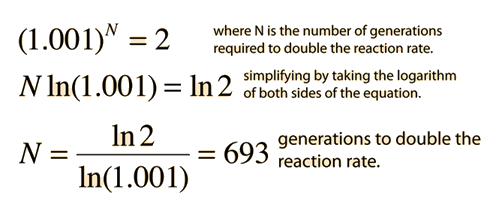
The average time for a neutron emitted in one fission to cause another fission is called the generation time. This generation time, along with the reproduction constant k for the reactor configuration, determines the time required to double the reaction rate. For example, if the reproduction constant were k=1.001, then to double the reaction rate would require 中子在一次裂变中发出后引发另一次裂变的平均时间称为生成时间。这种生成时间,加上反应堆配置的繁殖常数k,决定了使反应率翻倍所需的时间。例如,如果繁殖常数为k=1.001,那么要使反应率翻倍就需要
![]() Now if the generation time for the fission is 0.001 seconds, the time to double the rate would be 现在如果裂变的生成时间是0.001秒,那么速率翻倍所需的时间就是
Not much time to respond to a power surge! This is modified significantly by inclusion of the delayed neutrons. 没什么时间应对一次功率浪涌!这在考虑了延迟中子的影响后发生了显著变化。
倍增时间 = (693)(0.001s) = 0.693 秒 |
Index Fission concepts 索引 裂变概念 | ||
|
Go Back
返回 |
Reproduction Constant for Fission裂变分裂常数
The reproduction constant k for a nuclear fission process is defined as the average number of neutrons from each fission which subsequently cause another fission. For U-235 fission the average number of neutrons emitted is 2.4, so the maximum reproduction constant would be 2.4. While the highly enriched uranium-235 for weapons applications arranged in an optimum geometry might approach that, the reproduction constant is greatly diminished in nuclear reactors by the fact that the fuel is only about 2-3% U-235. For power reactors the reproduction constant is kept just above 1. A reactor configuration with a reproduction constant of 1 is said to be critical. 铀-235裂变过程的繁殖常数k定义为每个裂变事件平均产生并引发另一次裂变的中子数。对于铀-235裂变,平均释放的中子数为2.4,因此最大繁殖常数为2.4。虽然用于武器应用的高浓缩铀-235在最优几何排列下可能接近这个值,但核反应堆中由于燃料仅含有约2-3%的铀-235,繁殖常数会大大降低。对于功率反应堆,繁殖常数被保持在略高于1的水平。繁殖常数为1的反应堆配置被称为临界。
|
Index Fission concepts 索引 裂变概念 | ||
|
Go Back
返回 |
Delayed Neutron Effect延迟中子效应
The doubling time of a nuclear fission reaction is a reasonable measure of the response time within which reactor safety devices would have to react to some kind of emergency. This doubling time is determined by the reproduction constant of the reactor configuration and the generation time of the fission process. One margin of safety in the kinds of nuclear power reactors used in the U.S. and Canada comes from the fact that in their operating range they are only critical with the inclusion of the delayed neutrons. The effect this has on the doubling time can be seen in the following example. For k = 1.001 , it takes 693 generations to double the rate, and at generation time of 0.001 s, the doubling time is 0.693 seconds. If .65% of the neutrons are delayed by an average of 14 seconds, the doubling time is increased by almost a factor of a hundred to 核裂变反应的倍增时间是衡量反应堆安全装置在发生某种紧急情况时必须响应的时间的一个合理指标。这个倍增时间由反应堆配置的繁殖常数和裂变过程的世代时间决定。在美国和加拿大使用的核功率反应堆中,一种安全余量来自于它们在运行范围内仅在包含延迟中子时才处于临界状态。这种影响可以在以下例子中看到。对于k = 1.001,需要693个世代才能使反应率翻倍,当世代时间为0.001秒时,倍增时间是0.693秒。如果65%的中子平均延迟14秒,倍增时间会增加到几乎一百倍,即
which is sufficient time for mechanical controls to respond. For example, the Three Mile Island safety devices had shut down the reactor within 9 seconds of the event which triggered the accident. 这足以让机械控制装置做出响应。例如,三里岛安全装置在事故发生后9秒内就将反应堆停机。
693 ((0.9935)(0.001s) + (0.0065)(14s)) = 63.8 秒 |
Index Fission concepts 索引 裂变概念 | ||
|
Go Back
返回 |