Bilingual edition: English is preserved and Chinese follows each unit. Terminology uses the confirmed v20260916 glossary; automated semantic review remains traceable.
中英双语版:英文原文完整保留,中文紧随对应单元;术语采用 v20260916 确认表,自动语义审校结果可追溯。

Nuclear Fission

核裂变

If a massive nucleus like uranium-235 breaks apart (fissions), then there will be a net yield of energy because the sum of the masses of the fragments will be less than the mass of the uranium nucleus. If the mass of the fragments is equal to or greater than that of iron at the peak of the binding energy curve, then the nuclear particles will be more tightly bound than they were in the uranium nucleus, and that decrease in mass comes off in the form of energy according to the Einstein equation. For elements lighter than iron, fusion will yield energy.
如果一个像铀-235这样的重核裂变(裂解),则会产生净能量释放,因为碎片的总质量将小于铀核的质量。如果碎片的质量等于或大于铁在结合能曲线顶点处的质量,则核粒子的结合将比铀核中的更紧密,这种质量的减少会以能量的形式根据爱因斯坦方程释放出来。对于比铁轻的元素,聚变将产生能量。

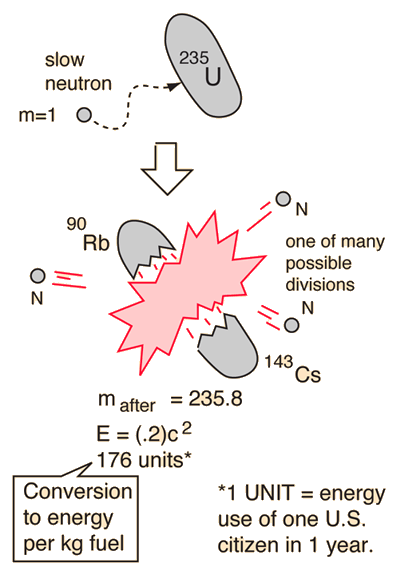
The fission of U-235 in reactors is triggered by the absorption of a low energy neutron, often termed a "slow neutron" or a "thermal neutron". Other fissionable isotopes which can be induced to fission by slow neutrons are plutonium-239, uranium-233, and thorium-232.

铀-235在反应堆中的裂变是由低能量中子的吸收触发的,通常称为'慢中子'或'热中子'。其他可以通过慢中子引发裂变的裂变同位素包括钚-239、铀-233和钍-232。
Uranium-235 Fission
铀-235裂变
Index

Fission concepts
索引 裂变概念
 
HyperPhysics***** Nuclear
HyperPhysics ***** 核物理
R Nave
Go Back
返回


Uranium-235 Fission

铀-235裂变

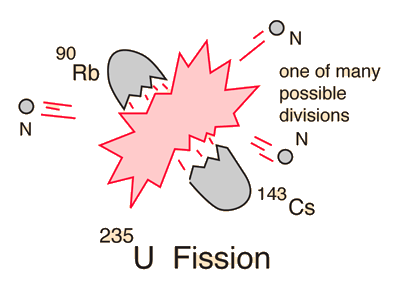
In one of the most remarkable phenomena in nature, a slow neutron can be captured by a uranium-235 nucleus, rendering it unstable toward nuclear fission. A fast neutron will not be captured, so neutrons must be slowed down by moderation to increase their capture probability in fission reactors. A single fission event can yield over 200 million times the energy of the neutron which triggered it!

在自然界中最引人注目的现象之一中,一个慢中子可以被铀-235核捕获,使其趋向于发生核裂变。快中子不会被捕获,因此必须通过减速来提高中子在裂变反应堆中被捕获的概率。一次裂变事件可以释放出超过200百万倍于触发它的中子的能量!
More detailed illustration
更详细的说明
Comparison with fusion
与熔化相比
Some history.
一些历史
Detailed energy release calculation
详细能量释放计算
Index

Fission concepts
索引 裂变概念
 
HyperPhysics***** Nuclear
HyperPhysics ***** 核物理
R Nave
Go Back
返回


Uranium Fuel

铀燃料

Natural uranium is composed of 0.72% U-235 (the fissionable isotope), 99.27% U-238, and a trace quantity 0.0055% U-234 . The 0.72% U-235 is not sufficient to produce a self-sustaining critical chain reaction in U.S. style light-water reactors, although it is used in Canadian CANDU reactors. For light-water reactors, the fuel must be enriched to 2.5-3.5% U-235.

天然铀由0.72%的铀-235(裂变同位素)、99.27%的铀-238以及痕量的0.0055%的铀-234组成。尽管0.72%的铀-235不足以在美式轻水反应堆中产生自持的链式反应,但它被用于加拿大的CANDU反应堆。对于轻水反应堆而言,燃料必须富集到2.5-3.5%的铀-235。

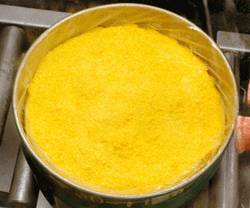
Uranium is found as uranium oxide which when purified has a rich yellow color and is called "yellowcake". After reduction, the uranium must go through an isotope enrichment process. Even with the necessity of enrichment, it still takes only about 3 kg of natural uranium to supply the energy needs of one American for a year.

铀以氧化铀的形式存在,纯化后呈丰富的黄色,称为'黄饼'。经过还原后,铀必须经过同位素富集过程。即使需要富集,仅需约3公斤天然铀就能满足美国一人一年的能量需求。
Index
索引
 
HyperPhysics***** Nuclear
HyperPhysics ***** 核物理
R Nave
Go Back
返回


Fissionable Isotopes

裂变同位素

While uranium-235 is the naturally occuring fissionable isotope, there are other isotopes which can be induced to fission by neutron bombardment. Plutonium-239 is also fissionable by bombardment with slow neutrons, and both it and uranium-235 have been used to make nuclear fission bombs. Plutonium-239 can be produced by "breeding" it from uranium-238. Uranium-238, which makes up 99.3% of natural uranium, is not fissionable by slow neutrons. U-238 has a small probability for spontaneous fission and also a small probability of fission when bombarded with fast neutrons, but it is not useful as a nuclear fuel source. Some of the nuclear reactors at Hanford, Washington and the Savannah-River Plant (SC) are designed for the production of bomb-grade plutonium-239. Thorium-232 is fissionable, so could conceivably be used as a nuclear fuel. The only other isotope which is known to undergo fission upon slow-neutron bombardment is uranium-233.

虽然铀-235是天然存在的裂变同位素,但还有其他同位素可以通过中子轰击引发裂变。钚-239也可以通过慢中子轰击发生裂变,而且它和铀-235都被用来制造核裂变弹。钚-239可以通过‘增殖’从铀-238中产生。占天然铀99.3%的铀-238不能被慢中子引发裂变。铀-238有很小的自发裂变概率,也能在被快中子轰击时发生裂变,但不适合作为核燃料。华盛顿州汉福德和萨凡纳河工厂(SC)的一些核反应堆设计用于生产武器级钚-239。钍-232是裂变的,因此可能被用作核燃料。已知能被慢中子轰击引发裂变的唯一其他同位素是铀-233。
Nuclear fission
裂变
Index
索引
 
HyperPhysics***** Nuclear
HyperPhysics ***** 核物理
R Nave
Go Back
返回


History of U-235 Fission

铀-235裂变史

In the 1930s, German physicists/chemists Otto Hahn and Fritz Strassman attempted to create transuranic elements by bombarding uranium with neutrons. Rather than the heavy elements they expected, they got several unidentified products. When they finally identified one of the products as Barium-141, they were reluctant to publish the finding because it was so unexpected. When they finally published the results in 1939, they came to the attention of Lise Meitner, an Austrian-born physicist who had worked with Hahn on his nuclear experiments. Upon Hitler's invasion of Austria, she had been forced to flee to Sweden where she and Otto Frisch, her nephew, continued to work on the neutron bombardment problem. She was the first to realize that Hahn's barium and other lighter products from the neutron bombardment experiments were coming from the fission of U-235. Frisch and Meitner carried out further experiments which showed that the U-235 fission yielded an enormous amount of energy, and that the fission yielded at least two neutrons per neutron absorbed in the interaction. They realized that this made possible a chain reaction with an unprecedented energy yield.

20世纪30年代,德国物理学家/化学家奥托·哈恩和弗里茨·施特拉斯曼试图通过用中子轰击铀来制造超铀元素。然而,他们得到的并非预期的重元素,而是几种未鉴定的产物。当他们最终将其中一种产物识别为钡-141时,他们不愿发表这一发现,因为这一结果非常意外。直到1939年他们才发表结果,这一发现引起了奥地利出生的物理学家莉泽·梅特纳的注意,她曾与哈恩一起进行核实验。当希特勒入侵奥地利时,她被迫逃往瑞典,在那里她与侄子奥托·弗里希继续研究中子轰击问题。她首先意识到,哈恩的钡及其他较轻产物来自铀-235的裂变。弗里希和梅特纳进行了进一步的实验,证明铀-235裂变释放出大量能量,并且每次中子被吸收在相互作用中会产生至少两个中子。他们意识到这使得一种链式反应成为可能,这种反应具有前所未有的能量释放。
Index
索引
 
HyperPhysics***** Nuclear
HyperPhysics ***** 核物理
R Nave
Go Back
返回