The Most Tightly Bound Nuclei
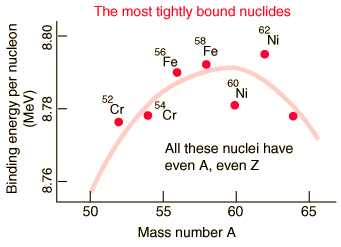
The most tightly bound of the nuclei is 62Ni, a case made convincingly by M. P. Fewell in an article in the American Journal of Physics. Though the championship of nuclear binding energy is often attributed to 56Fe, it actually comes in a close third. The four most tightly bound nuclides are listed in the table below with a tabulation of the binding energy B divided by the mass number A. The curve adapted from Fewell shows those nuclides that are close to the peak.
Wapstra 和 Bos 的数据 |
|
The most tightly bound nuclides are all even-even nuclei. The curve drawn through the cluster of nuclei above is just to show the nature of the trend with mass number. A similar kind of trend is observed with even-odd nuclides at a lower range of binding energy, and then by odd-odd nuclei at the least-bound extreme. The peaks of all three groups occur around A = 60.
The high binding energy of this group of elements around A=60, typically called "the iron group" by astrophysicists, is significant in the understanding of the synthesis of heavy elements in the stars. It is curious that the abundance of 56Fe is an order of magnitude higher than that of 62Ni. Fewell discusses this point, and indicates that the reason lies with the greater photodisintegration rate for 62Ni in stellar interiors.
| Binding energy curve.
结合能曲线。 | Nuclear units.
核单位。 |
Nuclear Structure Concepts
Reference
Fewell, M. P.
| HyperPhysics***** Nuclear
HyperPhysics ***** 核物理 | R Nave |