Bilingual edition: English is preserved and Chinese follows each unit. Terminology uses the confirmed v20260916 glossary; automated semantic review remains traceable.
中英双语版:英文原文完整保留,中文紧随对应单元;术语采用 v20260916 确认表,自动语义审校结果可追溯。

Some Nuclear Units

一些核单位

Nuclear energies are very high compared to atomic processes, and need larger units. The most commonly used unit is the MeV.

核能比原子过程高得多,需要更大的单位。最常用的单位是MeV。
1 electron volt = 1eV = 1.6 x 10⁻¹⁹ joules
1 MeV = 106 eV; 1 GeV = 109 eV; 1 TeV = 1012 eV

However, the nuclear sizes are quite small and need smaller units:

然而,核的尺寸相当小,需要更小的单位:
Atomic sizes are on the order of 0.1 nm = 1 Angstrom = 10-10 m
Nuclear sizes are on the order of femtometers which in the nuclear context are usually called fermis:

1 fm = 10-15m

Atomic masses are measured in terms of atomic mass units with the carbon-12 atom defined as having a mass of exactly 12 amu. It is also common practice to quote the rest mass energy E=m0c2 as if it were the mass. The conversion to amu is:

原子质量以原子质量单位(amu)来测量,碳-12原子被定义为具有恰好12 amu的质量。也常将静止质量能量 E = m₀c² 作为质量来引用。转换到amu为:
1 u = 1.66054 x 10⁻²⁷ kg = 931.494 MeV


Electron volt definition
电子伏特定义
Energies in electron volts.
电子伏特中的能量。
1 电子伏特 = 1eV = 1.6 × 10⁻¹⁹ 焦耳;1 兆电子伏特 = 10⁶ eV;1 吉电子伏特 = 10⁹ eV;1 泰电子伏特 = 10¹² eV。原子尺寸约为 0.1 纳米 = 1 埃 = 10⁻¹⁰ 米。核尺寸约为费米,而在核物理中通常称为费米:1 费米 = 10⁻¹⁵ 米。1 原子质量单位 = 1.66054 × 10⁻²⁷ 千克 = 931.494 兆电子伏特。
Index
索引
 
HyperPhysics***** Nuclear
HyperPhysics ***** 核物理
R Nave
Go Back
返回


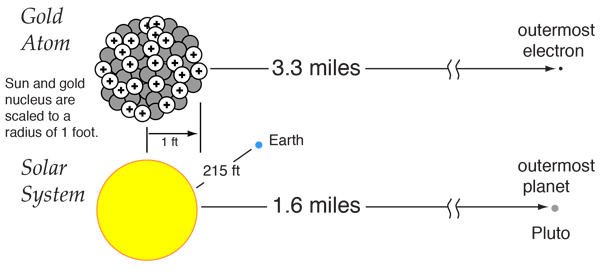
Relative scale model of an atom and the solar system

原子与太阳系的相对比例模型

Do you perceive a gold ring to contain a larger fraction of solid matter than the solar system?

你认为黄金戒指中的固体物质所占比例比太阳系大吗?

On this scale, the nearest star would be a little over 10,000 miles away.

在这个尺度上,最近的恒星距离我们略超过10000英里。
Model data
模型数据
Nuclear size.
核尺寸
How does such a compact nucleus stay together?
这样的紧凑核如何保持在一起?
Index

Nuclear Structure Concepts
核素结构概念
 
HyperPhysics***** Nuclear
HyperPhysics ***** 核物理
R Nave
Go Back
返回


Data for Scale Model of Atom

原子尺度模型的数据
A. GOLD ATOM
      Nuclear density = 2 x 10¹⁷ kg/m3
      Density of solid gold = 19.32 gm/cm3
      Atomic mass = 196.97 amu (1 mole = 196.97 grams)
      1 amu = 1.66 x 10⁻²⁷ kg
      Avogadro's number = 6.02 x 10²³ atoms/mole
      Calculated atomic radius = 1.3 x 10⁻¹⁰ m
      Calculated nuclear radius = 7.3 x 10⁻¹⁵ m
B. SOLAR SYSTEM
      Radius of Sun = 432,000 miles = 695,000 km
      Radius of Earth = 3963 miles = 6376 km
      Sun-Earth distance = 93 x 106 miles = 150 x 106 km
      Sun-Pluto distance = 3666 x 106 miles = 5900 x 106 km


Model sketch
模型草图
Nuclear size and density.
核尺寸与密度。
A. 金原子核密度 = 2 × 10¹⁷ kg/m³ 固态金的密度 = 19.32 克/立方厘米 原子质量 = 196.97 amu(1 摩尔 = 196.97 克)1 amu = 1.66 × 10⁻²⁷ kg 阿伏伽德罗常数 = 6.02 × 10²³ 个/摩尔 计算得到的原子半径 = 1.3 × 10⁻¹⁰ 米 计算得到的核半径 = 7.3 × 10⁻¹⁵ 米 B. 太阳系 太阳半径 = 432,000 英里 = 695,000 公里 地球半径 = 3963 英里 = 6376 公里 地球-太阳距离 = 93 × 10⁶ 英里 = 150 × 10⁶ 公里 太阳-冥王星距离 = 3666 × 10⁶ 英里 = 5900 × 10⁶ 公里
Index
索引
 
HyperPhysics***** Nuclear
HyperPhysics ***** 核物理
R Nave
Go Back
返回


Nuclear Size and Density

核尺寸与密度

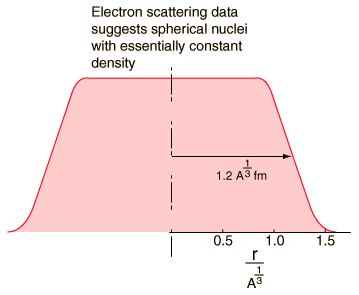
Various types of scattering experiments suggest that nuclei are roughly spherical and appear to have essentially the same density. The data are summarized in the expression called the Fermi model:

各种散射实验表明,核大致是球形的,并且似乎具有几乎相同的密度。这些数据总结在称为费米模型的表达式中:

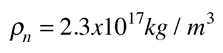
where r is the radius of the nucleus of mass number A. The assumption of constant density leads to a nuclear density

其中 r 是质量数为 A 的核的半径。假设密度恒定会导致核密度

For mass number
A =
this gives
r = x10^ m
r = fermi.
对于质量数A = 这给出了r = x10^m r = 费米。
中文译文中的待填/计算数值依次对应:1:a 2:rb 3:rp 4:rf。实际数值以上方原输入框为准。

The most definitive information about nuclear sizes comes from electron scattering. The comparison of calculated and experimental radii for nuclei are very sensitive to the exact onset of the overlap between the probe particle and the nuclear matter. These comparisons have made it clear that there is a "tail" where the density of nuclear matter decreases toward zero. The nucleus is not a hard sphere. Krane comments that the evidence points to a mass radius and a charge radius which agree with each other within about 0.1 fermi. Since heavy nuclei have about 50% more neutrons than protons, one might expect a mass radius larger than the charge radius. One can visualize the protons being pushed toward the outside by the proton repulsion and the neutrons being pulled inward by the neutron-proton attraction, so the observed result agrees with what one might expect with this kind of model.

关于核尺寸的最确切信息来自电子散射。核的计算半径与实验半径的比较对探针粒子与核物质重叠的起始点非常敏感。这些比较表明,核物质密度在接近零时有一个‘尾部’下降。核并不是一个刚性球体。Kranе指出,证据表明质量半径和电荷半径在约0.1费米范围内一致。由于重核中中子数比质子数多约50%,人们可能会预期质量半径大于电荷半径。可以想象质子因质子间的排斥力被推到外面,而中子则因中子-质子吸引力被拉向内,因此观测结果与这种模型预期的结果一致。
Scale model of nucleus
原子核比例模型
Implications about the strong force
关于强力的含义
Index

Nuclear Structure Concepts

Reference
Krane
Ch. 3
索引 核结构概念 参考 Krane 第3章
 
HyperPhysics***** Nuclear
HyperPhysics ***** 核物理
R Nave
Go Back
返回


Nuclear Density and the Strong Force

核密度与强力

The fact that the nuclear density seems to be independent of the details of neutron number or proton number implies that the force between the particles is essentially the same whether they are protons or neutrons. This correlates with other evidence that the strong force is the same between any pair of nucleons.

核密度似乎与中子数或质子数的细节无关,这表明粒子之间的力无论它们是质子还是中子都是基本相同的。这与其他证据一致,即强力在任何两个核子之间都是相同的。
Model sketch
模型草图
Nuclear size and density.
核尺寸与密度。
Index
索引
 
HyperPhysics***** Nuclear
HyperPhysics ***** 核物理
R Nave
Go Back
返回


Nuclear Particles

核粒子

Nuclei are made up of protons and neutrons bound together by the strong force. Both protons and neutrons are referred to as nucleons. The number of protons is called the atomic number and determines the chemical element. Nuclei of a given element (same atomic number) may have different numbers of neutrons and are then said to be different isotopes of the element.

原子核由质子和中子通过强力结合在一起,质子和中子统称为核子。质子的数量称为原子序数,决定了化学元素。同一元素的原子核(相同的原子序数)可能有不同数量的中子,因此被称为该元素的不同同位素。
Model sketch
模型草图
Nuclear size and density.
核尺寸与密度。
Index
索引
 
HyperPhysics***** Nuclear
HyperPhysics ***** 核物理
R Nave
Go Back
返回