Water Droplet Diffraction
To make the distinction between diffraction and refraction effects in the atmosphere, consider what size droplet would be necessary to produce diffraction at 22° to coincide with the 22° halo. The calculation illustrated below models the diffraction with the presumption that a small drop of water would diffract like a circular aperture. The green wavelength 500nm was chosen to model diffraction, and the circular aperture calculation was used to obtain the droplet size 2.18 microns to put the first maximum outside the central peak at 22° .
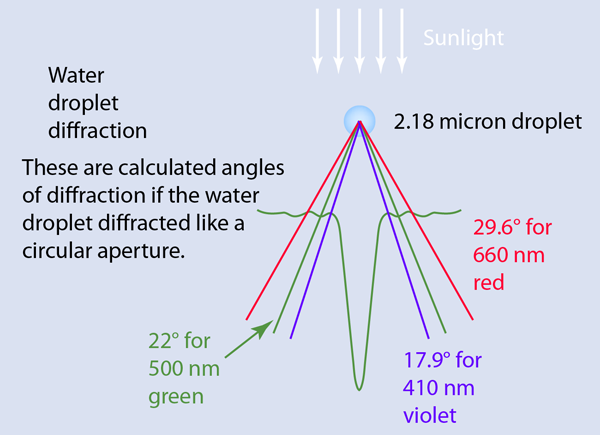
While very small, the particle size to produce a maximum at 22° is conceivable, but the effect would be quite different from the 22° halo. The colors of the visible spectrum would be spread from about 18 to 30 degrees. The normal corona around the Sun is more like 10°, corresponding to a particle size on the order of 6 micrometers.
Atmospheric optics concepts
| HyperPhysics***** Light and Vision
HyperPhysics ***** 光与视觉 | R Nave |