Atmospheric Refraction大气折射
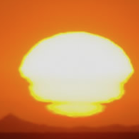
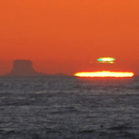
The phenomenon of refraction is responsible for our ability to focus images with a lens or our eye. The refraction, or bending of light, depends upon the index of refraction of the transmitting medium. The amount of bending can be very large at the surface of a lens because of its large index of refraction, typically about n= 1.5. 折射现象使我们能够通过透镜或眼睛聚焦图像。折射,即光的弯曲,取决于传输介质的折射率。由于透镜材料通常具有约n=1.5的较大折射率,因此在透镜表面可能发生显著的弯曲。 A number of refraction phenomena can be observed in the atmosphere, but the conditions are quite different because the index of refraction of the air is very small, it being a nearly transparent medium. The index of refraction of air at standard temperature and pressure (STP) is n= 1.00029 compared to exactly 1 for a vacuum. The interesting observations of refraction effects in the atmosphere arise from the fact that the index of refraction varies with temperature and pressure, and the fact that distances for observation can be very large so that a small amount of refraction produces observable effects. Refraction leads to bending of the light rays toward the slower medium at an interface, so in air the light will tend to bend toward the area of greater pressure since the light speed decreases with increasing pressure. It will also tend to bend toward the area of lower temperature since the light speed will be slightly lower. 大气中可以观察到多种折射现象,但条件却相当不同,因为空气的折射率非常小,它是一种几乎透明的介质。在标准温度和压力(STP)下,空气的折射率n=1.00029,与真空中的恰好1相比。大气中折射效应的有趣观察源于两个事实:一是空气的折射率随温度和压力变化,二是观测距离可以非常大,因此即使有少量的折射也会产生可观察的效果。折射会使光线在界面处向较慢的介质弯曲,因此在空气中,光线会倾向于向压力较大的区域弯曲,因为光速随着压力的增加而减小。它也会倾向于向温度较低的区域弯曲,因为光速会略微降低。 For light coming from outside the Earth's atmosphere, the biggest influence on the light speed is the atmospheric pressure. Incoming light rays from the Sun or stars will be bent downward by refraction toward the Earth. The bending is significant mainly when the light is coming from near the horizon when the light will travel through a long pathway of air. For the Sun near sunset, the refraction will cause the Sun to appear higher in the sky than it is. Because of this refraction, the Sun is actually past the direction tangent to the Earth when you see the big red Sun effect and, on rare occasions, the green flash. Stars near the horizon will likewise appear higher in the sky than they are because of this refraction. ![]() 对于来自地球大气层外的光,大气压对光速的影响最大。来自太阳或恒星的入射光线会因折射而向下弯曲,朝向地球。这种弯曲效应在光线接近地平线时尤为显著,因为此时光线需要穿过较长的空气路径。对于日落时的太阳,折射会使太阳看起来比实际位置更高。由于这种折射现象,当你看到红色太阳效应时,太阳实际上已经过了地球的切线方向,有时还会出现绿色闪光的现象。同样,由于这种折射,接近地平线的恒星也会看起来比实际位置更高。 Some of the visible effects of refraction in the atmosphere are mirages, looming, a flattened Sun near the horizon, the green flash, red sunsets, and twinkling of stars 大气中折射的一些可见效应包括海市蜃楼、地平线处的太阳扁化、绿色闪光、日落时的红色太阳以及恒星的闪烁。 |
Index Atmospheric optics concepts Young, Introduction to Mirages Greenler, Ch 7 NIST, Air index table Hecht, 2nd Ed, Sec 4.2 索引 大气光学概念 年轻,介绍幻象 格林勒,第7章 NIST,空气索引表 海赫特,第二版,第4.2节 | ||
|
Go Back
返回 |
Mirages幻象
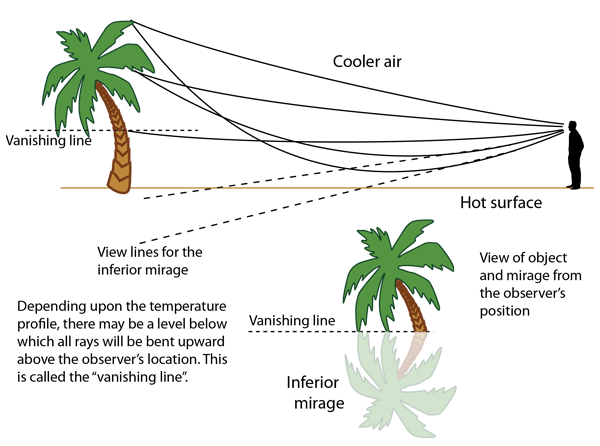
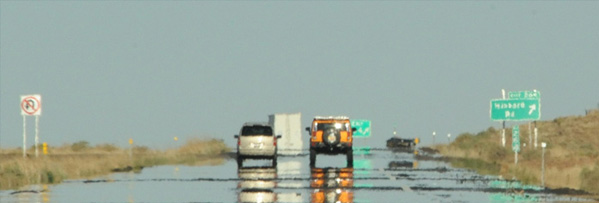
![]() Mirages are produced by atmospheric refraction and are mainly seen in settings where there are large variations in the air temperature, such as in deserts or over cold bodies of water. The refraction which occurs near the Earth's surface is mainly due to temperature gradients where the light rays will be bent toward the cooler side of a given interface. ![]() 海市蜃楼是由大气折射产生的,主要出现在空气温度有显著变化的环境中,例如沙漠或寒冷水域上方。接近地球表面的折射主要是由于温度梯度,其中光线会向较凉一侧的给定界面弯曲。 The photograph above was taken on a hot Arizona highway in summer. Refraction bends the light rays from the bright sky upward from the hot surface producing a mirage which has the appearance of a wet surface. Gallant refers to this kind of mirage as a "puddle mirage". The light from the vehicles ahead which moves toward the hot surface is refracted back upward, producing mirage images below the vehicles. ![]() 上图是在夏日的炎热亚利桑那高速公路拍摄的。折射使来自明亮天空的光线向上弯曲,从热表面产生海市蜃楼,其外观像湿润的表面。Gallant将这种海市蜃楼称为“水坑海市蜃楼”。前方车辆发出的光向热表面移动时,会被折射回上方,产生位于车辆下方的海市蜃楼图像。 The inferior mirage is produced when light rays from an object approach a hotter region and are refracted away from the hot area. In the desert mirage, the rays approaching the hot surface are turned upward away from the surface. If those upward rays are intercepted by your eye, you see the mirage image appearing below the actual object. Following the pattern of Greenler to demonstrate this kind of mirage, the amounts of curvature shown in the illustration are greatly exaggerated. Such inferior mirages are typically seen from a large distance and the curvatures are much less that those illustrated. The Vanishing Line消失线
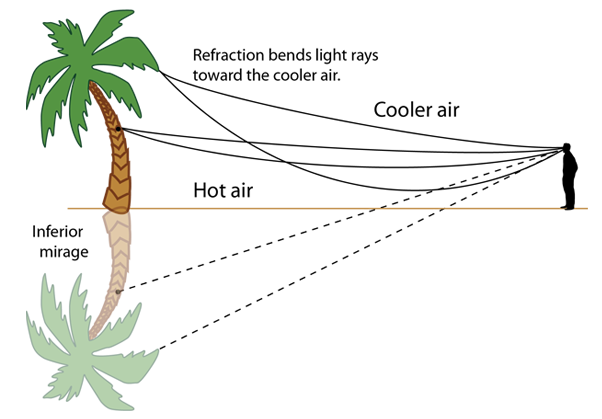
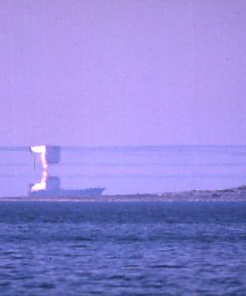
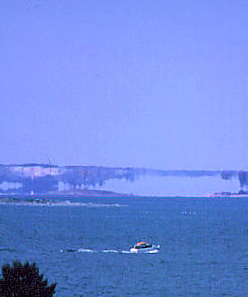
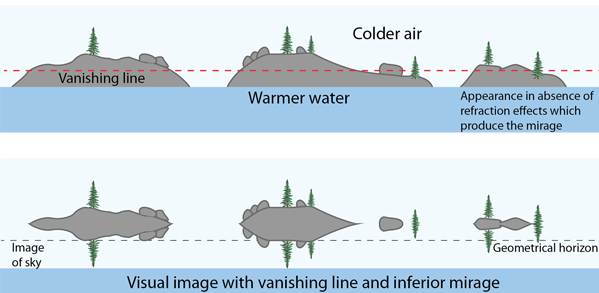
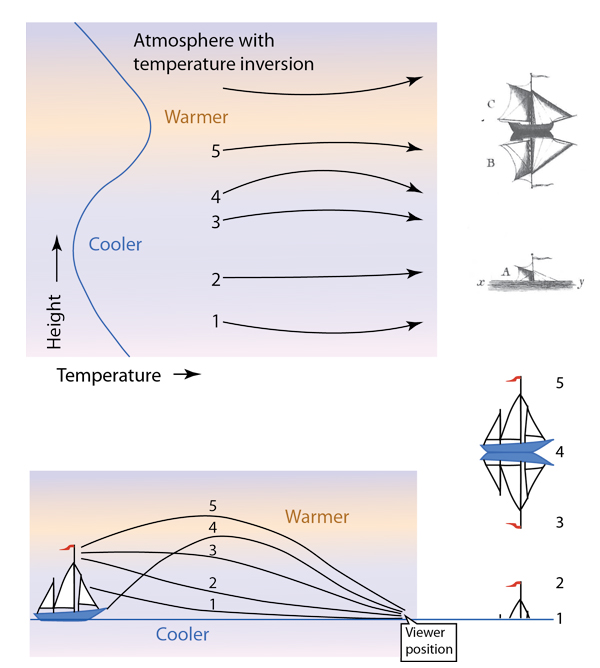
![]() 当光线从物体发出,接近较热的区域时,会折射远离热区,从而形成下部海市蜃楼。在沙漠海市蜃楼中,接近热表面的光线会被向上折射,远离表面。如果这些向上折射的光线被你的眼睛拦截,你就会看到一个出现在实际物体下方的海市蜃楼图像。按照Greenler的模式来展示这种海市蜃楼,图中显示的曲率被大大夸大了。这种下部海市蜃楼通常从远处观察到,其曲率远小于图中所示。 Considering the desert example, the rays from an object will be refracted upward toward the cooler air region. There can be a level on the object such that all rays from points below that level will be refracted over the observer's position. Points below that "vanishing line" on the object will not be seen by the observer. The observer can see both the object above the vanishing line, and corresponding points in the inferior mirage below that level. ![]() 考虑沙漠的例子,物体发出的光线会向较冷的空气区域折射。物体上可能存在一个水平面,使得所有来自该水平面以下的光线都会折射到观察者的位置。物体上低于该‘消失线’的点将不会被观察者看到。观察者可以看到物体上位于消失线以上的部分,以及对应位置在该水平面以下的点。 The above illustration is patterned after one in Greenler, based on his observations of lakes in northern latitudes. The vanishing line limits the amount of the distant shore line that is visible, and an inferior mirage is exhibited below the vanishing line. The above illustration shows the inferior mirage at the same vertical scale as the object, but that is not necessarily the case. Greenler notes that the inferior mirage is often vertically compressed. With a greater viewing distance, the vanishing line will rise so that less of the object is seen. Greenler notes that with a small change in viewing height, like stooping down, a dramatic change in the vanishing line may occur. Thanks to Travis Finley for photography and discussion of mirages and the nature of mirages of the sky. 上述示意图是根据Greenler的示意图改编的,基于他对北纬地区湖泊的观察。消失线限制了远处岸线可见的部分,而在消失线以下会显示出一种下部海市蜃楼。上述示意图以与物体相同的垂直比例显示下部海市蜃楼,但这并不一定是实际情况。Greenler指出,下部海市蜃楼通常会被垂直压缩。随着观察距离的增加,消失线会上升,从而使得物体的可见部分减少。Greenler指出,即使观察高度有微小变化,比如弯腰,消失线也可能发生显著变化。感谢Travis Finley为摄影和讨论海市蜃楼及天空中的海市蜃楼所做出的贡献。 Some aspects of the above graphic are hypothetical - that is, I have never seen one like it. But the link above to Atmospheric Optics shows that the refracted light from the sky does refract to make the mirage, replacing the view of the water below the geometrical horizon. As depicted above, the refracted light from the sky matches in brightness and hue the direct light from the sky, which seems unlikely. I would expect a discernable border between the direct view of the sky and the refracted light from the sky. The extent of the mirage of the sky is placed at the extent of the trees in the mirage of the islands, but that extent would presumably depend on the temperature profile of air around the islands. 上述图形中的某些方面是假设性的——也就是说,我从未见过这样的景象。但上面链接到大气光学的内容显示,来自天空的折射光确实会折射以形成海市蜃楼,取代了几何地平线以下水体的视图。如上所示,来自天空的折射光在亮度和色调上与直接来自天空的光相匹配,这似乎不太可能。我预计天空的直接视图与来自天空的折射光之间应有明显的分界线。天空的海市蜃楼范围被放置在岛屿的海市蜃楼中树木的范围处,但该范围 presumably 会取决于岛屿周围空气的温度分布。 While it is difficult to anticipate the detailed appearance of a mirage, it does appear that those details arise from the nature of the profile of air temperature vs height. Again making use of the work of Robert Greenler with his permission, consider the proposed set of light pathways leading to one of the interesting sailing ship images from northern seas. ![]() 尽管难以预见海市蜃楼的具体外观,但可以确定这些细节源于空气温度随高度变化的分布特性。再次利用罗伯特·格林勒的工作(经他许可),考虑导致北海域一艘有趣帆船图像的光路路径。 These remarkable sketches of the mirages associated with sailing ships were published by S. Vince, "Observations on an Unusual Refraction of the Air, with Remarks on the Variation to Which the Lower Parts of the Atmosphere Are Sometimes Subject", Philosophical Transactions of the Royal Society of London 89, 436 [1799]. 这些与帆船相关的幻象草图由S. Vince发表于《伦敦皇家学会哲学交易》89卷,第436页[1799年]。 The illustration below, which is redrawn with permission from Greenler, shows how the left hand image above might have been produced by refraction from the vertical variation of the air temperature. An increase in temperature produces a slight decrease in the index of refraction, corresponding to a slight increase in light speed in the air. From a table published by NIST the decrease in the index is from n=1.0002718 at 20°C to 1.000243285 at 50°C. The tiny change in light speed over large distances produces the visible refraction effects. ![]() Superior Images and False Horizons优质图像与假地平线
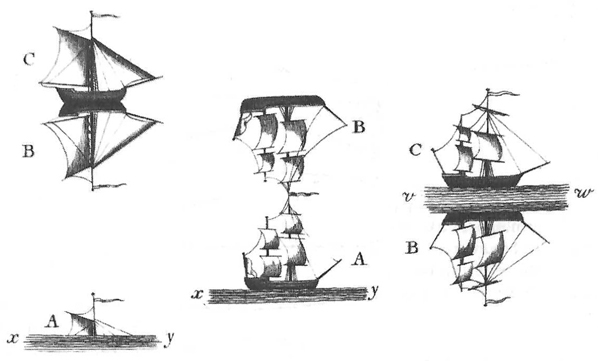
![]() A superior image can be produced when warm air exists over cold water. Again, using the pattern from Greenler, the vertical scale and the curvature are greatly exaggerated to show the effect. Such images are often seen at great distances in the arctic region when the air is significantly warmer than the water. Since the geometry of the mirage images depends on the details of the temperature contour, a great variety of mirage images can be formed. 当暖空气存在于冷水中时,可以产生一种优越的图像。再次使用Greenler的模式,垂直尺度和曲率被大大夸大以显示效果。这种图像通常在北极地区远距离看到,此时空气温度显著高于水温。由于幻象图像的几何结构取决于温度等温线的细节,可以形成多种多样的幻象图像。
下面的插图(经Greenler授权重绘)展示了上方左侧图像可能是如何通过空气温度垂直变化产生的折射形成的。温度升高会导致折射率稍有下降,对应空气中光速稍有增加。根据NIST发表的表格,折射率从20°C时的n=1.0002718下降到50°C时的1.000243285。在大距离范围内光速的微小变化产生了可见的折射效应。 |
Index Atmospheric optics concepts Young, Introduction to Mirages Young Bibliography Greenler, Ch 7 Gallant, Ch 2 索引 大气光学概念 年轻,引入幻象 年轻 参考文献 格林勒,第7章 加兰特,第2章 | ||||||||
|
Go Back
返回 |
Looming迫近
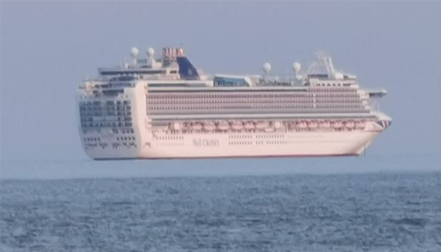
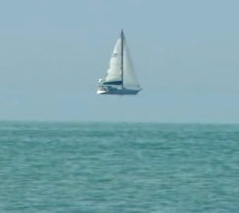
The looming effect is the result of a superior mirage. A typical example is a mirage of a ship formed over cool water in an area where the temperature increases with height. Refraction bends light down toward the water in this case. 这种现象是由于高层海市蜃楼产生的。一个典型例子是在温度随高度增加的区域,冷却水面上形成的船的海市蜃楼。这种情况下,折射会使光线向下弯曲至水面。
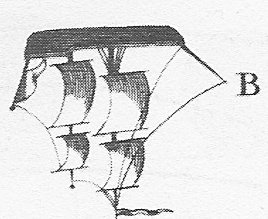
Sailors have long been aware that under the proper conditions they could see a ship which was geometrically over the horizon, just as we can see the red Sun after it has set below the horizon because of atmospheric refraction. They would say that the ship is "looming" over the horizon. Since the visability of this mirage depends upon the details of the temperature contour of the air over the water, there can be great variety in these mirage images. The sailors observed that the mirages were sometimes stretched in the vertical direction, which they called "towering", and were sometimes compressed, which they called "stooping". 水手们早就意识到,在适当的条件下,他们可以看到一艘几何上位于地平线以外的船,就像我们能看到夕阳在地平线以下由于大气折射而显现一样。他们会说这艘船是“出现在”地平线上。由于这种幻象的可见性取决于水面上空气温度轮廓的细节,这些幻象图像可以有很大差异。水手们观察到,这些幻象有时在垂直方向被拉长,他们称之为“高耸”,有时被压缩,他们称之为“低垂”。 There is a rich literature of the varieties of looming mirages, particularly from the Arctic region. Gallant relates some of these stories. Looming mirages may appear to be nearby, and may appear to be greatly magnified (towering). The polar explorer Fridtjof Nansen once nearly shot one of his sled dogs, thinking it was a polar bear because it formed an enlarged mirage. A ship's captain off Newfoundland saw what he thought was a white boat ahead and way about to turn to avoid ramming it, when it flapped its wings and flew away. That is dramatic "towering" when a seagull appears like a boat!
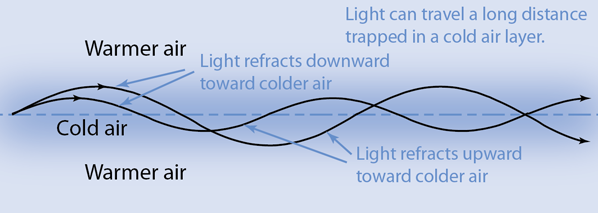
有关海市蜃楼种类的文献相当丰富,尤其是来自北极地区的。Gallant讲述了其中一些故事。海市蜃楼可能看起来很近,也可能看起来被放大了很多(高耸的)。极地探险家弗里德乔夫·南森曾差点射杀了一只雪橇犬,因为他误以为那是一只北极熊,因为那只狗形成了一个放大的海市蜃楼。在纽芬兰的一位船长看到前方有一艘白色的船,认为那艘船即将转向以避免撞上它,但船却拍打着翅膀飞走了。这就是一种戏剧性的‘高耸’现象,当一只海鸥看起来像一艘船时! The ship mirage image above is from a 1799 article by S. Vance titled "Observations on an Unusual Horizontal Refraction of the Air, with Remarks on the Variations to Which the Lower Parts of the Atmosphere Are Sometimes Subject", Philosophical Transactions of the Royal Society of London 89,436. ![]() 上图中的海市蜃楼影像来自1799年S. Vance在《伦敦皇家学会哲学交易》89卷中发表的文章《关于空气异常水平折射的观察,以及对大气下层有时会受到的变动的评论》中提到的。 This illustration of how light can be trapped in a cold layer of the atmosphere is after Robert Greenler. He gives an example of a photograph of the Alaska Range of mountains from the University of Alaska, which is over a hundred miles away. 这张图说明了光线如何被大气中的冷层捕获,是罗伯特·格林勒的插图。他举了一个例子,即从阿拉斯加大学拍摄的阿拉斯加山脉的照片,该山脉距离拍摄地点有一百英里之远。 Looming mirage images have also been called the "fata morgana" (see wiki). "It is an Italian term named after the Arthurian sorceress Morgan le Fay, from a belief that these mirages, often seen in the Strait of Messina, were fairy castles in the air or false land created by her witchcraft to lure sailors to their deaths." looming mirage images 也被称为“fata morgana”(见维基)。‘fata morgana’是一个意大利词,源自亚瑟王传说中的女巫Morgan le Fay,人们相信这些幻象,常常在墨西拿海峡出现,是空中幻化的城堡或由她施法制造的虚假陆地,用来诱骗船员丧命。 "Morgana (Breton equivalent of sea woman) according to a Celtic legend and Arthurian romance, was a fairy, half-sister of King Arthur, who exhibited her power by the mirage. Italian poets represent her as dwelling in a crystal palace beneath the waves. Hence, presumably, the name Fata Morgana (Italian for Morgan le Fay, or Morgan the fairy) was given, centuries ago, to those complicated mirages that occasionally appear over the strait of Messina ... molding the bluffs and houses on the opposite shore into wondrous castles that, alike, tower into the sky and sink beneath the surface; nor is it strange that this poetical name should have become generic, as it has, for all such multiple mirages, whenever they occur." (Humphreys, W. J., "Physics of the Air", 3rd Ed, Dover, 1940. Reprint 1964, pp 474-5.) 根据凯尔特传说和亚瑟王传奇,莫尔甘娜(布列塔尼对海女的等价物)是一位仙女,是亚瑟王的半姐妹,她通过海市蜃楼展示她的能力。意大利诗人把她描绘为居住在水下水晶宫殿中。因此,或许在几个世纪前,人们将这种复杂的海市蜃楼称为“福塔·莫尔甘娜”(意为莫根·莱·法伊,或莫根仙女),因为这种海市蜃楼偶尔会在墨西拿海峡上出现,使对岸的山丘和房屋幻化成奇妙的城堡,既高耸入云,又沉入水面之下;也不奇怪,这种诗意的名字最终成为通用术语,用于所有此类多重海市蜃楼的出现。 Below are links to posted examples of looming mirages: 以下是已发布的关于幻象的示例链接:
|
Index Atmospheric optics concepts Looming Greenler, Ch 7 Gallant, Ch 2 索引 大气光学概念 Looming Greenler,第7章 Gallant,第2章 | ||||||||||
|
Go Back
返回 |
Twinkling闪烁
Star twinkling is caused by nonuniformity in the index of refraction caused by turbulence of the air through which the light from the stars travel. Any boundary where the index of refraction changes will experience bending, or refraction, of the light. Stars are so distant that they appear as points of light, so that point of light will appear to dance about as it encounters different "cells" of the atmosphere which have different temperatures and/or densities. Planets are close enough that they appear as disks of light which tend to average the light over multiple cells of the atmosphere and they appear as steadier, even though they are not perceived to be larger than stars by the unaided eye. 恒星的闪烁是由于空气中的折射率非均匀性引起的,而这种非均匀性是由空气中的湍流造成的。任何折射率发生变化的边界都会使光线发生折射。由于恒星距离非常遥远,它们在天空中看起来像是光点,因此当这些光点遇到不同温度和/或密度的“大气层单元”时,它们会看起来在跳舞。而行星则足够近,看起来像是光盘,其光会平均多个大气单元的光,因此看起来更稳定,尽管人眼在不借助仪器的情况下并不觉得它们比恒星更大。
|
Index Atmospheric optics concepts Greenler, Ch 7 索引 大气光学概念 Greenler,第7章 | ||
|
Go Back
返回 |
Pillars支柱
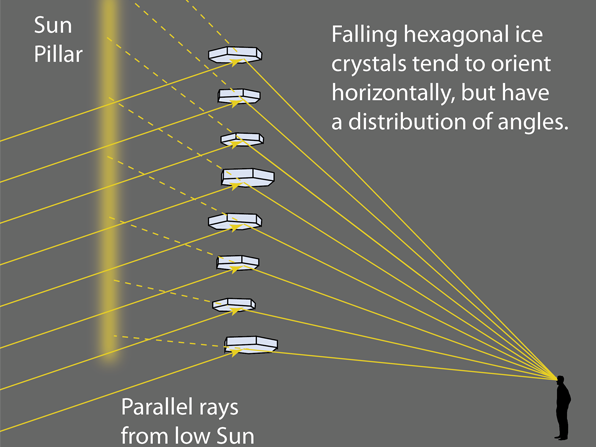
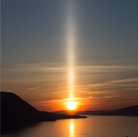
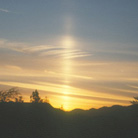
Sun pillars are caused by reflection from falling ice crystals, unlike the 22° halo and sun dogs which are also associated with such ice crystals, but are refraction phenomena. Ice crystals in the atmosphere often form hexagonal flat crystals. As such crystals fall through the atmosphere and interact with the air, they tend to orient parallel to the Earth, but have enough variation in their angles to reflect a low Sun's rays downward to an observers eyes from various heights. This gives the appearance of a pillar of light in the sky. 太阳柱是由冰晶反射造成的,不同于22°晕和太阳狗,后者也与这类冰晶有关,但属于折射现象。大气中的冰晶常常形成六边形扁平晶体。当这些晶体在大气中下落并与空气相互作用时,它们倾向于平行于地面,但其角度存在足够的变化,能够将低角度太阳的光线向下反射到观察者的眼睛中,从不同高度反射。这形成了天空中一柱光的视觉效果。
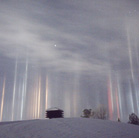
![]() Pillars can also produced by the bright lights of a city at night, but those are divergent sources and the light columns are much narrower - like vertical lines of light. Only those ice crystals in a very narrow vertical column from the light source can reflect to a viewer's eyes. 城市夜间的明亮灯光也可以形成支柱,但这些是发散光源,光柱要窄得多——就像垂直的光线。只有来自光源非常狭窄垂直柱中的冰晶才能反射到观众的眼睛中。 Below are links to posted examples of Sun pillars and other light pillar images: 以下是已发布的一些太阳柱和其它光柱图像的链接:
|
Index Atmospheric optics concepts Greenler, Ch 3 索引 大气光学概念 Greenler,第三章 | ||||||||
|
Go Back
返回 |
Crepuscular Rays日出光线
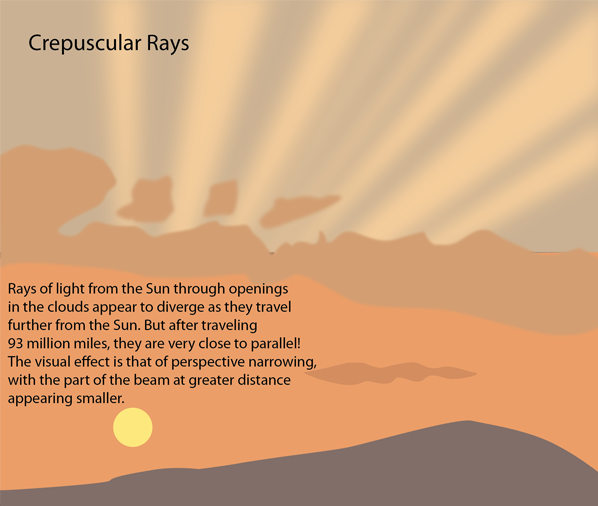
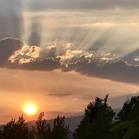
Rays or beams of light may appear to fan out radially from a low sun when the cloud structure is right. The rays from the sun, 93 million miles away, are parallel - but in the setting of the crepuscular rays they appear to diverge because of perspective narrowing over the long path on which they are visible (like the apparent converging of railroad tracks when you look down a long straight track.) Under rare conditions the crepuscular rays extend all the way across the sky and appear to converge back together on the horizon opposite the sun. 当云层结构合适时,来自低处太阳的光线或光束可能会看起来从云层中向四周扩散。太阳发出的光线距离地球9300万英里,本应是平行的,但在暮色光线的背景下,由于在漫长的路径上视觉上的透视收缩,它们看起来会扩散开来(就像你沿着一条长长的直轨道看时,铁轨似乎会向内汇聚一样)。在罕见的情况下,暮色光线可以延伸至整个天空,并看起来在太阳对面的地平线上重新汇聚在一起。
![]() This sketch attempts to match the perspective of the image of crepuscular rays over Reno, Nevada below. 这幅草图试图与内华达州雷诺市日出时的光线透视相匹配。 Below are links to posted examples of crepuscular rays: 以下是已发布示例的链接:
|
Index Atmospheric optics concepts 索引:大气光学概念 | ||||||||
|
Go Back
返回 |