Bilingual edition: English is preserved and Chinese follows each unit. Terminology uses the confirmed v20260916 glossary; automated semantic review remains traceable.
中英双语版:英文原文完整保留,中文紧随对应单元;术语采用 v20260916 确认表,自动语义审校结果可追溯。

Rainbows

彩虹

Rainbows result from refraction of sunlight in falling water droplets plus reflection of the light from the back of the droplet.

彩虹是阳光在下落的水滴中的折射加上水滴后表面的反射所形成的。
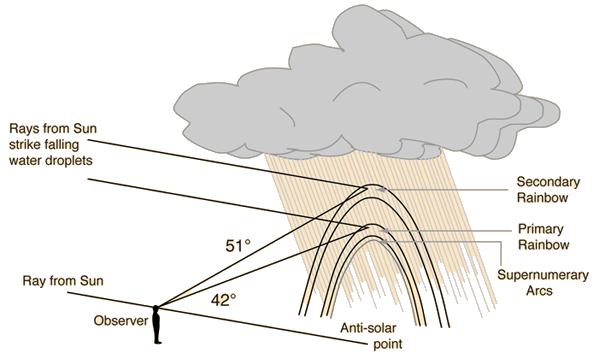
If during a rain shower you can see the shadow of your own head, then you are in position to see a rainbow if conditions are favorable. The rainbow forms a circular arc around the anti-solar point, which is located at the shadow of your head. You can search for the shadow of your head to find a rainbow in a waterfall, or even in the spray from a hose or sprinkler. (Photo by Dubby Waggoner, used by permission.)

Primary rainbow
虹
Secondary rainbow
霓
Supernumerary arcs
幻影弧
Rainbow image
彩虹图像
如果在雨中你能看到自己头顶的影子,那么在条件合适的情况下,你处于能够看到彩虹的位置。彩虹围绕着反太阳点形成一个圆弧,而该点正好位于你头顶的影子位置。你可以寻找头顶的影子来在瀑布中寻找彩虹,甚至在水管或喷淋器的水雾中也一样。(照片由Dubby Waggoner提供,经许可使用。)
Index

Rainbow concepts

Atmospheric optics concepts

References
Greenler

Schaaf
索引 雨虹概念 大气光学概念 参考文献 Greenler Schaaf
 
HyperPhysics***** Light and Vision
HyperPhysics ***** 光与视觉
R Nave
Go Back
返回


Primary Rainbow

虹

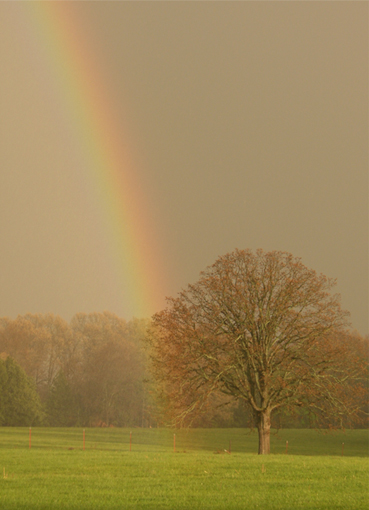
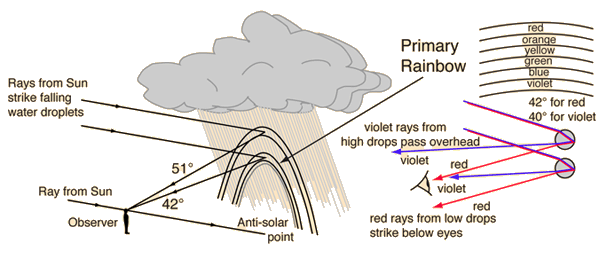
The primary rainbow forms between about 40° and 42° from the antisolar point. The light path involves refraction and a single reflection inside the water droplet. If the drops are large, 1 millimeter or more in diameter, red, green, and violet are bright but there is little blue. Such large droplets are suggested by the rainbow at right.

第一个虹形成于大约40°到42°的反太阳点方向。光的路径涉及折射和水滴内部的一次反射。如果水滴较大,直径1毫米或更大,红、绿和紫光会比较明亮,但蓝光较少。这种较大的水滴被解释为右方的虹。

As the droplets get smaller, red weakens. In fine mist, all colors except violet may disappear. Even finer fog droplets, smaller than 0.05 mm, produce the white rainbow or fog bow. The secondary rainbow involves two reflections inside the falling droplets.

当水滴变小的时候,红色会减弱。在细密的雾中,除了紫色,其他颜色可能都会消失。比0.05毫米更小的雾滴会产生白虹或雾弧。次级虹则涉及水滴内部的两次反射。
Photo by Dubby Waggoner, used by permission.
照片由Dubby Waggoner拍摄,经许可使用。

Rainbows are not seen in midday since the whole 42° circle is below the horizon at most latitudes. So rainbows tend to be seen most in the later afternoon when a thundershower has passed and the sun from the west is illuminating the receding edge of an eastwardly moving raincloud. It is possible to see the entire circle of the rainbow from an airplane since there can be falling droplets both above and below you.

雨bows在正午时分不会出现,因为在大多数纬度,整个42°圆弧都位于地平线以下。因此,雨bows通常在傍晚后半段时间出现,当雷雨云经过并向西移动时,太阳从西方照射到云的西侧边缘。从飞机上可以看见整个雨bows圆弧,因为飞机上既有上方的雨滴,也有下方的雨滴。
Rainbow image
彩虹图像
Light paths
光路
Index

Rainbow concepts

Atmospheric optics concepts

References
Greenler

Schaaf
索引 雨虹概念 大气光学概念 参考文献 Greenler Schaaf
 
HyperPhysics***** Light and Vision
HyperPhysics ***** 光与视觉
R Nave
Go Back
返回


Secondary Rainbow

霓

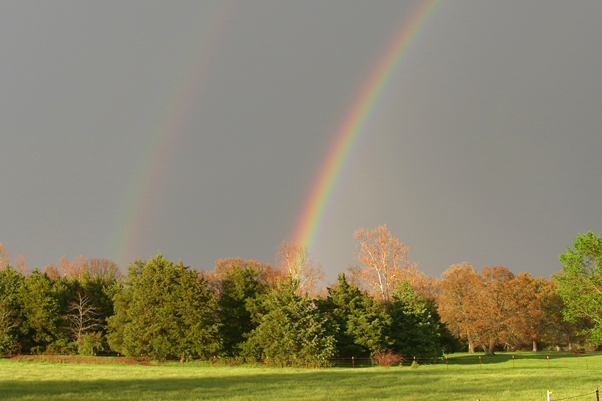
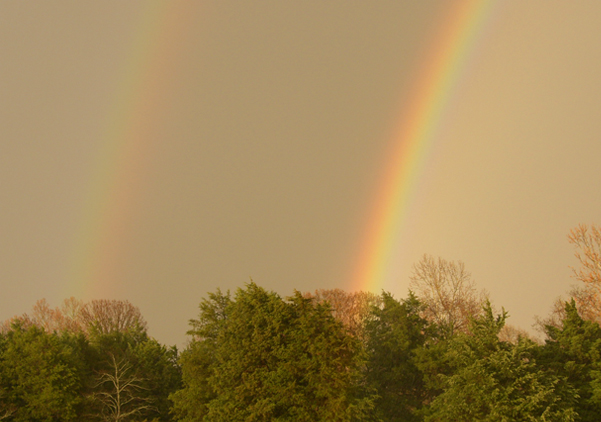
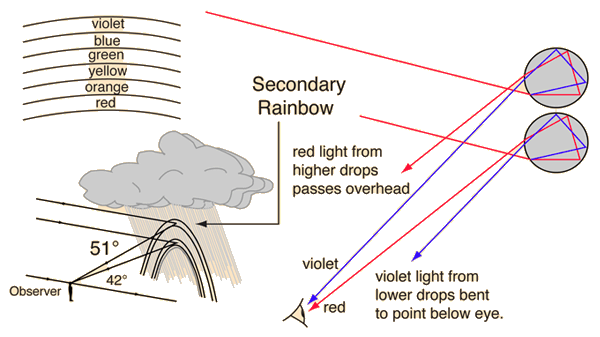
The secondary rainbow is about 10° further out from the antisolar point than the primary bow, is about twice as wide, and has its colors reversed.

次级虹约在反太阳点外侧10°处出现,宽度约为两倍,且颜色顺序相反。

According to Schaaf, the light of the secondary bow is one-tenth the intensity of that of the primary bow, given the same viewing conditions.

根据Schaaf的说法,在相同的观看条件下,次级光斑的光强是初级光斑的十分之一。

Photos by Dubby Waggoner, used by permission. Note the reversal in the order of the colors in the secondary rainbow. These photos also show the increase in brightness inside the primary rainbow. The region between the two rainbows should be a bit darker than the sky just outside the secondary rainbow, but this is a smaller difference.
这些照片由Dubby Waggoner拍摄,经许可使用。请注意次级彩虹中颜色顺序的反转。这些照片还显示了主彩虹内部亮度的增加。两个彩虹之间的区域应该比次级彩虹外侧的天空稍暗一些,但这种差异较小。
Rainbow image
彩虹图像
Light paths
光路
Index

Rainbow concepts

Atmospheric optics concepts

References
Greenler

Schaaf
索引 雨虹概念 大气光学概念 参考文献 Greenler Schaaf
 
HyperPhysics***** Light and Vision
HyperPhysics ***** 光与视觉
R Nave
Go Back
返回


Higher Order Bows

高阶折射

The third order bow has an arc of 40°20' around the sun itself, so you would have ot look back toward the sun to see it. Schaaf reports that it has been seen a number of times in nature, but that no record of the sighting of the fourth order bow is found. A sighting of the fifth order bow is attributed to nineteenth-century scientist Eleuthere Mascart. It would be positioned between the primary and secondary rainbows and would be about 7° wide, its red overlapping that of the primary bow. Rainbow orders up to thirteen have been seen with a laser and water droplets in the laboratory. Experiments for the observation of higher order bows are described by Jearl Walker in "The Amateur Scientist" section of the July 1977 issue of Scientific American.

第三级彩虹的弧度约为40°20',围绕太阳本身,因此你必须向太阳后方看才能看到它。Schaaf报告说,这种彩虹在自然界中被观测到过几次,但没有发现第四级彩虹的记录。第五级彩虹的观测归因于19世纪的科学家Eleuthere Mascart。它将位于主彩虹和次彩虹之间,宽度约为7°,其红色部分会与主彩虹的红色部分重叠。使用激光和水滴在实验室中已观测到第十三级彩虹。Jearl Walker在1977年7月号《科学美国人》杂志“业余科学家”专栏中描述了观测更高级彩虹的实验。
Index

Rainbow concepts

Atmospheric optics concepts

References
Greenler

Schaaf
索引 雨虹概念 大气光学概念 参考文献 Greenler Schaaf
 
HyperPhysics***** Light and Vision
HyperPhysics ***** 光与视觉
R Nave
Go Back
返回