Bilingual edition: English is preserved and Chinese follows each unit. Terminology uses the confirmed v20260916 glossary; automated semantic review remains traceable.
中英双语版:英文原文完整保留,中文紧随对应单元;术语采用 v20260916 确认表,自动语义审校结果可追溯。

Strengths of Oxidizing and Reducing Agents

氧化剂和还原剂的强度

The strengths of oxidizing and reducing agents are indicated by their standard electrode potentials. A sample from the table of standard potentials shows the extremes of the table.

氧化剂和还原剂的强度由它们的标准电极电势表示。表中的一例显示了表的极端值。
Cathode (Reduction)
Half-Reaction
阴极(还原)半反应
Standard Potential
E° (volts)
标准电势 E ° (伏特)
Li+(aq) + e- → Li(s)
Li⁺(aq) + e⁻ → Li(s)
-3.04
K+(aq) + e- → K(s)
K⁺(aq) + e⁻ → K(s)
-2.92
Ca2+(aq) + 2e- → Ca(s)
Ca²⁺(aq) + 2e⁻ → Ca(s)
-2.76
Na+(aq) + e- → Na(s)
Na⁺(aq) + e⁻ → Na(s)
-2.71
Zn2+(aq) + 2e- → Zn(s)
Zn²⁺(aq) + 2e⁻ → Zn(s)
-0.76
Cu2+(aq) + 2e-→ Cu(s)
Cu²⁺(aq) + 2e⁻ → Cu(s)
0.34
O3(g) + 2H+(aq) + 2e- → O2(g) + H2O(l)
O₃(g)+ 2H⁺(aq)+ 2e⁻ → O₂(g)+ H₂O(l)
2.07
F2(g) + 2e-→ 2F-(aq)
F₂(g) + 2e⁻ → 2F⁻(aq)
2.87

The values for the table entries are reduction potentials, so lithium at the top of the list has the most negative number, indicating that it is the strongest reducing agent. The strongest oxidizing agent is fluorine with the largest positive number for standard electrode potential.

Table of Standard Electrode Potentials
标准电极电势表
表中的数值是还原电势,因此列表顶部的锂具有最负的数值,表明它是最强的还原剂。最强的氧化剂是氟,因为它具有最大的标准电极电势正数值。
Index

Oxidation/
Reduction concepts


Electrochemistry concepts

Reference
Hill & Kolb
Ch 8

Ebbing
Ch 19
索引 氧化还原概念 电化学概念 参考 Hill & Kolb 第8章 Ebbing 第19章
 
HyperPhysics***** Electricity and Magnetism ***** Chemistry
HyperPhysics ***** 电磁学 ***** 化学
R Nave
Go Back
返回


Free Energy and Electrode Potentials

自由能与电极电势

The cell potential of a voltaic cell is a measure of the maximum amount of energy per unit charge which is available to do work when charge is transferred through an external circuit. This maximum work is equal to the change in Gibbs free energy, ΔG, in the reaction. These relationships can be expressed as

伏打电池的电动势是衡量在电荷通过外部电路转移时可用于做功的最大能量 per 单位电荷的量。这个最大功等于反应中的吉布斯自由能变化,ΔG。这些关系可以表示为

Maximum work = ΔG = -nFE°cell

最大功 = ΔG = -nFE°cell

where n is the number of electrons transferred per mole and F is the Faraday constant.

其中n是每摩尔转移的电子数,F是法拉第常数。

Consider the historic Daniell cell in which zinc and copper were used as electrodes. The data from the table of standard electrode potentials is

考虑历史上使用的丹尼尔电池,其中锌和铜被用作电极。表中标准电极电势的数据是
Cathode (Reduction)
Half-Reaction
阴极(还原)半反应
Standard Potential
E° (volts)
标准电势 E ° (伏特)
Zn2+(aq) + 2e- → Zn(s)
Zn²⁺(aq) + 2e⁻ → Zn(s)
-0.76
Cu2+(aq) + 2e- → Cu(s)
Cu²⁺(aq) + 2e⁻ → Cu(s)
0.34

The standard cell potential is then E°cell = 1.1 volt and 2 electrons are transferred per mole of reactant. The change in free energy is then

标准电池的电动势是 E ° cell = 1.1 伏特,每摩尔反应物转移 2 个电子。自由能的变化是
ΔG = -nFE°cell = -2 x 96,485 coul/mole x 1.10 joule/coul = -212 kJ

This relationship with free energy can be used in the opposite direction as well. From a table of thermodynamic quantities, the free energy changes for the ions under standard conditions are

这种与自由能的关系也可以反过来使用。从热力学数据表中,可以在标准条件下得到离子的自由能变化为

Zn2+(aq), ΔG = -147.21 kJ/mol

Zn²⁺(aq),ΔG = -147.21 kJ/mol

Cu2+(aq), ΔG = 64.98 kJ/mol

Cu²⁺(aq),ΔG = 64.98 kJ/mol

Since the Zn ion is produced and the Cu ion is reduced in the cell process, the net change in free energy is -212 kJ/mol, as we obtained above. Starting from these free energy changes, we could have calculated the cell potential of 1.1 volts by reversing the above calculation.

由于电池过程中锌离子被产生而铜离子被还原,自由能的净变化为-212 kJ/mol,如上所述。从这些自由能变化出发,我们可以通过反转上述计算得出电池的电动势为1.1伏特。
Table of Standard Electrode Potentials
标准电极电势表
ΔG = -nFE°_cell = -2 x 96,485 coul/mole x 1.10 joule/coul = -212 kJ
Index

Oxidation/
Reduction concepts


Electrochemistry concepts

Reference
Hill & Kolb
Ch 8

Ebbing
Ch 19
索引 氧化还原概念 电化学概念 参考 Hill & Kolb 第8章 Ebbing 第19章
 
HyperPhysics***** Electricity and Magnetism ***** Chemistry
HyperPhysics ***** 电磁学 ***** 化学
R Nave
Go Back
返回


Electrode Potentials and Equilibrium Constants

电极电势与平衡常数

The cell potential of a voltaic cell is a measure of the maximum amount of energy per unit charge which is available to do work when charge is transferred through an external circuit. This maximum work is equal to the change in Gibbs free energy, ΔG, in the reaction. These relationships can be expressed as

伏打电池的电动势是衡量在电荷通过外部电路转移时可用于做功的最大能量 per 单位电荷的量。这个最大功等于反应中的吉布斯自由能变化,ΔG。这些关系可以表示为

Maximum work = ΔG = -nFE°cell

最大功 = ΔG = -nFE°cell

where n is the number of electrons transferred per mole and F is the Faraday constant.

其中n是每摩尔转移的电子数,F是法拉第常数。

This free energy change can also be related to the equilibrium constant K

这种自由能变也可以与平衡常数K相关联

ΔG = -RT ln K

ΔG = -RT ln K(专名或术语)

Combining these relationships allows us to express the cell potential in terms of the equilibrium constant.
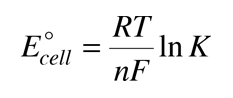
将这些关系结合起来,可以将电池电势表示为平衡常数的函数。

Consider the historic Daniell cell in which zinc and copper were used as electrodes. The data from the table of standard electrode potentials is

考虑历史上使用的丹尼尔电池,其中锌和铜被用作电极。表中标准电极电势的数据是
Cathode (Reduction)
Half-Reaction
阴极(还原)半反应
Standard Potential
E° (volts)
标准电势 E ° (伏特)
Zn2+(aq) + 2e- → Zn(s)
Zn²⁺(aq) + 2e⁻ → Zn(s)
-0.76
Cu2+(aq) + 2e- → Cu(s)
Cu²⁺(aq) + 2e⁻ → Cu(s)
0.34

The standard cell potential is then E°cell = 1.1 volt and 2 electrons are transferred per mole of reactant. The relationship for the equilibrium constant is then
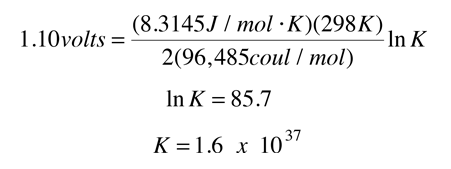
标准电池的电动势则是 E ° cell = 1.1 伏特,每摩尔反应物转移 2 个电子。平衡常数的关系为

This extremely high value for the equilibrium constant confirms that the reaction of the Daniell cell is indeed spontaneous and that it will proceed until the reactants are exhausted.

这个极高的平衡常数值证实了丹尼尔电池的反应确实自发进行,并将持续进行直到反应物耗尽。
Table of Standard Electrode Potentials
标准电极电势表
Index

Oxidation/
Reduction concepts


Electrochemistry concepts

Reference
Hill & Kolb
Ch 8

Ebbing
Ch 19
索引 氧化还原概念 电化学概念 参考 Hill & Kolb 第8章 Ebbing 第19章
 
HyperPhysics***** Electricity and Magnetism ***** Chemistry
HyperPhysics ***** 电磁学 ***** 化学
R Nave
Go Back
返回