Bilingual edition: English is preserved and Chinese follows each unit. Terminology uses the confirmed v20260916 glossary; automated semantic review remains traceable.
中英双语版:英文原文完整保留,中文紧随对应单元;术语采用 v20260916 确认表,自动语义审校结果可追溯。

pH

pH(专名或术语)

The pH of a solution is a measure of the molar concentration of hydrogen ions in the solution and as such is a measure of the acidity or basicity of the solution. The letters pH stand for "power of hydrogen" and the numerical value is defined as the negative base 10 logarithm of the molar concentration of hydrogen ions.

溶液的pH值是衡量溶液中氢离子的物质的量浓度的量,因此也是衡量溶液酸碱性的量。pH这一术语中的“p”代表“氢的幂次”,其数值定义为氢离子的物质的量浓度的负的以10为底的对数。

pH = -log10[H+]

pH = -log 10 [H⁺]

The measurement of the pH of a sample can be done by measuring the cell potential of that sample in reference to a standard hydrogen electrode, as in the accepted procedure for measuring standard electrode potentials. This procedure would give a value of zero for a 1 Molar solution of H+ ions, so that defines the zero of the pH scale. The cell potential for any other value of H+ concentration can be obtained with the use of the Nernst equation. For a solution at 25°C this gives

样品的pH值可以通过将其与标准氢电极相比测量其电池电势来测定,这与测定标准电极电势的公认程序一致。这种程序会将1摩尔/升H+离子溶液的电势值定为零,从而定义pH刻度的零点。对于其他H+浓度值的溶液,可以利用能斯特方程来获得其电池电势。在25°C时,这会给出
Ecell = -0.0592 log10[H+]

or

或者
pH = Ecell/0.0592

For this expression, a base change from the natural log to the base 10 logarithm was made in the Nernst equation.

为此,将自然对数转换为底数10的对数在能斯特方程中进行了基变换。

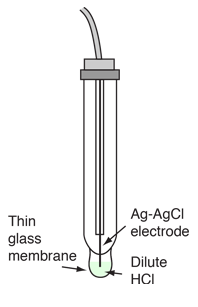
In practice, the pH is not usually measured in this way because it requires hydrogen gas at standard pressure, and the platinum electrode used in the standard hydrogen electrode is easily fouled by the presence of other substances in the solution (Ebbing). Fortunately, other practical electrode configurations can be calibrated to read the H+ ion concentration. Laboratory pH meters are often made with a glass electrode consisting of a silver wire coated with silver chloride immersed in dilute hydrochloric acid. The electrode solution is separated from the solution to be measured by a thin glass membrane. The potential which develops across that glass membrane can be shown to be proportional to the hydrogen ion concentrations on the two surfaces. In the measurement instrument, a cell is made with the other electrode commonly being a mercury-mercury chloride electrode. The cell potential is then linearly proportional to the pH and the meter can then be calibrated to read directly in pH.

实际上,通常不以这种方式测量pH值,因为这需要在标准压力下使用氢气,而标准氢电极中的铂电极容易因溶液中其他物质的存在而被污染(Ebbing)。幸运的是,其他实用的电极配置可以校准以直接读取H+离子浓度。实验室pH计通常由一个玻璃电极制成,该电极由涂有氯化银的银丝浸入稀盐酸中组成。电极溶液通过薄玻璃膜与待测溶液隔开。该玻璃膜两侧的电势可以证明与氢离子浓度成正比。在测量仪器中,另一个电极通常为汞-氯化汞电极。此时电极电势与pH值成线性关系,因此计数器可以校准以直接读取pH值。
Examples of pH values
pH值的例子
Other ion concentration measurements
其他离子浓度测量
电池电动势 E cell = -0.0592 log 10 [H + ],pH = E cell /0.0592
Index

Acid Concepts

Chemistry concepts

Electrochemistry concepts

Reference
Ebbing
Ch 19
索引 酸的概念 化学概念 电化学概念 参考 Ebbing 第19章
 
HyperPhysicsR Nave
Go Back
返回


Examples of pH Values

pH 值示例

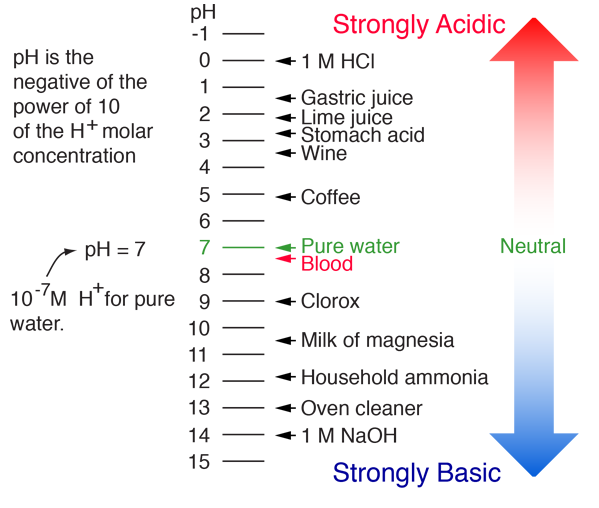
The pH of a solution is a measure of the molar concentration of hydrogen ions in the solution and as such is a measure of the acidity or basicity of the solution. The letters pH stand for "power of hydrogen" and numerical value for pH is just the negative of the power of 10 of the molar concentration of H+ ions.

溶液的pH值是衡量溶液中氢离子的物质的量浓度的量度,因此也是衡量溶液酸碱性的量度。pH这一术语中的“p”代表“氢的幂次”,pH数值只是氢离子物质的量浓度的10的幂次的负数。

The usual range of pH values encountered is between 0 and 14, with 0 being the value for concentrated hydrochloric acid (1 M HCl), 7 the value for pure water (neutral pH), and 14 being the value for concentrated sodium hydroxide (1 M NaOH). It is possible to get a pH of -1 with 10 M HCl, but that is about a practical limit of acidity. At the other extreme, a 10 M solution of NaOH would have a pH of 15.

通常遇到的pH值范围在0到14之间,其中0对应浓盐酸(1 mol/L HCl),7对应纯水(中性pH),14对应浓氢氧化钠溶液(1 mol/L NaOH)。可以得到pH为-1的溶液,如10 mol/L HCl,但这已接近酸度的实用极限。在另一端,10 mol/L NaOH溶液的pH值为15。
Numerical examples from Shipman, Wilson and Todd.

In pure water, the molar concentration of H+ ions is 10-7 M and the concentration of OH- ions is also 10-7 M. Actually, when looked at in detail, it is more accurate to classify the concentrations as those of [H3O]+ and [OH]-. The product of the positive and negative ion concentrations is 10-14 in any aqueous solution at 25°C.

在纯水中,H+离子的物质的量浓度为10⁻⁷ M,OH⁻离子的浓度也是10⁻⁷ M。实际上,若详细考察,更准确的分类应为[H₃O⁺]和[OH⁻]的浓度。在25°C下,任何水溶液中正负离子浓度的乘积均为10⁻¹⁴。

An important example of pH is that of the blood. Its nominal value of pH = 7.4 is regulated very accurately by the body. The kidney regulates the pH by balancing the concentrations of hydrogen and bicarbonate ions. If the pH of the blood gets outside the range 7.35 to 7.45 the results can be serious and even fatal.

一个重要的pH例子是血液。其名义上的pH值为7.4,由身体非常精确地调节。肾脏通过平衡氢离子和碳酸氢根离子的浓度来调节pH。如果血液的pH值超出7.35到7.45的范围,结果可能非常严重,甚至致命。

If you measure the pH of tap water with a pH meter, you may be surprised at how far from a pH of 7 it is because of dissolved substances in the water. Distilled water is necessary to get a pH near 7.

如果你用pH计测量自来水的pH值,可能会惊讶于其远离7这个数值,这是因为水中溶解了各种物质。要得到接近7的pH值,必须使用蒸馏水。

Meters for pH measurement can give precise numerical values, but approximate values can be obtained with various indicators. Red and blue litmus paper has been one of the common indicators. Red litmus paper turns blue at a basic pH of about 8, and blue litmus paper turns red at an acid pH of about 5. The measured value for the color change can vary over a range of approximately 4.5-8.3 . Neither changes color if the pH is nearly neutral. Litmus is an organic compound derived from lichens.

用于pH测量的量规可以给出精确的数值,但也可以使用各种指示剂获得近似值。红色和蓝色石蕊试纸曾是常用的指示剂。红色石蕊试纸在pH约为8的碱性条件下会变蓝,而蓝色石蕊试纸在pH约为5的酸性条件下会变红。颜色变化的测量值可能在约4.5-8.3的范围内变化。如果pH接近中性,试纸不会变色。石蕊是一种从地衣中提取的有机化合物。

Phenolpthalein is also a common indicator, being colorless in solution at pH below 8 and turning pink for pH above 8.

酚酞也是一种常用的指示剂,其在pH低于8的溶液中无色,当pH高于8时会变为粉红色。
Measurement of pH values
pH 值的测量
Other ion concentration measurements
其他离子浓度测量
Shipman、Wilson和Todd的数值示例
Index

Acid Concepts

Chemistry concepts

Electrochemistry concepts

Reference
Shipman, et al.
Ch 14
索引 酸的概念 化学概念 电化学概念 参考 Shipman 等人,第14章
 
HyperPhysicsR Nave
Go Back
返回


Measurement of Ion Concentration

离子浓度测量

Methods have been developed for the measurement of the concentrations of various kinds of ions using the cell potentials of special electrochemical cells. If you form a voltaic cell with two different kinds of metal electrodes, you get a characteristic cell potential for standard conditions where the electrolytes are at the standard 1 Molar concentration. If the ion concentrations are different from 1 M, then there is a change in the cell potential described by the Nernst equation. Measurement of that change is in essence a measure of the ion concentration, and can be exploited for that purpose.

已经开发出测量各种离子浓度的方法,这些方法利用特殊电化学电池的电池电势。如果你用两种不同种类的金属电极组成伏打电池,你将得到一个特征电池电势,该电势适用于标准条件,此时电解质的浓度为标准1摩尔/升。如果离子浓度不同于1摩尔/升,那么电池电势会发生变化,这种变化由能斯特方程描述。测量这种变化本质上就是测量离子浓度,可以用于此目的。

Perhaps best known is the measurement of pH which is a measurement of the H+ ion concentration. Other ion selective electrodes have been developed for the measurement of K+, Ca+, Mg+, NH4+, etc. Ebbing cites an example of a specialized electrode designed for measuring the concentration of urea, an nonelectrolyte. To do this, an electrode sensitive to the NH4+ concentration is coated with a gel containing urease, an enzyme which catalyzes the decomposition of urea, producing ammonium ions. The measured NH4+ concentration can then be calibrated in terms of the urea concentration in the solution.

最著名的可能是pH的测量,这是对H+离子浓度的测量。其他离子选择性电极也已开发用于测量K+、Ca2+、Mg2+、NH4+等。Ebbing举了一个专门设计用于测量尿素浓度的例子,尿素是一种非电解质。为此,一种对NH4+浓度敏感的电极被涂上含有尿素酶的凝胶,尿素酶是一种催化尿素分解产生铵离子的酶。测得的NH4+浓度可以依据溶液中尿素的浓度进行校准。
Index

Acid Concepts

Chemistry concepts

Electrochemistry concepts

Reference
Ebbing
Ch 19
索引 酸的概念 化学概念 电化学概念 参考 Ebbing 第19章
 
HyperPhysicsR Nave
Go Back
返回