The Urinary System is One of the Excretory Systems泌尿系统是排泄系统之一
|
Index Reference Audesirk & Audesirk Ch 26, 30 Thibodeau & Patton Ch 28 索引参考Audesirk & Audesirk第26章、第30章;Thibodeau & Patton第28章 | |||||||||||||||||
|
Go Back
返回 |
The Urinary System泌尿系统
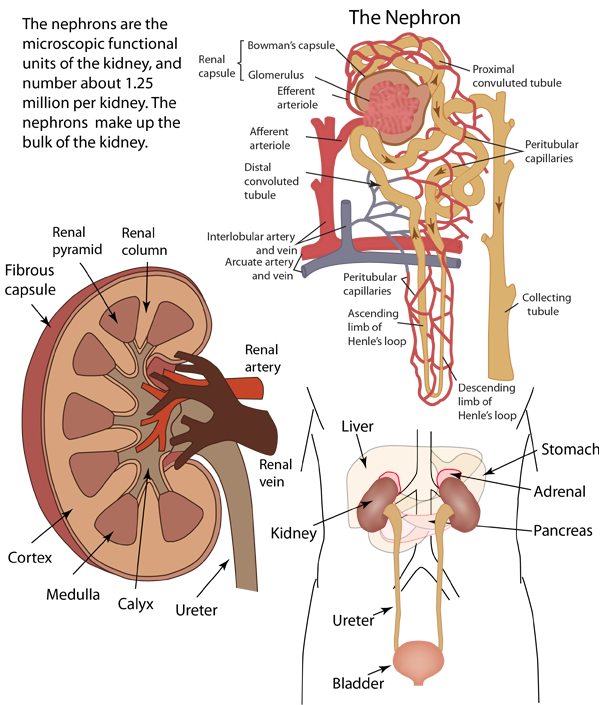
![]() These sketches of the elements of the urinary system are patterned after the treatment by Thibodeau & Patton. 这些泌尿系统元素的草图是根据Thibodeau & Patton的处理方式设计的。 |
Index Reference Audesirk & Audesirk Ch 26, 30 Thibodeau & Patton Ch 28 索引参考Audesirk & Audesirk第26章、第30章;Thibodeau & Patton第28章 | ||
|
Go Back
返回 |
The Urinary System and Homeostasis泌尿系统与内环境稳态
Walter B. Cannon is credited with introducing the term "homeostasis" in the 1920s to describe the constancy of the body's internal environment. Though "homeostasis" from the Greek implies that it "stays the same", the body is clearly a very active, ever-changing environment. The value of the term is to describe the dynamic equilibrium of many interacting systems in the body which result in a reasonably balanced functional organism. There are a number of physical and chemical parameters in the body that must be kept within a very narrow range for the cells to function properly. The kidneys and the urinary system are important parts of the homeostatic balance of the body. 沃尔特·B·坎农在20世纪20年代首次使用“稳态”一词来描述身体内部环境的恒定性。尽管“稳态”一词源自希腊语,意味着“保持不变”,但身体显然是一个非常活跃且不断变化的环境。该术语的价值在于描述身体内许多相互作用系统所维持的动态平衡,从而形成一个功能相对平衡的机体。身体内有许多物理和化学参数必须保持在非常狭窄的范围内,以确保细胞正常运作。肾脏和泌尿系统是维持身体稳态平衡的重要部分。 While we may think of the kidneys primarily as a "urine producer", Thibodeau & Patton suggest that a better image of the system would be that of "blood plasma balancer". Audesirk & Audesirk suggest a list of the ways that the urinary system helps maintain the homeostasis of the body:
尽管我们可能将肾脏主要视为“尿生成器”,但Thibodeau & Patton认为,对系统的更好形象应是“血浆调节器”。Audesirk & Audesirk建议列出泌尿系统如何帮助维持身体稳态的几种方式: The kidneys are the most important organs in the body for maintaining fluid-electrolyte and acid-base balance. "Each drop of blood in your body passes through a kidney about 350 times a day; thus the kidney is able to fine-tune the composition of the blood and thereby helps maintain homeostasis."(Audesirk & Audesirk) 肾脏是维持体内液体-电解质和酸碱平衡最重要的器官。‘你体内的每一滴血液每天都要经过肾脏约350次;因此肾脏能够调节血液的成分,从而帮助维持内环境稳定。’(Audesirk & Audesirk) |
Index Reference Audesirk & Audesirk Ch 26, 30 Thibodeau & Patton Ch 28 索引参考Audesirk & Audesirk第26章、第30章;Thibodeau & Patton第28章 | ||
|
Go Back
返回 |
Elements of the Urinary System尿液系统的组成
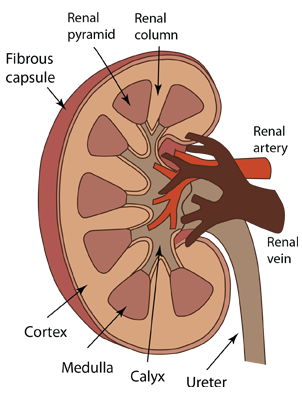
Kidney Structure肾脏结构
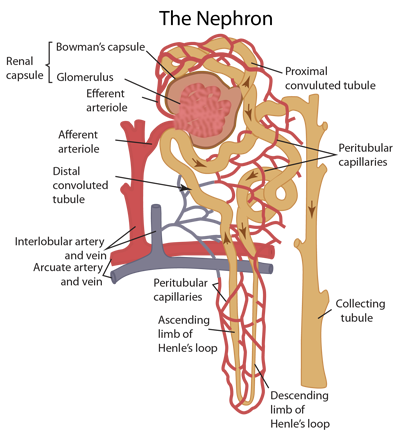
Renal Pelvis: The larger collection reservoir formed by the joining of the calyx units. This reservoir narrows as it exits the kidney to become the ureter. 肾盂:由肾盏单位汇合形成的较大收集储藏室。当它离开肾脏时,这个储藏室变窄,成为输尿管。 Renal artery and Renal vein: These blood vessels are quite large and carry about 1200ml of blood per minute, or about one fifth of the total blood flow from the heart. Between the pyramids of the kidney's medulla, the renal artery branches to form interlobular arteries that extend outward toward the cortex and arch over the bases of the pyramids to form the arcuate arteries. From these arcuate arteries, interlobular arteries extend into the cortex. The Nephron肾单位
肾动脉和肾静脉:这些血管相当粗大,每分钟输送约1200毫升血液,约占心脏输出血量的五分之一。在肾髓质的肾锥体之间,肾动脉分出形成分布到肾皮质的弓状动脉,这些动脉延伸至皮质,并在肾锥体基底上方形成弧形动脉。从这些弧形动脉,弓状动脉延伸入皮质。 Afferent arteriole: From an interlobular artery, blood enters the afferent arteriole which carries the blood into the glomerulus for filtering. 肾小球入球小动脉:血液从肾小管动脉出发,经入球小动脉进入肾小球进行过滤。 Efferent arteriole: After passing through the glomerulus, the remaining fluid with the filtrate removed is much more concentrated and passes into the smaller efferent arteriole and branches into multiple small, highly porous capillaries. These capillaries surround the tubule which has carried the filtrate from Bowman's capsule and are in intimate contact with it. 肾小球滤液经肾小球后,剩余的液体因滤液被去除而变得更加浓缩,然后进入较小的出球小动脉,并分支为多个小而多孔的毛细血管。这些毛细血管围绕着将滤液从Bowman囊输送过来的肾小管,并与之紧密接触。 Proximal convoluted tubule: the filtrate leaving Bowman's capsule into the tubule contains nutrients and water and a portion of those are reabsorbed into the blood flowing through the nearby capillaries. This reabsorption can include salts, glucose, and amino acids which are excreted from the tubule by active transport and then diffuse into the porous capillaries. At the same time, remaining waste products including urea become more concentrated in the tubule. 近端小管:从球状囊滤出的液体进入小管后含有营养物质和水分,其中一部分通过附近毛细血管中的血液重新吸收。这种重吸收可以包括盐、葡萄糖和氨基酸,这些物质通过主动运输从管腔中排出,然后扩散进入毛细血管的孔隙中。同时,剩余的废物产物,包括尿素,在小管中变得更加浓缩。 Loop of Henle: just past the proximal tubule, a thinner tubule descends to a sharp turn and returns with an enlarged tubule. This structure extends into the medulla of the kidney for most nephrons. Along the loop of Henle there is more concentration of the urine by osmosis of water out of the tube and transfer of NaCl out by active transport. 肾小管的肾单位:在近端小管之后,一条较细的肾小管向下延伸,然后在一处急转弯后返回,此时肾小管变宽。这种结构在大多数肾单位中延伸至肾髓质。在肾小管的循环中,通过渗透作用将水分从管内排出,同时通过主动运输将NaCl排出,从而增加尿液的浓度。 Distal convoluted tubule: Beyond the loop of Henle the tubule moves to a point adjacent to the afferent arteriole and the two of them form the juxtaglomerular apparatus. This structure is important in maintaining homeostasis of blood flow because it reflexively secretes renin when the blood pressure in the afferent arteriole drops. Renin triggers a mechanism that produces angiotensin, a substance that causes vasoconstriction and a resulting increase in blood pressure. Also active in the distal tubule is the hormone aldosterone which is synthesized in the adrenal gland. This hormone is involved in the active transport of sodium out of the tubule to re-enter the capillaries, thus retaining more sodium. 远端粗螺旋管:在肾小球loop之后,该管段移向靠近入球动脉的位置,并与之形成球旁装置。该结构对维持血流的稳态很重要,因为当入球动脉的血压下降时,它会反射性地分泌肾素。肾素触发一种机制产生血管紧张素,这是一种引起血管收缩并导致血压升高的物质。此外,远端管段中还活跃着由肾上腺合成的激素醛固酮。这种激素参与钠的主动运输出管腔,重新进入毛细血管,从而保留更多的钠。 Collecting tubule: From the distal tubule the urine enters the straight tubule that is joined by the distal tubules of several nephrons.
集合管:从远端小管开始,尿液进入直管,该直管与多个肾单位的远端小管相连。 |
Index Reference Audesirk & Audesirk Ch 26, 30 Thibodeau & Patton Ch 28 索引参考Audesirk & Audesirk第26章、第30章;Thibodeau & Patton第28章 | ||||||
|
Go Back
返回 |
Regulating the Water Content of the Blood调节血液中的水分含量
![]() One of the most important functions of the kidney is to regulate the water content of the blood. Audesirk & Audesirk comment that the kidneys filter about 125 ml (about half a cup) of water per minute, so that without reabsorption you would produce more than 180 liters (45 gallons) of urine daily! The reabsorption into the blood occurs by osmosis from the convoluted tubules and collecting tubules of the nephrons. The water can then diffuse into the permeable capillaries of the nephron which surround the tubules. The amount or reabsorption is controlled by a negative feedback mechanism that involves the amount of antidiuretic hormone (ADH) circulating in the blood. This control process involves the endocrine system and involves the hypothalamus which detects the osmotic concentration of the blood. Also involved are receptors in the heart that monitor blood volume. In response to increased osmotic concentration, the hypothalamus signals the pituitary gland to release ADH into the blood to increase the permeability of the tubules of the nephrons. 肾脏最重要的功能之一是调节血液中的水分含量。Audesirk & Audesirk指出,肾脏每分钟可过滤约125毫升(约半杯)的水,因此如果没有重吸收,每天将产生超过180升(45加仑)的尿液!重吸收进入血液的过程是通过渗透作用从肾单位的弯曲小管和集合小管发生。水然后可以扩散到包围小管的肾单位的渗透性毛细血管中。重吸收的量由一种负反馈机制控制,该机制涉及血液中抗利尿激素(ADH)的含量。这一控制过程涉及内分泌系统,涉及下丘脑,它检测血液的渗透浓度。此外,心脏中的受体也监测血容量。当渗透浓度增加时,下丘脑会向垂体腺发出信号,将ADH释放到血液中,以增加肾单位小管的渗透性。 |
Index Reference Audesirk & Audesirk Ch 26, 30 Thibodeau & Patton Ch 28 索引参考Audesirk & Audesirk第26章、第30章;Thibodeau & Patton第28章 | ||
|
Go Back
返回 |
Fluid Exchange Processes in the Nephron肾单位中的流体交换过程
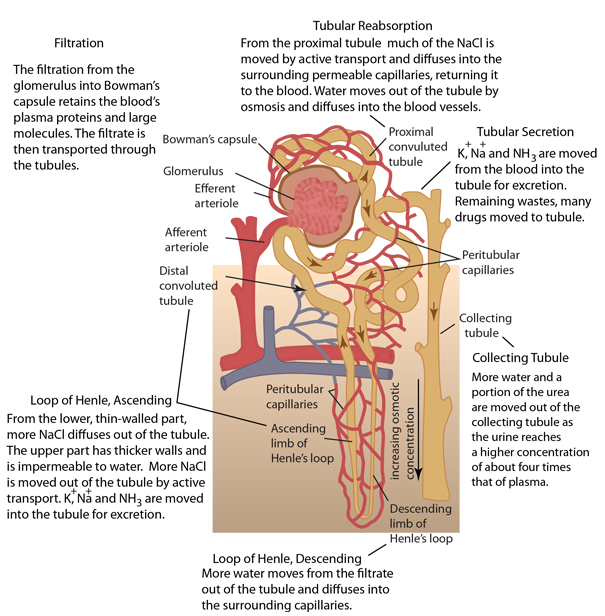
Multiple processes in the nephrons of the kidney accomplish the balancing of the constituents of the blood and interstitial fluid while concentrating the urine for excretion. In addition to the overall regulation of the water content of the blood, the complex process retains the plasma proteins and large molecules in the blood. It also regulates nutrients such as glucose, amino acids, vitamins, urea and a variety of ions including sodium, potassium, chloride and sulfate. In this context there are several descriptive terms: 肾小球的多种过程实现对血液及间质液成分的平衡,同时浓缩尿液以排出体外。除了调节血液的总体水分含量外,这一复杂过程还保留血浆蛋白和大分子在血液中。它还调节诸如葡萄糖、氨基酸、维生素、尿素以及包括钠、钾、氯和硫酸盐在内的多种离子。在此背景下,有几个描述性术语: Filtration: The main part of the filtration of the blood occurs in the glomerulus of the nephron, with the resulting fluid called the filtrate collected in Bowman's capsule and then proceeding to the tubules. The filtrate subsequently refers to the content of the tubules and further structures leading to the final excretion of the urine. 滤过:血液滤过的大部分发生在肾单位的肾小球中,产生的液体称为滤液,被收集到Bowman囊中,然后进入肾小管。滤液随后指肾小管及进一步结构中的内容,最终形成尿液排出。 Tubular Reabsorption: The process by which cells of the proximal tubule remove water and nutrients from the filtrate within the tubule and pass them back into the blood. 管状重吸收:近端小管细胞将滤过液中的水分和营养物质重新吸收回血液的过程。 Tubular Secretion: the process by which wastes and excess substances that were not initially filtered out into Bowman's capsule are removed from the blood for excretion. ![]() 管性分泌: wastes 和 excess 物质在未被初始过滤进入 Bowman 肾小球囊之前,通过从血液中移除进行排泄的过程。 The multiple exchange processes allow the kidney to maintain the needed constituents in the blood with appropriate balance and also to excrete urine that is about four times the molar concentration of the blood plasma. A significant contributor is the fraction of nephrons which have long loops of Henle that extend down into the medulla of the kidney. The fluid exchange processes of the lower parts of the loop lead to an increasing concentration. Audesirk & Audesirk comment on the example of the desert kangaroo rat which has only very long loops of Henle and is able to concentrate its urine to 14 times its plasma concentration! 多重交换过程使肾脏能够维持血液中所需的成分在适当平衡下存在,同时排出约为血浆浓度四倍的尿液。一个重要因素是那些具有长而深入肾髓质的亨利氏肾单位的分数。循环下部的液体交换过程导致浓度逐渐增加。Audesirk & Audesirk 提到沙漠袋鼠鼠的例子,这种动物只有非常长的亨利氏 loops,能够将尿液浓缩到血浆浓度的14倍! The tubular secretion process associated with the distal tubule is credited with helping remove a number of substances. Hydrogen ions are removed from the blood by active transport there, and the kidney's regulation of the pH of the blood is associated with control of the relative concentration of hydrogen and bicarbonate ions. The kidney removes some potential harmful substances such as some drugs, pesticides, food additives, and nicotine from cigarette smoke. 与远端小管相关的管形分泌过程有助于去除多种物质。氢离子通过主动运输从血液中移除,肾脏对血液pH值的调节与氢离子和碳酸氢根离子浓度的相对控制有关。肾脏还能去除一些潜在有害物质,如某些药物、农药、食品添加剂和香烟烟雾中的尼古丁。 |
Index Reference Audesirk & Audesirk Ch 26, 30 Thibodeau & Patton Ch 28 索引参考Audesirk & Audesirk第26章、第30章;Thibodeau & Patton第28章 | ||
|
Go Back
返回 |
Filtration and Reabsorption by the Kidney肾脏的滤过与重吸收
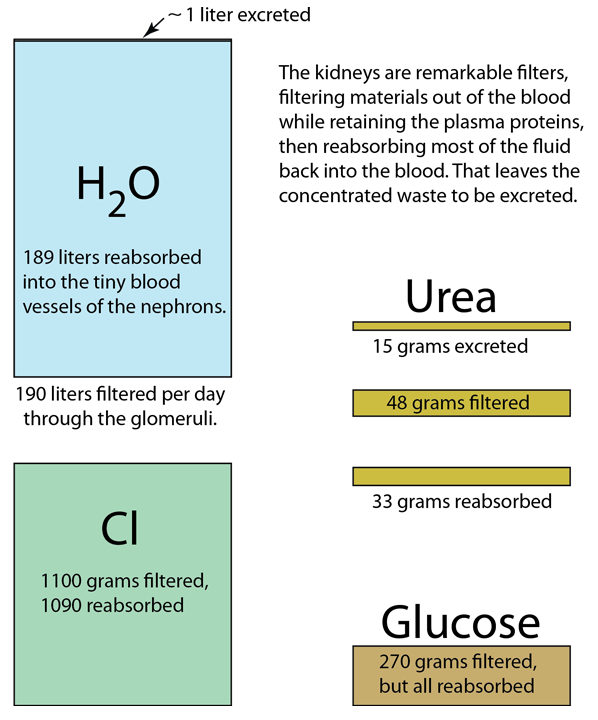
The kidneys handle many substances in their role of contributing the fluid balance and homeostasis of the body. This data is from Thibodeau & Patton. ![]() 肾脏在维持身体的体液平衡和稳态中起着重要作用。此数据来自Thibodeau & Patton。 Almost all of the useful cellular constituents are reabsorbed into the blood. The urea cycle in the liver converts the toxic NH3 into urea, a non-toxic form which is then transported to the kidneys. One might expect that the urea would all be excreted, but in fact only about a third of it is excreted. The reabsorption of urea provides a higher concentration of urea in the inner medulla of the kidney and is thought to contribute to being able to achieve the observed concentration of the urine in the collecting tubule. (Ask a Biologist) 几乎所有的有用细胞成分都会重新吸收回血液中。肝脏中的尿素循环将有毒的NH₃转化为尿素,这是一种无毒形式,随后被运输到肾脏。人们可能会认为尿素都会被排出,但实际上只有约三分之一的尿素会被排出。尿素的重吸收使肾髓质内侧形成较高的尿素浓度,并被认为有助于实现集合管中观察到的尿液浓度。(Ask a Biologist) |
Index Reference Audesirk & Audesirk Ch 26, 30 Thibodeau & Patton Ch 28 索引参考Audesirk & Audesirk第26章、第30章;Thibodeau & Patton第28章 | ||
|
Go Back
返回 |