Bilingual edition: English is preserved and Chinese follows each unit. Terminology uses the confirmed v20260916 glossary; automated semantic review remains traceable.
中英双语版:英文原文完整保留,中文紧随对应单元;术语采用 v20260916 确认表,自动语义审校结果可追溯。

The Expansion of Water Upon Freezing

水在冻结时的膨胀

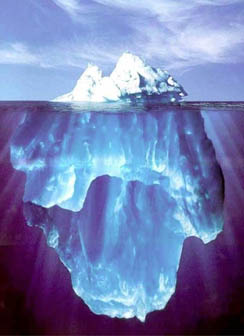
The fact that water expands upon freezing causes icebergs to float. The fact that water reaches a maximum density at about 4°C causes bodies of water to freeze on the top first. Then the further expansion as a part of the phase change keeps the ice floating with some 8% of its mass above the surface. The expansion during the phase change may be shown on a PvT surface, and contrasts with the contraction upon freezing of most substances.

水在冻结时膨胀的特性使得冰山能够漂浮。水在约4°C时达到最大密度的特性导致水体先在表面结冰。在相变过程中进一步的膨胀保持了冰的漂浮状态,其中约8%的质量位于水面之上。相变过程中的膨胀可以在PvT曲面上显示,并与大多数物质冻结时的收缩形成对比。

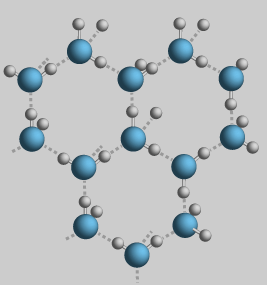
The expansion upon freezing comes from the fact that water crystallizes into an open hexagonal form. This hexagonal lattice contains more space than the liquid state.

水在冻结时膨胀是因为水结晶成一种开放的六边形结构。这种六边形晶格包含比液态更多的空间。

While the hexagonal ice form discussed above is the primary form of ice and is the dominant form from the freezing point at 273K down to about 72 K, 13 different crystalline forms of ice have been idendified according to Debenedetti and Stanley.

上述六边形冰晶是冰的主要形态,在从273K的冰点降至约72K的过程中占主导地位,但根据Debenedetti和Stanley的分类,已鉴定出13种不同的冰的晶体形态。
Index

Water concepts

Chemistry concepts
索引 水概念 化学概念
 
HyperPhysics*****Chemistry
HyperPhysics ***** 化学
R Nave
Go Back
返回


Water Density

水的密度

Water at ordinary temperatures contracts and increases in density as it is cooled, like most substances. But at about 4°C it reaches a maximum density and then decreases in density as it approaches the freezing point. This decrease in density is only about one part in 10,000 as it cools from 4°C to 0°C, but this is sufficient to cause the water near freezing to come to the top. The water further expands upon freezing, so that water freezes from the top down, and ice floats on water.

在常温下,水冷却时会收缩并密度增加,这与其他大多数物质类似。但大约在4°C时,水的密度达到最大值,随后随着温度接近冰点,密度开始减小。当水从4°C冷却到0°C时,密度减少约1/10000,但这一变化足以使接近冰点的水浮到水面。水在结冰时进一步膨胀,因此水是自上而下冻结的,冰浮在水面上。
Water has the highest specific heat of any common substance, 1 calorie/gm °C = 4.186 J/gm °C. This provides stability of temperature for land masses surrounded by water, provides stability for the temperature of the human body, makes it an effective cooling agent, and many other benefits. The high heat of vaporization of water makes it an effective coolant for the human body via evaporation of perspiration, extending the range of temperatures in which humans can exist.
水是所有常见物质中比热最高的,1 卡/克·摄氏度 = 4.186 焦/克·摄氏度。这为被水包围的陆地提供了温度稳定性,为人体温度提供了稳定性,使其成为一种有效的冷却剂,并有许多其他好处。水的高汽化热使其通过汗液蒸发成为人体的有效冷却剂,扩展了人类可以存在的温度范围。
Water provides the standard for density at 1 gram/cm3.
水的密度标准为1克/立方厘米。
Index

Water concepts

Chemistry concepts
索引 水概念 化学概念
 
HyperPhysics*****Chemistry
HyperPhysics ***** 化学
R Nave
Go Back
返回