Bilingual edition: English is preserved and Chinese follows each unit. Terminology uses the confirmed v20260916 glossary; automated semantic review remains traceable.
中英双语版:英文原文完整保留,中文紧随对应单元;术语采用 v20260916 确认表,自动语义审校结果可追溯。

Internal Energy

内能

Internal energy is defined as the energy associated with the random, disordered motion of molecules. It is separated in scale from the macroscopic ordered energy associated with moving objects; it refers to the invisible microscopic energy on the atomic and molecular scale. For example, a room temperature glass of water sitting on a table has no apparent energy, either potential or kinetic. But on the microscopic scale it is a seething mass of high speed molecules traveling at hundreds of meters per second. If the water were tossed across the room, this microscopic energy would not necessarily be changed when we superimpose an ordered large scale motion on the water as a whole.
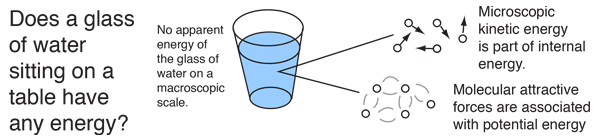
内能是指与分子无序、随机运动相关的能量。它在尺度上与宏观有序能量(与物体运动相关的能量)相分离;它指的是在原子和分子尺度上的不可见微观能量。例如,放在桌子上的室温玻璃水看起来没有明显的能量,无论是势能还是动能。但在微观尺度上,它却是一群高速运动的分子组成的沸腾体,这些分子以每秒数百米的速度运动。如果水被扔到房间的另一端,当我们在整体上给水叠加一个有序的大尺度运动时,这种微观能量并不会必然发生变化。


U is the most common symbol used for internal energy.

Related energy quantities which are particularly useful in chemical thermodynamics are enthalpy, Helmholtz free energy, and Gibbs free energy.

在化学热力学中特别有用的相关能量量是焓、亥姆霍兹自由能和吉布斯自由能。
Temperature and kinetic energy
温度与动能
Equipartition of energy
能量均分
Thermal energy
热能
Can a molecule's trajectory be predicted like that of a baseball?
分子的轨迹能否像棒球一样被预测?
U 是用于表示内能的最常用符号。
Index

Internal energy concepts
索引 内能概念
 
HyperPhysics***** Thermodynamics
HyperPhysics ***** 热力学
R Nave
Go Back
返回


Microscopic Energy

微观能量

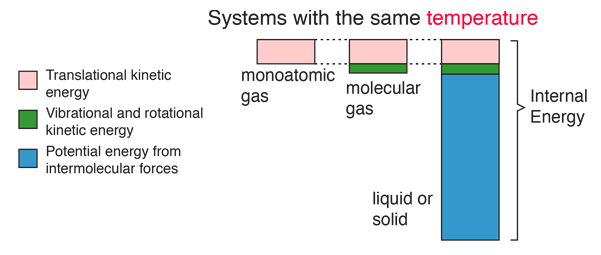
Internal energy involves energy on the microscopic scale. For an ideal monoatomic gas, this is just the translational kinetic energy of the linear motion of the "hard sphere" type atoms, and the behavior of the system is well described by kinetic theory. However, for polyatomic gases there is rotational and vibrational kinetic energy as well. Then in liquids and solids there is potential energy associated with the intermolecular attractive forces. A simplified visualization of the contributions to internal energy can be helpful in understanding phase transitions and other phenomena which involve internal energy.

内能涉及微观尺度上的能量。对于理想单原子气体,这仅仅是单个原子线性运动的平动动能,而系统的行为可以用气体动理论很好地描述。然而,对于多原子气体,还有转动和振动动能。在液体和固体中,还存在与分子间吸引力相关的势能。对内能贡献的简化可视化有助于理解涉及内能的相变及其他现象。
What is measured by temperature?
温度测量的是什么?
Energy to heat water
能量加热水
Index

Internal energy concepts
索引 内能概念
 
HyperPhysics***** Thermodynamics
HyperPhysics ***** 热力学
R Nave
Go Back
返回


Internal Energy Example

内能示例

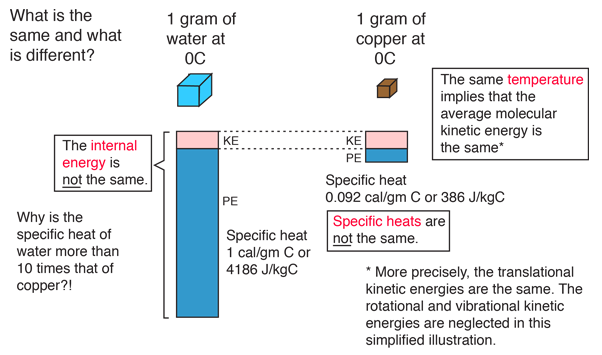
When the sample of water and copper are both heated by 1°C, the addition to the kinetic energy is the same, since that is what temperature measures. But to achieve this increase for water, a much larger proportion of the energy must be added to the potential energy portion of the internal energy. So the total energy required to increase the temperature of the water is much larger, i.e., its specific heat is much larger.

当水和铜的样本都加热1°C时,动能的增加量是相同的,因为温度正是衡量这一量的。但要实现这一增加,为水所加的能量中,必须有更大的比例转化为内能中的势能部分。因此,使水温度升高的总能量需求要大得多,即水的比热容远大于铜。
Temperature and kinetic energy
温度与动能
Specific heat
比热容
Internal energy
内能
Microscopic energy
微观能量
Water
水
Index

Internal energy concepts
索引 内能概念
 
HyperPhysics***** Thermodynamics
HyperPhysics ***** 热力学
R Nave
Go Back
返回