Bilingual edition: English is preserved and Chinese follows each unit. Terminology uses the confirmed v20260916 glossary; automated semantic review remains traceable.
中英双语版:英文原文完整保留,中文紧随对应单元;术语采用 v20260916 确认表,自动语义审校结果可追溯。

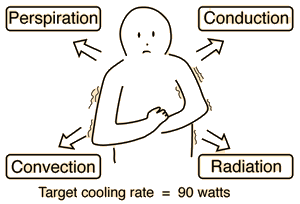
Perspiration Cooling of Body
体表蒸发散热

For 600 gm/day perspiration,
cooling rate Q/t = 17 watts.

对于每天蒸发600克的汗水,散热速率Q/t = 17瓦特。
Why is the heat of vaporization
greater at body temperature?
为什么在体温时汽化热更大?

When the ambient temperature is above body temperature, then radiation, conduction and convection all transfer heat into the body rather than out. Since there must be a net outward heat transfer, the only mechanisms left under those conditions are the evaporation of perspiration from the skin and the evaporative cooling from exhaled moisture. Even when one is unaware of perspiration, physiology texts quote an amount of about 600 grams per day of "insensate loss" of moisture from the skin.

当环境温度高于体温时,辐射、传导和对流都会将热量传入体内而非传出。由于必须有净的热量向外转移,此时剩下的传热机制只能是皮肤表面汗液的蒸发以及呼出的湿气的蒸发散热。即使人们并未意识到出汗,生理学教材仍引用每天约600克的‘无意识失水’从皮肤流失的数据。

The cooling effect of perspiration evaporation makes use of the very large heat of vaporization of water. This heat of vaporization is 540 calories/gm at the boiling point, but is even larger, 580 cal/gm, at the normal skin temperature.

汗水蒸发的冷却效应利用了水非常大的汽化热。这种汽化热在沸点时为540卡/克,但在正常皮肤温度时更大,达到580卡/克。

If the rate of evaporation of perspiration is gm/day = gm/hr

如果汗液的蒸发速率是 gm/day = gm/hr
中文译文中的待填/计算数值依次对应:1:s1 2:s2。实际数值以上方原输入框为准。
then the cooling rate is
Q/t = watts.

As part of the physiological regulation of body temperature, the skin will begin to sweat almost precisely at 37°C and the perspiration will increase rapidly with increasing skin temperature. Guyton reports that a normal maximum perspiration rate is about 1.5 liters/hour, but that after 4 to 6 weeks of acclimatization in a tropical climate, it can reach 3.5 liters/hr! You would have to just sit around drinking constantly, just to keep from getting dehydrated! That maximum rate corresponds to a maximum cooling power of almost 2.4 kilowatts!

作为身体调节体温的生理过程之一,皮肤几乎在37°C时开始出汗,且随着皮肤温度的升高,出汗量会迅速增加。Guyton指出,正常最大出汗速率约为1.5升/小时,但经过4到6周在热带气候中的适应后,可以达到3.5升/小时!你必须一直坐着不停地喝水,否则就会脱水!这个最大速率对应的最大冷却功率几乎为2.4千瓦!
Heat transfer by vaporization
通过汽化传热
Evaporation cooling
蒸发冷却
Modeling the cooling of the human body
人体冷却的建模
则冷却速率是Q/t = 瓦特。
中文译文中的待填/计算数值依次对应:1:q。实际数值以上方原输入框为准。
Index

Heat transfer concepts

Heat transfer examples

Reference
Guyton
Ch. 47
索引 热传递概念 热传递示例 参考 Guyton 第47章
 
HyperPhysics***** Thermodynamics
HyperPhysics ***** 热力学
R Nave
Go Back
返回


Heat Transfer by Vaporization

通过汽化传热

If part of a liquid evaporates, it cools the liquid remaining behind because it must extract the necessary heat of vaporization from that liquid in order to make the phase change to the gaseous state. It is therefore an important means of heat transfer in certain circumstances, such as the cooling of the human body when it is subjected to ambient temperatures above the normal body temperature.

如果液体中的一部分汽化,它会冷却剩下的液体,因为它必须从该液体中提取必要的汽化热,以便完成到气态的相变。因此,在某些情况下,这是重要的散热方式,例如当人体处于高于正常体温的环境温度时,人体的冷却。
Cooling by evaporation
蒸发冷却
Index

Heat transfer concepts

Heat transfer examples
索引 热传递概念 热传递示例
 
HyperPhysics***** Thermodynamics
HyperPhysics ***** 热力学
R Nave
Go Back
返回


Cooling by Evaporation

通过蒸发冷却

Because of the large heat of vaporization of water, the evaporation from a liquid surface is a very effective cooling mechanism. The human body makes use of evaporative cooling by perspiration to give off energy even when surrounded by a temperature higher than body temperature. The cooling process is an example of the approach to thermal equilibrium. The evaporative cooling rate is given by

由于水的汽化热很大,液体表面的蒸发是一个非常有效的冷却机制。人体通过出汗利用蒸发冷却来在周围温度高于体温时散发能量。这个冷却过程是向热平衡靠近的一个例子。蒸发冷却速率由

If m = gm of water at 100 °C is evaporated in t = sec, the cooling rate at 100 °C is

Q/t= cal/s = watts = BTU/hr.

若将100 °C时水的质量m在t秒内蒸发,则100 °C时的冷却速率为Q/t = cal/s = watts = BTU/hr。
中文译文中的待填/计算数值依次对应:1:m 2:t 3:qc 4:qw 5:qb。实际数值以上方原输入框为准。

The cooling rate for a liquid (below boiling) is more complicated since the heat of vaporization changes with temperature, and the rate of evaporation depends upon ambient temperature and relative humidity.

液体(低于沸点)的冷却速率更为复杂,因为汽化热随温度变化,而蒸发速率取决于环境温度和相对湿度。
Vaporization as a heat transfer mechanism
汽化作为传热机制
Index

Heat transfer concepts

Heat transfer examples

Thermal equilibrium
热传导概念 热传导实例 热平衡
 
HyperPhysics***** Thermodynamics
HyperPhysics ***** 热力学
R Nave
Go Back
返回

