Some energy details related to heating water
与加热水有关的一些能量细节
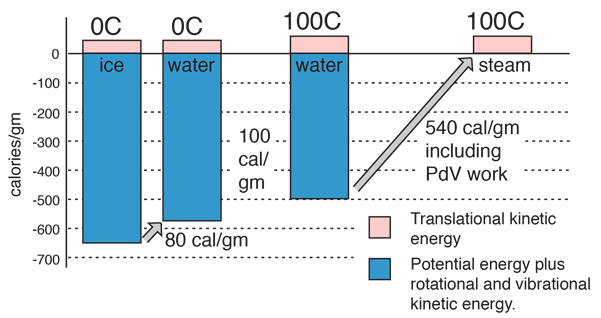
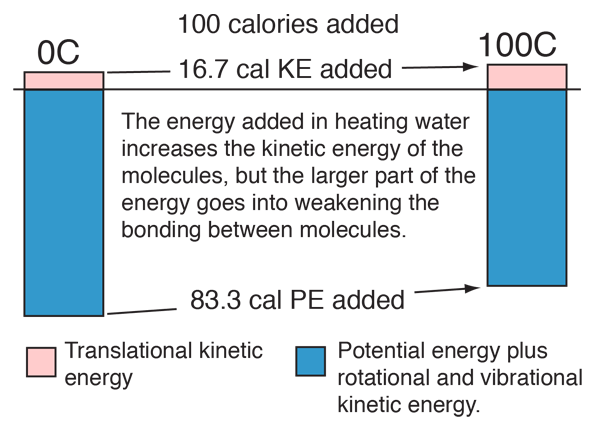
In the process of heating water from 0 to 100 C, 100 calories of energy must be added. Part of that energy increases the kinetic energy of the molecules, and some adds to the potential energy. To assess the amount added to kinetic energy, the molecular speeds at the two temperatures may be evaluated with the Boltzmann speed distribution.
在将水从0°C加热到100°C的过程中,必须加入100卡路里能量。其中一部分能量增加了分子的动能,另一部分则增加了势能。要评估加到动能中的能量,可以利用波尔兹曼速度分布评估两个温度下的分子速度。
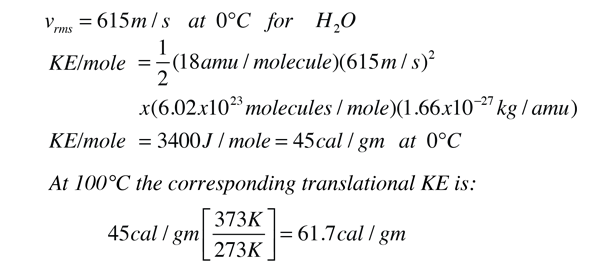
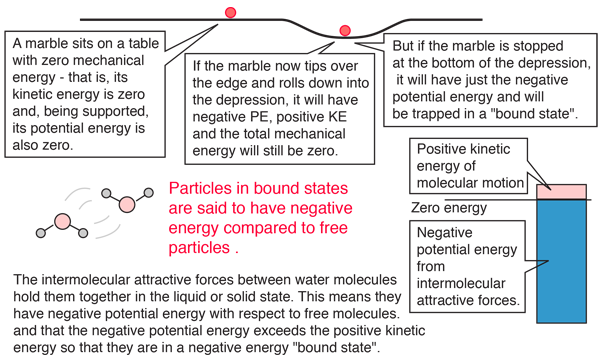
The net gain in kinetic energy is then 16.7 calories/gram when the water is heated from 0 to 100 C. The remainder of the energy goes into weakening the attractive forces between the water molecules. This weakening of the intermolecular forces manifests itself in the reduction of the surface tension of water as it is heated.
水从0°C加热到100°C时,动能的净增加量为16.7卡/克。剩余的能量则用于削弱水分子之间的吸引力。这种削弱 intermolecular forces 的现象表现为水的表面张力随着加热而减少。
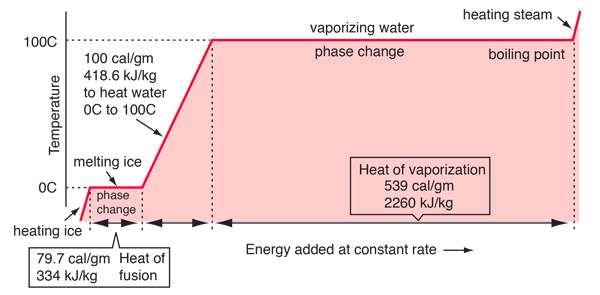
In the process of vaporization of water, a large amount of energy must be added to overcome the remaining cohesive forces between the molecules and an additional amount of energy goes into PdV work to expand the gas from its very small liquid volume to the volume occupied by the resulting vapor.
在水的汽化过程中,必须加入大量能量以克服分子间的剩余内聚力,同时还需要额外的能量用于将气体从非常小的液态体积膨胀到由生成的蒸汽占据的体积,这部分能量以PdV功形式存在。
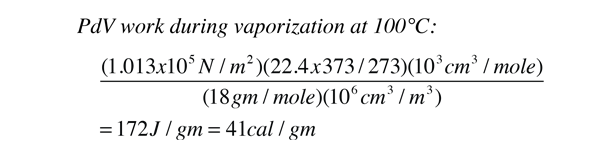
If the heat of vaporization of water at 100°C is 539 calories, then subtracting the 41 calorie work component suggests that the actual binding energy of the water molecules at 100°C is 539-41=498 calories.
如果水在100°C时的汽化热为539卡路里,那么减去41卡路里的工作成分,意味着水分子在100°C时的实际结合能为539-41=498卡路里。
Why is the heat of vaporization more at body temperature?
为什么汽化热在体温时更大?
An interesting feature of the process of cooling the human body by evaporation is that the heat extracted by the evaporation of a gram of perspiration from the human skin at body temperature (37°C) is quoted in physiology books as 580 calories/gm rather than the nominal 540 calories/gm at the normal boiling point. The question is, why is it larger at body temperature?
人体蒸发散热过程的一个有趣特征是,当一克皮肤上的汗水在体温(37°C)下蒸发时,生理学书籍中引用的热量为580卡/克,而不是在正常沸点时的名义值540卡/克。问题是,为什么在体温下这个数值更大?
The main part of the answer is that the binding energy of the water molecules is greater at that lower temperature, and it therefore takes more energy to break them apart into the gaseous state. The change in the heat of vaporization can be roughly calculated using what we know from the specific heat of water, 1 calorie/gm °C. It takes 37 calories to heat a gram of water from 0°C to 37°C, but the change in the kinetic energy is much less than that:
答案的主要部分是,水分子在较低温度下的结合能更大,因此将它们分解为气态需要更多的能量。利用我们对水的比热容,1 卡/克·摄氏度,可以大致计算出汽化热的变化。将 1 克水从 0°C 加热到 37°C 需要 37 卡路里,但动能的变化远小于这个数值:
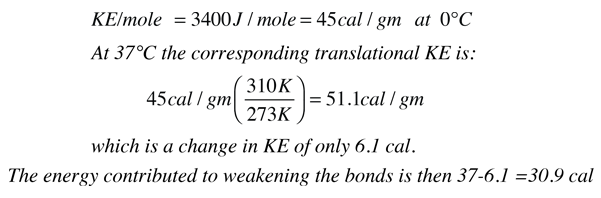
It was shown above that the kinetic energy of the water molecules only increases by 61.7 - 45 = 16.7 calories/gm when the water is heated from zero to 100°C but we know it takes 100 calories to do that heating. Therefore the contribution to weakening the water bonds is 83.3 calories/gm. Using the result for water at 37°C it is evident that 52.4 calories of additional energy must be supplied at 37°C to vaporize the water.
如上所示,当水从0°C加热到100°C时,水分子的动能仅增加61.7 - 45 = 16.7卡/克,但我们知道要实现这种加热需要100卡。因此,对水分子间键的削弱贡献为83.3卡/克。利用水在37°C时的结果可以明显看出,在37°C时,要使水汽化还需额外供给52.4卡的能量。
There is one additional element in modeling the heat of vaporization at body temperature - the PdV work required to expand the water into its gaseous form is slightly less at 37°C. By analogy with the work calculation above, that work is found to be 34.2 calories/gm, 6.8 calories/gm less than at 100°C.
This model then suggests a heat of vaporization at 37°C:
该模型则建议在37°C时存在汽化热:
Body temperature heat of vaporization = 539 cal/gm + 52.4 cal/gm - 6.8 cal/gm = 585 cal/gm.
So this simple model agrees fairly well with the quoted 580 cal/gm.
因此,这个简单的模型与引用的580 cal/gm基本相符。
在模拟体温下的汽化热时,还有一个额外的因素——将水膨胀为气态所需的PdV功在37°C时略低。类比上述功的计算,该功被发现为34.2 cal/gm,比在100°C时少6.8 cal/gm。体温下的汽化热=539 cal/gm + 52.4 cal/gm - 6.8 cal/gm = 585 cal/gm。 |