| Standard collision examples
标准碰撞示例 | Development of equations
方程的建立 | Elastic vs Inelastic
弹性 vs 非弹性 |
Collision concepts
索引 碰撞概念
| HyperPhysics***** Mechanics
力学 | R Nave |
返回
|
Index Collision concepts 索引 碰撞概念 | |||
|
Go Back
返回 |
Head-on Elastic Collisions, Target at Rest正面对撞弹性碰撞,目标静止
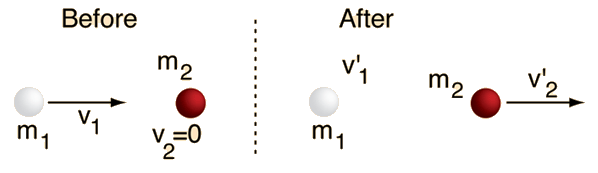
To obtain expressions for the velocities after the collision, rewrite the above as: 
Note that these equations apply only to the case where the target is at rest.
请注意,这些方程仅适用于目标静止的情况。
为获得碰撞后速度的表达式,将上述内容重写为: |
Index Collision concepts 索引 碰撞概念 | ||||||||||||
|
Go Back
返回 |
Velocities After Collision碰撞后的速度
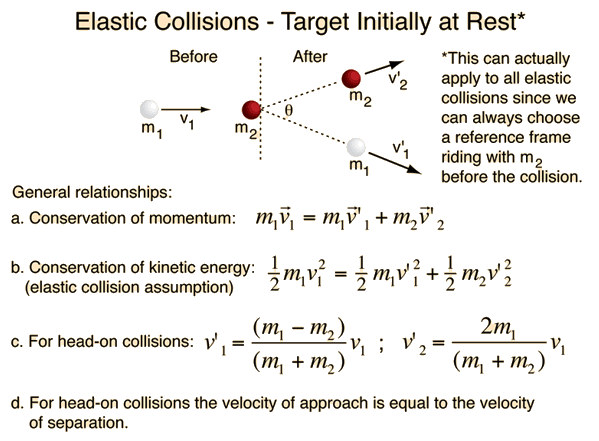
For head-on elastic collisions where the target is at rest, the derived relationship may be used along with conservation of momentum equation 可以与动量守恒方程一起使用
 to obtain expressions for the individual velocities after the collision. 为了获得碰撞后个体速度的表达式
 These relationships may be used for any head-on collision by transforming to the frame of the target particle before using them, and then transforming back after the calculation. However, one may calculate the case for head-on collisions where both particles are moving with the relationships: 
这些关系可以用于任何正面对撞的情况,通过先转换到目标粒子的参考系中再应用它们,计算完成后再转换回原参考系。然而,也可以直接利用这些关系来计算正面对撞的情况,其中两个粒子均在运动。
对于目标物静止的正碰弹性碰撞,推导出的关系式 |
Index Collision concepts Elastic collisions 索引 碰撞概念 弹性碰撞 | ||
|
Go Back
返回 |


