Head-on Elastic Collisions
正面弹性碰撞
Click on any of the examples for further details.
 |
 |
 |
单击任一示例可查看详情。
Collision concepts
索引 碰撞概念
| HyperPhysics***** Mechanics
力学 | R Nave |
返回
Head-on Elastic Collisions正面弹性碰撞
Click on any of the examples for further details.
单击任一示例可查看详情。 |
Index Collision concepts 索引 碰撞概念 | |||
|
Go Back
返回 |
Elastic Collision, Equal Masses弹性碰撞,等质量
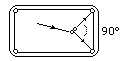
For a head-on collision with a stationary object of equal mass, the projectile will come to rest and the target will move off with equal velocity, like a head-on shot with the cue ball on a pool table. This may be generalized to say that for a head-on elastic collision of equal masses, the velocities will always exchange.
对于一个静止质量相等的物体的正面对撞,弹丸将停止运动,而目标物将以相同的速度运动,就像在台球桌上,击打的球杆球碰到其他球一样。这可以推广为,在质量相等的正面对撞弹性碰撞中,速度总是会交换。 |
Index Collision concepts Elastic collisions 索引 碰撞概念 弹性碰撞 | ||||||
|
Go Back
返回 |
Elastic Collision, Massive Projectile弹性碰撞,大质量弹体
In a head-on elastic collision where the projectile is much more massive than the target, the velocity of the target particle after the collision will be about twice that of the projectile and the projectile velocity will be essentially unchanged. For non-head-on collisions, the angle between projectile and target is always less than 90 degrees. This was important in the analysis of the original Rutherford scattering experiment. 对于非正面碰撞,弹丸与靶子之间的夹角始终小于90度。这一点在分析原始的卢瑟福散射实验时非常重要。
This case implies that a train moving at 60 miles/hr which hits a small rock on the track could send that rock forward at 120 miles/hr if the collision were head-on and perfectly elastic. It also implies that if the speed of the head of your golf club is 110 miles/hr, the limiting speed on the golf ball off the tee is 220 miles/hr in the ideal case. That is, the limiting speed of the ball depends strictly on the clubhead speed, and not on how much muscle power you put into the swing.
在迎面碰撞的弹性碰撞中,如果弹丸的质量远大于目标物体,碰撞后目标物体的速度将大约是弹丸速度的两倍,而弹丸的速度几乎不变。这种情形表明,一列以60英里/小时行驶的火车如果撞上轨道上的一个小石头,且碰撞是迎面的完全弹性碰撞,那么石头将被向前推出约120英里/小时。它也表明,如果高尔夫球杆头的速度是110英里/小时,那么在理想情况下,球的最高速度将为220英里/小时。也就是说,球的最高速度仅取决于球杆头的速度,而与你挥杆时施加的肌肉力量无关。 |
Index Collision concepts Elastic collisions 索引 碰撞概念 弹性碰撞 | |||
|
Go Back
返回 |
Elastic Collision, Massive Target弹性碰撞,大质量目标
In a head-on elastic collision between a small projectile and a much more massive target, the projectile will bounce back with essentially the same speed and the massive target will be given a very small velocity. One example is a ball bouncing back from the Earth when we throw it down.
In the case of a non-headon elastic collision, the angle of the projectiles path after the collision will be more than 90 degrees away from the targets motion.
在小弹丸与远比它质量大的目标物发生正碰弹性碰撞时,弹丸将几乎以相同速率弹回,而质量大的目标物将获得很小的速度。一个例子是当我们将球向下抛出时,球会从地球弹回。在非正碰的弹性碰撞中,弹丸碰撞后的路径角度将偏离目标物的运动方向超过90度。 |
Index Collision concepts Elastic collisions 索引 碰撞概念 弹性碰撞 | |||
|
Go Back
返回 |
Elastic Headon Collision弹性正碰
The head-on elastic collision relationships:  A positive velocity is taken as a velocity to the right in the calculation, so for leftward motion you should enter a negative number. The calculation assumes that a collision took place, but if you get a negative number for the velocity of approach above, this means you chose a scenario where no collision would actually happen. 在计算中,正速度被定义为向右的方向,因此对于向左的运动,应输入一个负数。计算假设发生了碰撞,但如果上述速度接近的数值为负数,这表明你选择了实际上不会发生碰撞的情景。
头对头的弹性碰撞关系:可用于计算此类碰撞后的速度。当目标静止(v₂ = 0)时,这些关系简化为 |
Index Collision concepts Elastic collisions Inelastic head-on collisions 索引 碰撞概念 弹性碰撞 直接碰撞 | ||
|
Go Back
返回 |