Electric Field: Sheet of Charge
电场:带电平面
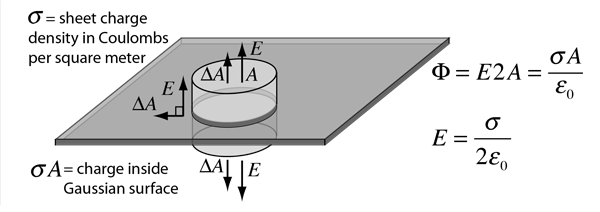
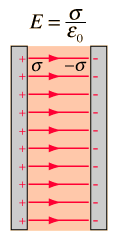
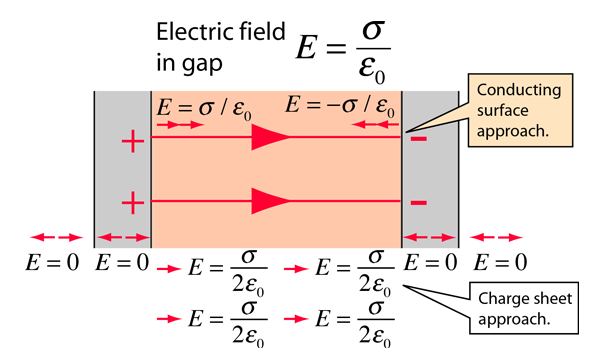
For an infinite sheet of charge, the electric field will be perpendicular to the surface. Therefore only the ends of a cylindrical Gaussian surface will contribute to the electric flux . In this case a cylindrical Gaussian surface perpendicular to the charge sheet is used. The resulting field is half that of a conductor at equilibrium with this surface charge density.
对于无限大的带电平面,电场将垂直于表面。因此,圆柱形高斯面的两端将对电通量做出贡献。在这种情况下,使用一个与带电平面垂直的圆柱形高斯面。所得的电场强度是该带电表面密度在平衡状态下导体上电场强度的一半。
| Fields for other charge geometries
其他电荷几何形状的场 |
Electric field concepts
索引 电场概念
| HyperPhysics***** Electricity and Magnetism
HyperPhysics ***** 电学和磁学 | R Nave |
返回