Gaussian Surfaces高斯面
Part of the power of Gauss' law in evaluating electric fields is that it applies to any surface. It is often convenient to construct an imaginary surface called a Gaussian surface to take advantage of the symmetry of the physical situation. 高斯定律在评估电场方面的优势之一在于它适用于任何曲面。通常方便地构造一个称为高斯面的假想曲面,以利用物理情境的对称性。
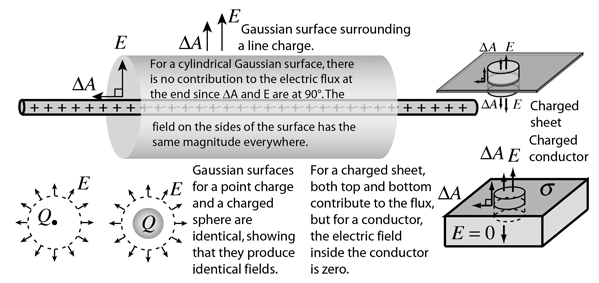
![]() If the symmetry is such that you can find a surface on which the electric field is constant, then evaluating the electric flux can be done by just multiplying the value of the field times the area of the Gaussian surface. 如果对称性允许你找到一个电场在该表面上恒定的曲面,则计算电通量只需将电场的值乘以高斯面的面积。
|
Index Electric field concepts 索引 电场概念 | ||
|
Go Back
返回 |
Conductor at Equilibrium导体处于平衡状态
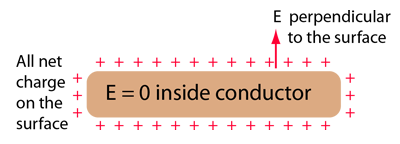
1. The net electric charge of a conductor resides entirely on its surface. (The mutual repulsion of like charges from Coulomb's Law demands that the charges be as far apart as possible, hence on the surface of the conductor.) 导体的净电荷完全位于其表面。(根据库仑定律,同种电荷之间的相互排斥要求电荷尽可能远离,因此位于导体的表面。)
2. The electric field inside the conductor is zero. (Any net electric field in the conductor would cause charge to move since it is abundant and mobile. This violates the condition of equilibrium: net force = 0.) 导体内部的电场为零。(导体中的任何净电场都会导致电荷移动,因为电荷丰富且可移动。这违反了平衡条件:净力=0。)
3. The external electric field at the surface of the conductor is perpendicular to that surface. (If there were a field component parallel to the surface, it would cause mobile charge to move along the surface, in violation of the assumption of equilibrium.) 3. 电场在导体表面处垂直于该表面。(如果存在平行于表面的电场分量,将会导致自由电荷沿表面移动,这与平衡的假设相矛盾。)
|
Index Electric field concepts 索引 电场概念 | ||||
|
Go Back
返回 |
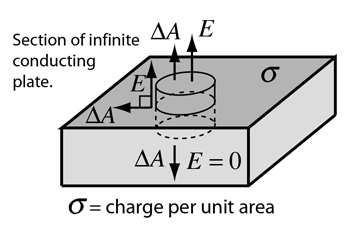
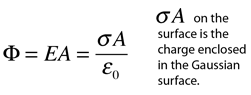
Electric Field: Conductor Surface电场:导体表面
|
Index Electric field concepts 索引 电场概念 | ||||
|
Go Back
返回 |