Household Wiring家庭布线
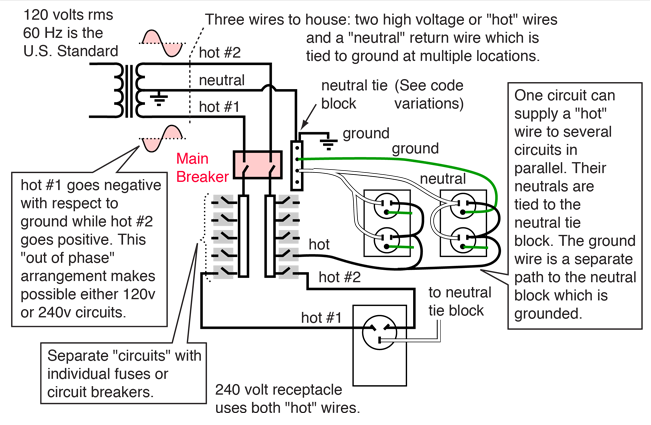
![]() The standard U.S. household wiring design has two 120 volt "hot" wires and a neutral which is at ground potential. The two 120 volt wires are obtained by grounding the centertap of the transformer supplying the house so that when one hot wire is swinging positive with respect to ground, the other is swinging negative. This versatile design allows the use of either hot wire to supply the standard 120 volt household circuits. For higher power applications like clothes dryers, electric ranges, air conditioners, etc. , both hot wires can be used to produce a 240 volt circuit. 美国标准的家庭布线设计包含两根120伏的'火线'和一根零线,其电位为接地电位。这两根120伏的火线是通过将变压器的中心抽头接地获得的,使得当一根火线相对于接地为正时,另一根则为负。这种灵活的设计允许使用任一火线来供电给标准的120伏家庭电路。对于更高功率的应用,如电 dryer、电烤箱、空调等,可以同时使用两根火线来产生240伏的电路。
|
Index Practical circuit concepts 索引 实用电路概念 | ||||||
|
Go Back
返回 |
Polarized Receptacles偏振接收器
![]()
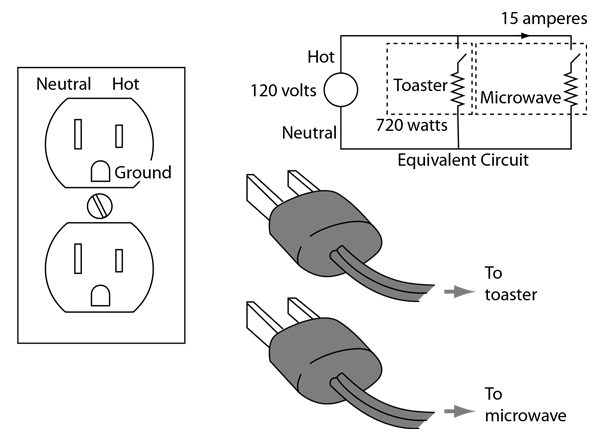
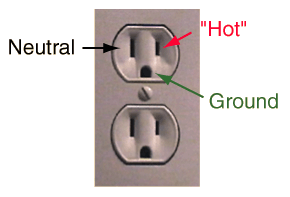
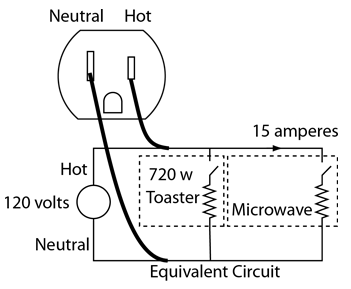
The two receptacles in a common "duplex" receptacle receive power from the same circuit leading from the main electrical supply panel. They are wired in parallel so that two appliances which are plugged into the receptacle receive the same voltage, but can draw different amounts of electric current. Parallel wiring is the standard for 120 volt circuits in the entire house, making possible the independent use of all appliances, supplied by the same voltage. 一个常见的“双孔”插座的两个插孔从主配电板引出的电路中获得电力。它们并联连接,使得插入手中的两个电器获得相同的电压,但可以抽走不同的电流。并联布线是整个房屋120伏电路的标准,使得所有电器都能独立使用,均受同一电压供电。
|
Index Practical circuit concepts 索引 实用电路概念 | ||||
|
Go Back
返回 |
Polarized Receptacles偏振接收器
|
Index Practical circuit concepts 索引 实用电路概念 | ||
|
Go Back
返回 |
The Electrical Code and Variations电气代码与变体
U.S. electrical wiring is governed by a general electrical code. For example, current code dictates three-prong polarized receptacles and dictates the use of ground fault interrupters in locations where an electrical appliance may be dropped in water. 美国的电气布线受一般电气规范的约束。例如,现行规范规定了三孔极化插座,并规定在可能有电器掉入水中的地点使用漏电保护器。
No attempt to summarize the code will be made here, but a few examples may be instructive. One recent variation which is in force in some locations is the requirement that the neutral tie block and ground wire tie block be separate. The neutral tie block is grounded at the center tap of the transformer which supplies the house, and the ground tie block is tied directly to ground via a ground stake or other grounding mechanism. This is different from the circuit panel illustration which reflects the long-standing practice of having a common neutral and ground tie block which was grounded at the house as well as at the transformer. 此处不作代码的总结,但举几个例子可能有助于理解。一种最近出现的变通做法在某些地区生效,即要求中性连接块和接地连接块必须分开。中性连接块通过变压器中性点接地,而接地连接块则通过接地棒或其他接地装置直接接地。这与电路面板的示意图不同,后者反映了长期以来的做法,即中性连接块和接地连接块共用,并且同时接地于房屋和变压器。
|
Index Practical circuit concepts 索引 实用电路概念 | ||
|
Go Back
返回 |