Resistor AC Response电阻AC响应
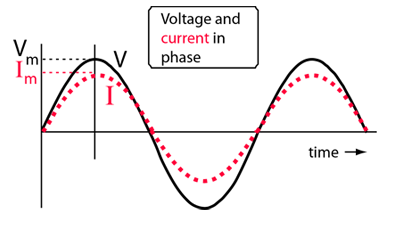
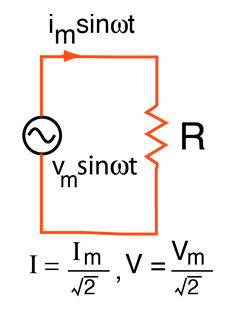
For ordinary currents and frequencies the behavior of a resistor is that of a dissipative element which converts electrical energy into heat. It is independent of the direction of current flow and independent of the frequency. So we say that the AC impedance of a resistor is the same as its DC resistance. That assumes, however, that you are using the rms or effective values for the current and voltage in the AC case. 对于普通电流和频率,电阻的行为是作为耗散元件将电能转化为热能。其行为与电流方向无关,也与频率无关。因此,我们说电阻的交流阻抗等同于其直流电阻。这假设在交流情况下使用的是均方根值或有效值的电流和电压。
|
Index AC Circuits 索引 AC 电路 | |||||||||||||||
|
Go Back
返回 |
RMS and Effective Values均方根值和有效值
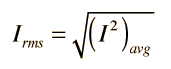
Circuit currents and voltages in AC circuits are generally stated as root-mean-square or rms values rather than by quoting the maximum values. The root-mean-square for a current is defined by 在交流电路中,电路电流和电压通常以均方根值(或称rms值)表示,而不是用最大值来表述。电流的均方根值定义为
![]() That is, you take the square of the current and average it, then take the square root. When this process is carried out for a sinusoidal current 也就是说,你对电流平方后取平均值,再取平方根。当这一过程应用于正弦电流时,
![]() Since the AC voltage is also sinusoidal, the form of the rms voltage is the same. These rms values are just the effective value needed in the expression for average power to put the AC power in the same form as the expression for DC power in a resistor. In a resistor where the power factor is equal to 1: 由于交流电压也是正弦的,rms电压的形式相同。这些rms值只是在平均功率表达式中所需的等效值,以便将交流功率表达式与直流功率在电阻中的表达式形式一致。在功率因数等于1的电阻中:
![]() Since the voltage and current are both sinusoidal, the power expression can be expressed in terms of the squares of sine or cosine functions, and the average of a sine or cosine squared over a whole period is = 1/2. 由于电压和电流都是正弦波,功率表达式可以表示为正弦或余弦函数的平方,而正弦或余弦平方在整个周期内的平均值为 1/2。
|
Index AC Circuits 索引 AC 电路 | ||
|
Go Back
返回 |