Incandescent Lighting
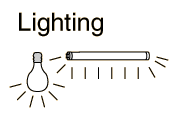 |
Although there are a large number of lighting options, the majority of lighting in homes is done by either incandescent or fluorescent lights. Fluorescent lighting has a considerable advantage in energy efficiency over incandescent lighting. Fluorescent lights can produce 50-100 lumens/watt compared to about 15 lumens/watt for incandescent bulbs. 尽管有众多的照明选择,家庭中大部分照明仍由白炽灯或荧光灯完成。荧光灯在节能方面比白炽灯有显著优势。荧光灯可产生50-100流明/瓦,而白炽灯约为15流明/瓦。
|
As an example, a 60 watt incandescent bulb produces light by heating a tungsten filament. A review by Denardo suggests that the temperature of the filament of a 60 W bulb is 2780 K. If you treat it as a blackbody radiator at that temperature and calculate the fraction of power in the visible wavelength range of 400-700nm, the result is 5.7% . That figure may be a bit low - typical figures quoted are 7%. Some factors affecting the real efficiency are the variation of the eye's sensitivity for the different wavelengths, and the possibility that some of the UV could be converted to visible in the material coating the bulb.
| Comment on energy cost
评论能量成本 | Energy units
能量单位 |
| Household energy use
家庭能源使用 |
Practical electric circuits
Reference
Bloomfield
Ch 12
Denardo
| HyperPhysics***** Electricity and Magnetism
HyperPhysics ***** 电学和磁学 | R Nave |