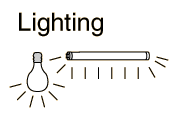
Fluorescent Lighting荧光照明
The familiar geometry of fluorescent lights involve a long narrow glass tube with two electrical connections on each of the metal caps which seal the ends of the tube. The tube is filled with noble gases such as argon, neon or krypton to suppress chemical reactions resulting from the electrical discharges in the tube. According to Bloomfield, these gases are at a pressure of about 0.3% of atmospheric pressure. A few drops of mercury is placed in the tube, and the vapor pressure is sufficient so that something like one in a thousand of the atoms inside the tube is a mercury atom in the gas phase. The properties of these mercury atoms make them very efficient light emitters by fluorescence when they are struck by energetic electrons inside the tube. 荧光灯熟悉的几何结构涉及一个长而窄的玻璃管,管的两端由金属帽密封,每个帽上都有两个电气连接。管内填充了惰性气体,如氩、氖或氪,以抑制管内电气放电引起的化学反应。根据Bloomfield的说法,这些气体的压力约为大气压的0.3%。管中加入少量汞,其蒸气压足够高,使得管内原子中约有千分之一是汞原子,处于气态。这些汞原子的性质使它们在被管内高能电子撞击时,通过荧光非常高效地发光。
If electrons are removed from the mercury atoms by collisions with high speed electrons, they can produce light by emission (see mercury spectrum) when electrons make transitions downward to fill the electron gaps produced. One key to getting light out of the fluorescent tube is then to produce the high speed electrons which can "excite" the mercury atoms so that they will produce light. This is done in most fluorescent tubes by heating a filament in the end of the tube, which frees some electrons . Other types use high voltages to eject electrons from electrodes at the ends. Once freed, the electrons can be accelerated in the tube by the applied AC voltage. Some of the electrons transfer energy to the mercury atoms in collisions, so that one or more of the electrons of the mercury atom is elevated to an excited state. Once the electrical discharge in the tube is started, the current must be controlled to maintain a steady light source. This is done by coil arrangement called a fluorescent light ballast. 如果高能电子与汞原子碰撞,使电子脱离汞原子,这些电子可以通过发射产生光(见汞光谱)来填补电子空位。因此,要从荧光灯管中得到光,关键在于产生高能电子,使它们能够‘激发’汞原子,从而产生光。大多数荧光灯管通过加热灯管末端的灯丝来实现这一点,这会释放出一些电子。其他类型则使用高压从电极末端击射电子。一旦电子被释放,它们可以在管内被施加的交流电压加速。一些电子在碰撞中将能量传递给汞原子,使汞原子中的一个或多个电子跃迁到激发态。一旦管内的电气放电开始,必须通过称为荧光灯镇流器的线圈排列来控制电流,以维持稳定的光源。
The process of producing light from the mercury atoms is fairly efficient, but a large part of it is in the ultraviolet rather than the visible range. The final transition of the electrons to the ground state of the mercury atom produces light at 254 nm, considerably below the blue limit of human vision at about 400 nm. The ultraviolet light does not get through the glass envelope of the tube, but because of its high quantum energy it can be used to advantage in producing visible light. To produce light in the visible range, the inside of the tube is coated with a phosphor powder. When the ultraviolet light strikes the powder, it produces excitations of the electrons of the phosphor which then produce visible light by a process called fluorescence. Ultraviolet photons associated with the 254 nm uv light have quantum energies of 4.9 electron volts, whereas the energy range for the visible photons which we can see is from 1.6 to 3.1 eV. Since there are many intermediate levels for the electrons to drop to after being excited by the uv photons, they can produce visible photons of light throughout the visible range, producing nearly white light. 汞原子产生光的过程相当高效,但大部分光位于紫外区域而非可见光范围。电子最终跃迁到汞原子的基态时,会产生波长为254 nm的光,这明显低于人眼可见光的蓝色极限,约为400 nm。紫外光无法穿透管子的玻璃外壳,但由于其高量子能量,可以被用来产生可见光。为了产生可见光,管内壁涂有磷光粉。当紫外光照射到粉层时,会激发磷光粉中的电子,这些电子通过一种称为荧光的过程产生可见光。与254 nm紫外光相关的紫外光子具有4.9电子伏特的量子能量,而我们能看到的可见光的光子能量范围是从1.6到3.1 eV。由于电子在被紫外光激发后可以跃迁到许多中间能级,因此可以产生覆盖整个可见光范围的可见光子,产生近似白光。
The production of white light is a challenging undertaking. In the case of the fluorescent lights, a carefully selected and blended set of phosphors is used so that the wavelengths at which it fluoresces are distributed evenly over the visible range. Current fluorescent lighting uses six standard phosphor blends: cool white, deluxe cool white, warm white, deluxe warm white, white, and daylight. The daylight phosphor which was used in early fluorescent lights tips the light toward the blue end and is criticized as being "cold". The "cool" phosphors resemble daylight and are more nearly color neutral, while the "warm" phospors tip the spectrum toward the red end and resemble incandescent lighting. 产生白光是一项具有挑战性的任务。在荧光灯的情况下,使用了一种精心选择并混合的磷光材料,使得其发光的波长在整个可见范围内均匀分布。目前荧光灯使用六种标准的磷光混合物:冷白光、豪华冷白光、暖白光、豪华暖白光、白光和日光。早期荧光灯中使用的日光磷光材料会使光线偏向蓝色端,并因其被描述为“冷”而受到批评。‘冷’型磷光材料更接近日光,且更接近色中性,而‘暖’型磷光材料则使光谱偏向红色端,更接近白炽灯的光效。
|
Index Practical electric circuits Reference Bloomfield Ch 12 索引 实用电子电路 参考 Bloomfield 第12章 | |||||
|
Go Back
返回 |
Fluorescent Light Ballast荧光灯镇流器
The operation of an incandescent light bulb is fairly simple and self-regulating. You apply the full electrical line voltage to the bulb and the current heats up the filament until it glows. The heating of the filament increases its electrical resistance, and that resistance limits the current to a controlled value. 白炽灯的工作原理相当简单且具有自我调节性。你将全电压施加到灯泡上,电流使灯丝加热直至发光。灯丝的加热使其电阻增加,而这一电阻限制了电流至一个受控的数值。
You can't just apply the full voltage to a fluorescent tube; you must provide for starting the electrical discharge and then controlling the resulting current in the arc discharge in the bulb. Many different strategies and approaches have been employed - for detailed information you need an industry source like that maintained on the web by Summit Electrical. 你不能直接将全电压加到荧光灯管上;你必须提供启动电弧放电的条件,并控制灯泡中形成的弧光放电电流。许多不同的策略和方法已被采用——要获取详细信息,你需要参考行业资料,如由Summit Electrical维护的网页资料。
Starting the lamp is the ballast's first task. The major types of starting strategies are (1) preheat, (2) slimline instant start, and (3) rapid start. If you need current technical information then you should be aware of two more recent types, (4) modified rapid start and (5) instant start of rapid start lamps. 启动灯泡是 ballast 的首要任务。主要的启动策略有三种:(1)预热,(2) slimline 瞬时启动,以及(3)快速启动。如果你需要技术信息,还应了解两种较新的类型,即(4)改良型快速启动和(5)快速启动灯的瞬时启动。
The "preheat" strategy was the original method used for fluorescent lights. The filaments in the lamp are heated for a few seconds before applying the full operating voltage to the lamp. This is done by having a switch in parallel with the gas tube which shunts current around the gas discharge path and through the filament heaters. After a few seconds the filaments reach the temperature necessary for them to emit electrons, and the switch is opened, applying the operating voltage to the tube to start the arc discharge in the gas. The ballast must then employ the current regulating circuitry discussed below. ‘预热’策略最初是荧光灯使用的办法。灯丝在施加全工作电压之前,会被加热几秒钟。这是通过在气体管子旁并联一个开关来实现的,该开关可以将电流分流到气体放电路径和灯丝加热器上。几秒钟后,灯丝达到能够发射电子的温度,开关则被断开,将工作电压施加到管子上,开始在气体中产生弧光放电。然后,镇流器必须采用下文讨论的电流调节电路。
The "slimline instant start" system produces light instantly by employing a transformer in the ballast to produce a voltage about three times the normal operating voltage to "strike the arc" in the bulb. Preheating the filaments is not required for this kind of system. ‘ slimline instant start ’系统通过在镇流器中使用变压器,立即产生光,产生约三倍于正常工作电压的电压以‘点燃灯丝间的弧光’。这种系统不需要预热灯丝。
The "rapid start" system is reportedly the most popular in the U.S. currently. These ballasts provide for continuous heating of the filaments for electron supply. They require that the fixture be properly grounded and that the lamps are within 1-2 cm of the metal fixture for proper starting. Because of the continuously heated filaments, these units do not require the high starting voltage of the slimline instant start types . The bulbs light immediately at low brightness and are fully lighted in about two seconds. ‘快速启动’系统目前在美国是最受欢迎的。这些镇流器可为电子供应提供持续的加热,以保持灯丝的温度。它们要求灯具正确接地,并且灯泡必须距离金属灯具1-2厘米以确保正常启动。由于灯丝持续加热,这些装置不需要像细线即时启动类型那样的高启动电压。灯泡在低亮度下立即点亮,并在约两秒内完全发光。
Once the bulbs are lighted, the ballast must control the current. An arc discharge is an inherently variable thing, and could be subject to high surge currents. The main mass of the ballast consists of a large coil wound around a laminated steel core to produce a large inductor, or "choke" as they are often called in the industry. The coil also acts as a transformer. The nature of an inductor is to limit the rate of change of current, so the large inductance of the ballast acts to suppress current spikes. The laminated-core coil is often "potted" in a material like asphalt to help with heat dissipation, and the combination is housed in a steel case. 一旦灯泡被点亮,镇流器必须控制电流。电弧放电是一种固有变化的现象,可能受到高浪涌电流的影响。镇流器的主要部分由一个绕在叠层钢芯上的大线圈组成,以产生一个大的电感器,或者在工业中通常称为“电感器”或“ choke”。线圈也起到变压器的作用。电感器的性质是限制电流变化率,因此镇流器较大的电感量有助于抑制电流尖峰。叠层芯线圈通常用类似沥青的材料“浇铸”以帮助散热,该组合被装入钢制外壳中。
There are also electronic and hybrid ballasts which perform the regulation tasks. Description of those systems may be added here. Comments and suggestions are welcomed. If you have detailed schematics of ballast operation, I would be interested - I have not found any. 还有电子式和混合式镇流器,它们负责调节任务。可以在此处添加这些系统的描述。欢迎提出意见和建议。如果您有详细的镇流器工作原理图,我将非常感兴趣——我尚未找到任何相关资料。
|
Index Practical electric circuits Reference Summit Ch 12 索引 实用电子电路 参考 总结 第12章 | ||
|
Go Back
返回 |