Bilingual edition: English is preserved and Chinese follows each unit. Terminology uses the confirmed v20260916 glossary; automated semantic review remains traceable.
中英双语版:英文原文完整保留,中文紧随对应单元;术语采用 v20260916 确认表,自动语义审校结果可追溯。

Household Energy Use

家庭能源使用
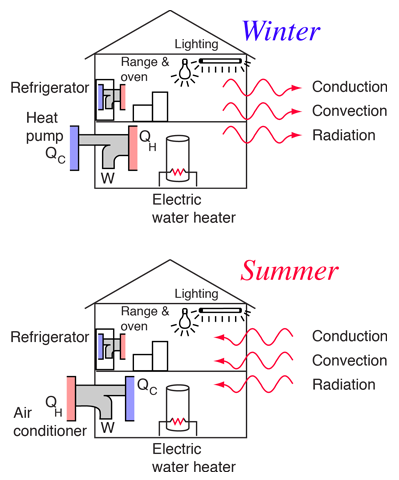
This is an active graphic. Click on any energy use for details.
这是一个动态图形。点击任何能源使用以获取详细信息。

When the need to conserve energy in your house is considered, then the focus should be mainly on heating and cooling processes. They are the major uses of energy. Hot water heating is also a sizable use of energy, as is the cooking process with surface unit and oven. The use of energy by a refrigerator is significant, and the lighting process for a whole house becomes a significant energy use. Electronic appliances on the whole use a small amount of energy, and are not a major part of energy conservation initiatives.

当考虑房屋中能源的保存时,重点应放在供暖和制冷过程上。它们是能源的主要用途。热水供暖也是能源的重要消耗,烹饪过程(使用表面单位和烤箱)也是如此。冰箱的能耗也很显著,全屋的照明过程也成为重要的能源消耗。电子设备整体上消耗的能源较少,因此不是节能措施的主要部分。
Comment on energy cost
评论能量成本
Energy units
能量单位
Table of insulation R-values
绝缘材料R值表
Index

Heat transfer concepts

Heat transfer examples
索引 热传递概念 热传递示例
 
HyperPhysics***** Thermodynamics
HyperPhysics ***** 热力学
R Nave
Go Back
返回


Electric Hot Water Heater

电热水壶
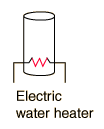
Commonly used electric water heaters in the U.S. use an electric resistance element to heat water directly. Some commercial water heaters employ the heat pump principle and are therefore more efficient by perhaps a factor of three, but they are not available in the residential market. Sometimes electric utility companies, in overenthusiastic marketing strategies, claim almost 100% efficiency for these water heaters. This is misleading because of the thermal bottleneck at the electric power plant; about three units of primary fuel is used to produce a unit of delivered electric energy, so the real efficiency is more like 33%. Natural gas water heaters at 60-70% efficiency are then about twice as efficient in the use of energy resources as the electric water heater.

美国常用的电水加热器通常使用电阻元件直接加热水。一些商用加热器采用热泵原理,因此可能效率高达三倍,但它们在住宅市场并不常见。有时电力公司为了吸引顾客,会声称这些水加热器几乎达到100%的效率。这种说法是误导的,因为电力站存在热瓶颈;大约需要三单位的初级燃料才能产生一单位的输送电能,因此实际效率可能只有33%。而天然气水加热器的效率为60-70%,因此在能源利用方面大约是电水加热器的两倍。

The energy necessary to heat water is determined by the specific heat of water:

加热水所需的能量由水的比热容决定:
cwater = 1 calorie/gm °C = 4186 J/kg°C = 1 BTU/lb °F

A typical U.S. residential water heater will be taken as one which has a capacity of 40 U.S. gallons (= 320 pounds, 145 kg, 151 liters). The typical heating range will be taken to be from 60 °F to 140 °F (15.6 °C to 60 °C). The energy required to heat the water can be determined from the specific heat relationship.

美国典型的家用热水器将被选为容量为40加仑(=320磅,145千克,151升)的热水器。通常的加热范围将被设定为从60华氏度到140华氏度(15.6摄氏度到60摄氏度)。加热水量所需的能量可通过比热关系确定。
Q = cmΔT

The energy required to heat one tank of water over the specified range is then

加热一个水箱在指定范围内的所需能量是

(1 BTU/lb °F)(320 lb)(140°F - 60 °F) = 25,600 BTU

(1 BTU/lb °F)(320 lb)(140°F - 60 °F) = 25,600 BTU(专名或术语)

or

或者

(4186 J/kg°C)(145 kg)(60 °C - 15.6 °C) = 26.9 million Joules

(4186 J/kg°C)(145 kg)(60 °C - 15.6 °C) = 26.9 million Joules(专名或术语)

Since a kilowatt-hour is 3.6 million Joules, this energy amounts to about 7.5 kWh of electricity. Taking an electric energy cost of 9.5¢/kWh, it would cost about 71¢ to heat one tank of hot water with an electric hot water heater assuming all the electric energy went into heating the water.

由于1千瓦时等于360万焦耳,这种能量相当于约7.5千瓦时的电能。若电价为每千瓦时9.5美分,那么用电动水加热器将一桶水加热,假设所有电能都用于加热水,费用大约为71美分。

If you use gallons of hot water

如果你使用大量热水
中文译文中的待填/计算数值依次对应:1:w。实际数值以上方原输入框为准。

and your electricity rate is ¢/kWh

你的电费是每千瓦时 ¢
中文译文中的待填/计算数值依次对应:1:r。实际数值以上方原输入框为准。

then your energy cost will be $

那么你的能耗将是 $
中文译文中的待填/计算数值依次对应:1:c。实际数值以上方原输入框为准。
Comment on energy cost
评论能量成本
Energy units
能量单位
Household energy use
家庭能源使用
水的比热容 c_water = 1 千卡/克·摄氏度 = 4186 焦/千克·摄氏度 = 1 英热单位/磅·华氏度 Q = cmΔT
Index

Heat transfer concepts

Heat transfer examples
索引 热传递概念 热传递示例
 
HyperPhysics***** Thermodynamics
HyperPhysics ***** 热力学
R Nave
Go Back
返回


Household Lighting

家庭照明

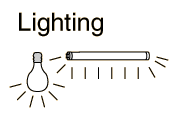
Although there are a large number of lighting options, there is a long history of either incandescent or fluorescent lights. Fluorescent lighting has a considerable advantage in energy efficiency over incandescent lighting.

尽管有众多的照明选择,但无论是白炽灯还是荧光灯都有很长的历史。荧光灯在节能方面比白炽灯有显著优势。

Other options for lighting include high pressure mercury lamps, metal-halide lamps, and sodium lamps. With rapidly increasing efficiency, light emitting diodes (LEDs) are becoming the first choice for many applications.

其他照明选项包括高压汞灯、金属卤化物灯和钠灯。随着效率迅速提高,发光二极管(LEDs)正成为许多应用的首选。
Comment on energy cost
评论能量成本
Energy units
能量单位
Household energy use
家庭能源使用
Index

Heat transfer concepts

Heat transfer examples
索引 热传递概念 热传递示例
 
HyperPhysics***** Thermodynamics
HyperPhysics ***** 热力学
R Nave
Go Back
返回


Energy for Cooking

烹饪所需的能量

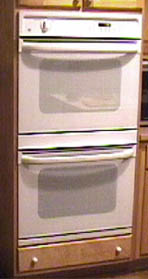
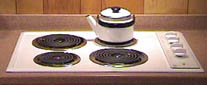
An oven and surface unit for cooking consume a lot of energy when they are used, but the total use depends upon how much you cook. Pictured is an electric double oven and an electric surface unit. Alternatively, the oven and surface unit may be either natural gas or propane. The choice is generally made on the basis of preference, but from an energy point of view, the gas is more energy efficient. The reason is that it takes about three units of primary fuel to produce one unit of electrical energy because of the thermal bottleneck in electricity generation.

烤箱和表面加热器用于烹饪时会消耗大量能量,但总的使用量取决于你烹饪的量。图中展示的是一个电双烤箱和一个电表面加热器。 alternatively,烤箱和表面加热器可能使用天然气或丙烷。选择通常基于个人偏好,但从能源角度来看,燃气更节能。原因是由于电力生成中的热瓶颈,产生一单位的电能需要大约三单位的初级燃料。

The power ratings for appliances are required to be displayed on an Underwriters Laboratory label somewhere on the appliance. The voltage for these appliances is 240 volts, 60 Hz AC. The labels will sometimes give the current, from which you can calculate the power using the power relationship. Since these appliances are almost purely resistive, then the DC power relationship (i.e., just voltage times current) can be used to a good approximation. These appliances were labeled with power of 7.4 kilowatts for the surface unit and 7.2 kW for the oven.

电器的功率额定值必须在设备上的Underwriters Laboratory标签上显示。这些电器的电压为240伏,60赫兹交流电。标签有时会给出电流,从而可以利用功率关系计算功率。由于这些电器几乎完全是电阻性的,因此可以近似使用直流功率关系(即仅电压乘以电流)。这些电器被标记为表面单元的功率为7.4千瓦,烤箱的功率为7.2千瓦。

Operated for a full hour at full power, the surface unit would use 7.4 kWh of energy, which at 9.5¢/kWh costs just 70¢. It would be rare to operate at full power, so it becomes clear that the cooking energy cost is not comparable to that of household heating.

在满负荷运行一小时的情况下,该表面单元将消耗7.4 kWh的能源,按每kWh 9.5美分计算,仅需70美分。由于通常很少满负荷运行,因此可以明确看出烹饪的能源成本与家庭供暖的能源成本不可相比。
Comment on energy cost
评论能量成本
Energy units
能量单位
Household energy use
家庭能源使用
Index

Heat transfer concepts

Heat transfer examples
索引 热传递概念 热传递示例
 
HyperPhysics***** Thermodynamics
HyperPhysics ***** 热力学
R Nave
Go Back
返回