Electric Generation
The electricity generation sequence involves taking charge from the Earth, doing work on it to give it energy (expressed in terms of voltage), transporting the energy via a distribution system, using the energy, and dumping the spent charge back to the Earth. The Earth acts as a charge reservoir and reference potential for the energy transfer process.
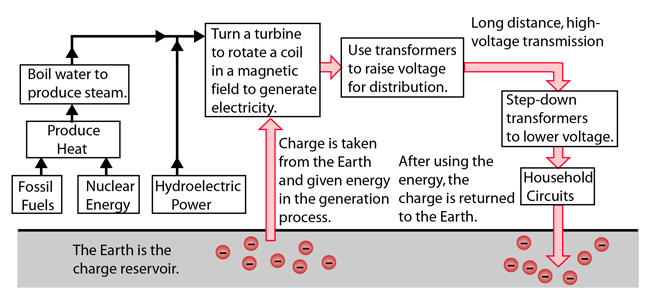
While this picture of the Earth as the reservoir of charge from which charge is taken and to which charge is returned after the energy is used is the "big picture" of the large generation and distribution system, it may not be applied too literally in the local situation. You cannnot depend on a "ground" connection to the Earth to be sufficient as the path by which charge returns to the Earth. In particular, just a connection to a grounding rod is not a sufficiently low resistance path to provide shock protection by quickly carrying charge to the Earth in the case of a short circuit to ground. For electrical safety, the ground wire must be "bonded" back to the neutral of the supply transformer to force the tripping of the breaker in a ground fault situation.
| Electric Power Distribution
电功率分配 | Grounding and Bonding
接地与等电位连接 |
Practical circuit concepts
| HyperPhysics***** Electricity and Magnetism
HyperPhysics ***** 电学和磁学 | R Nave |